
What is Twilio? Twilio is a cloud communications platform that lets developers add messaging, voice, email, verification and customer engagement to applications through APIs. It is the best known example of communications platform as a service, often shortened to CPaaS. Instead of negotiating with carriers and building telecom infrastructure, a team calls an API to send an SMS, place a call, verify a phone number or run a contact centre. This guide explains what Twilio does, its main products, how the API and webhook model works, where it fits in a customer communication stack, how pricing and compliance affect design and the mistakes that cause failed messages and surprise bills. Products and prices change, so confirm details in current Twilio documentation.
Short answer: Twilio provides APIs for SMS, voice, WhatsApp, email, verification and contact centre. You send requests with an account and credentials, receive events by webhook and pay by usage. Plan for carrier compliance, webhook security and cost monitoring from the start.
What is Twilio?
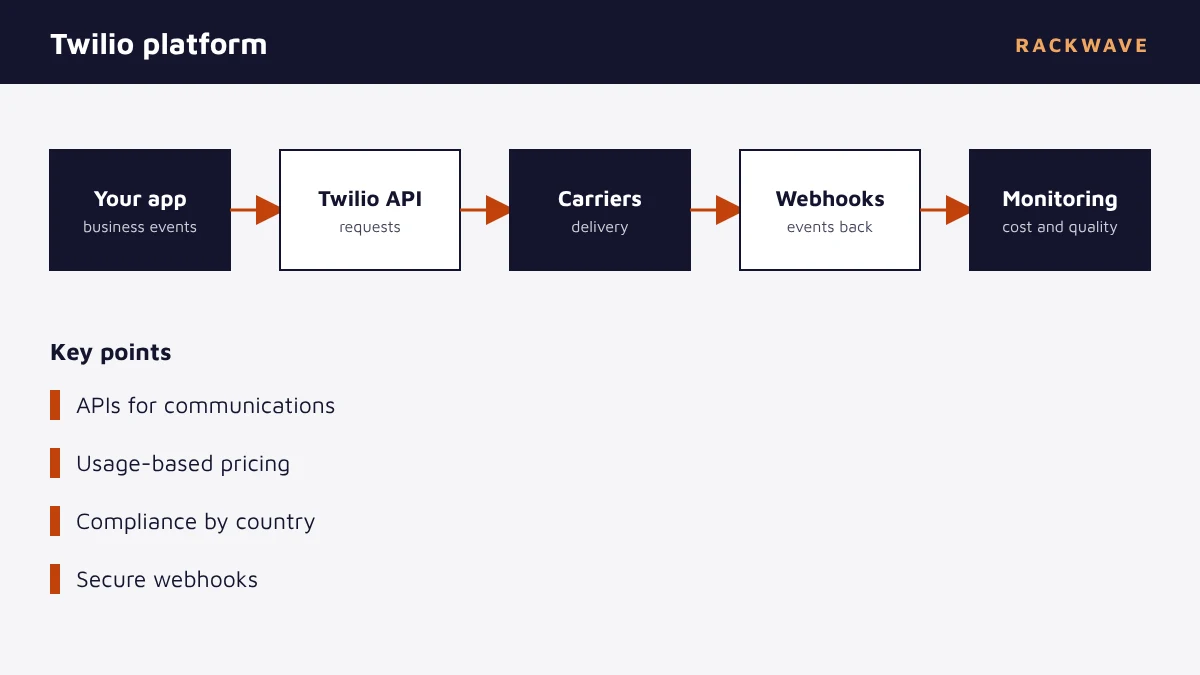
Twilio sits between your application and the telecom networks. Behind a simple HTTPS request is a mesh of carrier connections, number inventory, routing and compliance. Teams use it to send order updates, one-time passcodes, appointment reminders, marketing messages, voice calls and in-app chat. It is a building block, not a finished marketing suite, so it is often combined with a CRM, a marketing platform or a customer data platform. For the general concept see what is an API and what is SaaS.
Main products at a glance
| Product area | What it does | Typical use |
|---|---|---|
| Programmable Messaging | Send and receive SMS, MMS and messaging app messages | Alerts, reminders, two-way conversations. See programmable SMS |
| WhatsApp and other channels | Messaging over WhatsApp and other channels through one API | Customer service and notifications. See WhatsApp Business API integration |
| Programmable Voice | Make and receive calls, record, conference and route | IVR, click to call. See programmable voice |
| Verify | One-time passcodes and verification flows | Sign up and login checks. See Twilio Verify |
| SendGrid | Transactional and marketing email delivery | Receipts and campaigns. See Twilio SendGrid |
| Flex | Programmable contact centre | Support and sales teams. See Twilio Flex |
| Studio | Visual builder for communication flows | Low-code IVR and chat flows. See Twilio Studio |
| Segment | Customer data collection and routing | Unified customer events. See what is Segment |
Product names and packaging change over time, so check the current catalogue for exact scope.
How the platform works
- Create an account and credentials. Use an account identifier with API keys, and keep secrets out of code.
- Get a sender. Buy or register a phone number, sender ID or messaging channel suited to your country and use case.
- Call the API. Send an HTTPS request, for example to create a message or a call.
- Receive events. Twilio sends webhooks for incoming messages and status changes. See Twilio webhooks.
- Respond and record. Reply with instructions, update your database and store identifiers for tracing.
- Monitor. Watch delivery rates, errors and spend.
Compliance and regulation
Messaging and calling are regulated, and rules differ by country. In the United States, application-to-person messaging over standard numbers requires brand and campaign registration, as covered in A2P 10DLC. Other countries have sender ID registration, consent and quiet hour rules, and data protection laws such as GDPR apply to the personal data you process. Treat consent and opt-out handling as product features, not afterthoughts. See also SMS marketing.
Pricing and cost control
- Most products charge by usage, such as per message segment, per minute or per verification, plus monthly fees for numbers.
- Message length, character encoding and destination country change the segment count and price.
- Failed or filtered messages can still incur charges in some cases, so quality matters for cost.
- Set usage alerts and spending limits on the account, and give each project its own sub-account where useful.
- Review usage by country and product each month.
Estimate cost from expected volumes before launch, and compare it with the value of each message, for example a one-time passcode compared with a promotional blast.
Where Twilio fits in a stack
| Layer | Role | Example |
|---|---|---|
| Application | Triggers messages and calls from business events | Order system, app backend |
| Communications platform | Delivers messages and voice through carriers | Twilio APIs |
| Customer data | Holds profiles, consent and preferences | CRM or CDP. See CRM |
| Orchestration | Decides who gets what and when | Marketing automation or journeys. See journey orchestration |
| Analytics | Measures delivery and outcomes | Warehouse and dashboards |
Keep consent and preference data in your own system of record and pass it to the communications layer, rather than letting each channel hold a separate copy.
Choosing between building and buying communications
| Option | Strength | Trade-off |
|---|---|---|
| CPaaS such as Twilio | Fast to start, global reach, flexible APIs | Usage cost, compliance work remains yours |
| Marketing platform with built-in channels | Campaign tools and audiences included | Less control over transactional and custom flows |
| Direct carrier or aggregator contracts | Potential cost advantage at scale | Heavy engineering, compliance and operations |
| Mix of platforms | Right tool per use case | More integration and monitoring effort |
Many companies use a communications platform for transactional and conversational traffic and a marketing platform for campaigns, with the CRM as the source of truth for consent and preferences. Decide who owns each message type, since duplicate ownership leads to duplicate or conflicting messages.
Security checklist
- Store account credentials and API keys in a secret manager and rotate them on a schedule.
- Use API keys with the narrowest scope instead of the main account token.
- Verify every webhook request signature and reject others.
- Restrict who can buy numbers, change routing or raise spend limits.
- Enable usage alerts and review them weekly.
- Log message and call identifiers, never full message bodies containing sensitive data.
Common mistakes
- Launching US messaging without completing registration, then seeing messages blocked.
- Hard-coding credentials in source control.
- Ignoring webhook security and trusting unsigned requests.
- No retry or idempotency handling, so duplicate messages go to customers.
- Sending promotional content on a number registered for notifications.
- Not monitoring spend, so a bug or abuse leads to a large bill.
A worked example
A clinic group wants appointment reminders, two-way rescheduling and one-time passcodes for its patient app. It uses a messaging service with registered numbers for reminders, Verify for passcodes and a webhook that updates appointments when a patient replies. Consent is stored in the clinic system and checked before each send.
Within a month the team saw fewer missed appointments, and a dashboard of delivery errors let them fix numbers that were no longer valid. The example is illustrative.
Best practices and support
- Use sub-accounts or projects to separate environments and brands.
- Store identifiers such as message and call ids with your records for traceability.
- Verify webhook signatures and use HTTPS everywhere. See API security.
- Design for failure: handle timeouts, status callbacks and provider errors.
- Document consent, retention and opt-out rules and review them with legal.
Our API development service and system integration service connect Twilio to CRM and operational systems, and our CRM and lifecycle service designs the customer journeys that use it.
Key takeaways
- Twilio provides communications APIs as a CPaaS.
- Products cover messaging, voice, email, verification and contact centre.
- Events arrive by webhook and billing is by usage.
- Plan registration, consent and webhook security early.
- Monitor spend and delivery quality.
Quick glossary
| Term | Meaning |
|---|---|
| CPaaS | Communications platform as a service |
| Webhook | HTTP callback sent when an event occurs |
| Sub-account | A separate account area under a main account |
| Segment | A billable unit of an SMS message |
| Sender ID | The name or number a message appears to come from |
Read next: What Is API Management? Lifecycle, Features, Tools · What Is a Message Queue? Patterns and Best Practices · What Is RabbitMQ? Exchanges, Queues and Use Cases
Frequently asked questions
What is Twilio used for?
It is used to add messaging, voice, email, verification and contact centre features to applications through APIs.
Is Twilio a CPaaS?
Yes. It is a communications platform as a service that exposes carrier connectivity and communication tools through APIs.
How does Twilio pricing work?
Most services are usage based, such as per message, per minute or per verification, plus fees for phone numbers. Check current pricing.
Do I need to register to send SMS in the US?
Yes for standard numbers used for application-to-person messaging, through brand and campaign registration, or use alternatives such as toll-free verification.
How does Twilio notify my app of events?
By sending webhooks to URLs you configure for incoming messages and status changes.
Can Twilio send email?
Yes, through SendGrid, which is part of the Twilio family.
Is Twilio a marketing platform?
No. It is a communications building block that you combine with CRM and marketing tools.
How do I keep Twilio secure?
Protect credentials, verify webhook signatures, restrict permissions and set usage alerts.