
SMS marketing is the use of text messages to send promotions, alerts, reminders and updates to customers who have agreed to receive them. Text messages are read quickly and almost universally, which makes SMS effective for time-sensitive communication such as delivery updates, appointment reminders, one-time passwords and limited offers. It also carries strict consent and sender-registration rules in many countries, so it needs careful setup. This guide explains what SMS marketing is, where it fits, the types of message, how to build a compliant programme, how to write effective texts, how to measure results and the mistakes to avoid.
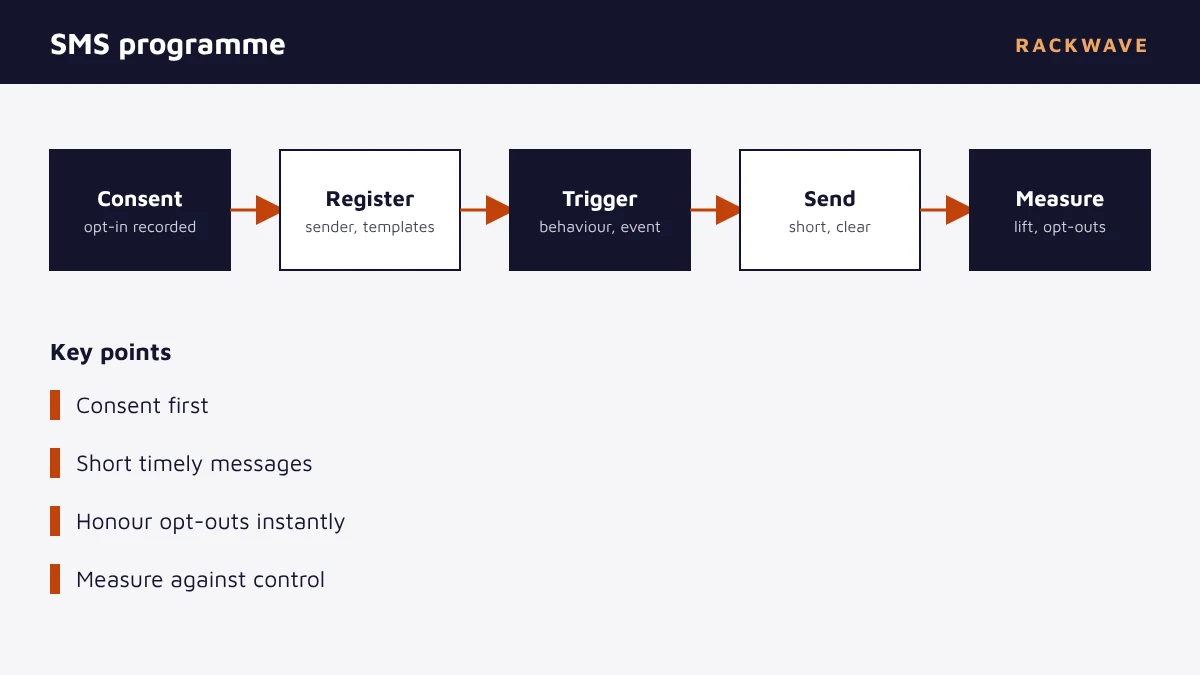
Short answer: Use SMS for short, timely and clearly valuable messages to customers who have opted in. Register your sender IDs and templates where required, honour opt-outs instantly, segment by behaviour, keep frequency low and measure conversion against a control group.
What is SMS marketing?
SMS stands for short message service, the basic text messaging standard described under SMS. In marketing, it covers both promotional messages and transactional ones. It is one channel within omnichannel marketing, and it complements push notifications and email by reaching customers who may not have an app or who do not check their inbox often.
Types of SMS messages
| Type | Purpose | Example |
|---|---|---|
| Transactional | Confirm or inform about an action | Order dispatched, payment received, one-time password |
| Reminder | Reduce missed appointments or payments | Appointment tomorrow at 10:00 |
| Promotional | Share offers or announcements | Weekend sale for members |
| Lifecycle | Support onboarding, win-back and renewal. See lifecycle marketing | Welcome text with a first-order incentive |
| Two-way conversational | Let customers reply for help or choices | Reply YES to reschedule |
A text message is the closest a business gets to the customer pocket. It deserves respect.
SMS vs email vs push
| Channel | Strengths | Limits |
|---|---|---|
| SMS | Very high visibility, works on any phone | Cost per message, short length, strict rules |
| Rich content, low cost, long form. See marketing automation | Slower response, crowded inboxes | |
| Push | Free, rich, immediate | Requires app and permission |
Consent and compliance
SMS is among the most regulated marketing channels. Requirements differ by country but commonly include prior opt-in consent, clear identification of the sender, an easy opt-out, restricted sending hours and, in some markets, registration of sender IDs and pre-approved message templates. Do not buy lists. Record when and how each person consented, honour stop requests immediately and keep suppression lists up to date. Because rules change, review them with your legal adviser and your messaging provider for each market you serve.
- Collect explicit consent with clear wording at sign-up, checkout or in-store.
- Identify your brand in every message.
- Include a simple opt-out instruction.
- Respect quiet hours and local sending windows.
- Register sender IDs and templates where the market requires it.
- Keep consent records for audit.
How to build an SMS marketing programme
- Set goals and use cases. Choose where SMS adds clear value, such as delivery updates, reminders and abandoned baskets.
- Build a consented audience. Use clear sign-up points and store consent against each profile in your CRM.
- Select a messaging provider. Check delivery quality, registration support, reporting and integrations.
- Register senders and templates. Complete any regulatory registration before sending.
- Segment and trigger. Send by behaviour and lifecycle stage. See customer segmentation.
- Write short, clear messages. State who you are, the benefit and the action.
- Set frequency caps and suppression. Prevent overlap with other channels and open service cases.
- Test and measure. Use control groups and track downstream revenue and opt-outs.
Writing effective SMS messages
- Open with the brand name so the sender is clear.
- Keep it short and put the key information first.
- Use one link or one reply action only.
- Be specific about dates, amounts and conditions.
- Avoid shouting, excessive symbols and vague urgency.
- Offer value, not just reminders to buy.
Tools and integration
SMS is normally sent through a messaging provider connected to a CRM or engagement platform that holds consent and behaviour data. We implement SMS journeys on Braze, Klaviyo, Iterable, Salesforce Marketing Cloud and Brevo, and connect them to your customer data through our CRM and lifecycle service and system integration service. A shared customer record lets SMS respect preferences set elsewhere.
Measuring SMS marketing
| Metric | What it shows |
|---|---|
| Delivery rate | Messages reaching handsets |
| Click-through or reply rate | Engagement |
| Conversion and revenue per message | Value versus control |
| Opt-out and complaint rate | Whether frequency and relevance are right |
| Cost per conversion | Efficiency versus other channels |
| List growth and consent coverage | Health of the audience |
Common SMS marketing mistakes
- Sending without clear consent or records.
- Using SMS for long content that suits email.
- Texting too often or outside sensible hours.
- Ignoring opt-outs and suppression across systems.
- Failing to register senders or templates where required.
- Sending the same message to the whole list.
A short example
A clinic network loses revenue to missed appointments. It starts sending a text reminder three days and one day before each booking, with a simple reply to confirm or reschedule, and a short review request after the visit. Consent is collected at registration and stored in the CRM. No-shows fall noticeably, front desk time spent on calls drops and patients appreciate the convenience. Promotional texts are kept separate and are sent only to those who opted in for offers. The value came from useful, expected messages tied to a real event rather than from broadcast promotion.
Using SMS across the customer lifecycle
SMS can support each stage without overloading the customer. A welcome text confirms sign-up and sets expectations. Delivery and service updates reassure after purchase. Replenishment reminders and loyalty notices encourage repeat business, and win-back messages reach lapsed customers who ignore email. Because texts are personal, reserve them for moments where the value is high and use other channels for lower-priority content. Coordinate with email and push through one journey so that a customer never receives the same message three times.
SMS in sectors
| Sector | Typical use |
|---|---|
| E-commerce | Order, delivery and abandoned basket texts. See e-commerce expertise |
| Banking and lending | Alerts, payment reminders, verification. See banking and lending work |
| Healthcare | Appointment reminders and follow-ups. See healthcare expertise |
| Travel | Itinerary changes and check-in prompts. See travel experience |
| Education | Deadlines and event reminders. See education expertise |
Data and personalization for SMS
Because a text is short, relevance matters even more. Use data from your CRM and commerce systems to mention the right product, date or location, and suppress messages when a customer has an open complaint or has just purchased. See marketing personalization for the principles. Keep sensitive details out of messages, since texts can appear on a locked screen.
Growing a consented SMS list
List quality matters more than size. Offer a clear reason to subscribe, such as order updates, early access or a first-purchase benefit, and collect consent at checkout, on the website, in store or through a click-to-text prompt. Confirm sign-up with a welcome message that repeats how to opt out. Avoid pre-ticked boxes and bundled consent, and review inactive numbers regularly so that you do not keep messaging people who no longer want to hear from you.
Key takeaways
- SMS marketing sends text messages to opted-in customers for promotions, alerts, reminders and updates.
- It is highly visible but regulated: obtain consent, identify the sender, honour opt-outs and register where required.
- Use SMS for timely, high-value messages and coordinate with email and push.
- Segment, trigger by behaviour, cap frequency and keep messages short and clear.
- Measure delivery, conversion versus control and opt-outs.
Quick glossary
| Term | Meaning |
|---|---|
| Opt-in | Consent given to receive messages |
| Sender ID | The name or number that identifies the sender |
| Template registration | Pre-approval of message formats in some markets |
| Suppression list | People who must not be messaged |
| Two-way SMS | Messaging where customers can reply |
Read next: Voice of Customer: Sources, Programme and Examples · Omnichannel Marketing: Strategy, Examples and Technology · RFM Analysis: Scoring, Segments and Marketing Use
Frequently asked questions
What is SMS marketing?
SMS marketing is the use of text messages to send promotions, alerts, reminders and updates to customers who have agreed to receive them.
Is SMS marketing effective?
It can be, because texts are quickly read and widely reachable. Results depend on consent, relevance, timing and frequency.
Do I need consent for SMS marketing?
Yes. Most countries require prior opt-in consent for marketing texts, and some require sender and template registration. Check the rules for each market.
What types of SMS messages can businesses send?
Transactional alerts, reminders, promotional offers, lifecycle messages and two-way conversational messages.
How often should I send marketing texts?
Sparingly. Set frequency caps, respect quiet hours and reduce volume if opt-outs rise.
What is the difference between SMS and push notifications?
SMS reaches any phone number but costs per message. Push needs an app or browser permission and is free to send.
How do I measure SMS marketing performance?
Track delivery, clicks or replies, conversion and revenue versus a control group, opt-out rates and cost per conversion.
What should an SMS marketing message include?
The brand name, a clear benefit, one action or link, and an easy opt-out instruction where required.