
What is A2P 10DLC? A2P 10DLC stands for application-to-person messaging over 10-digit long codes, the framework US carriers use to regulate business text messages sent from standard local numbers. Businesses must register their brand and each messaging campaign with The Campaign Registry, and carriers use that registration to decide how much traffic to allow and whether to trust it. Unregistered traffic is increasingly blocked or heavily filtered. This guide explains the registration process, brand and campaign types, how throughput and trust scores work, what content and consent rules apply, how to prepare a successful submission and how to fix rejections. Rules change, so confirm requirements with Twilio and The Campaign Registry before you register.
Short answer: If you send business texts to US recipients from standard local numbers, register your brand and campaigns, use the correct use case, show clear consent and opt-out, keep content consistent with the registration and monitor throughput and filtering.
What is A2P 10DLC?
Text messages sent from an application to a person, as opposed to person to person, are called A2P. Using ordinary 10-digit numbers for this at scale created spam problems, so US carriers introduced a registration regime. A business registers who it is, which is the brand, and what it sends, which is the campaign, and associates its numbers with that campaign. Messaging providers such as Twilio help submit this data to the registry and the carriers. See what is Twilio and programmable SMS for the sending side.
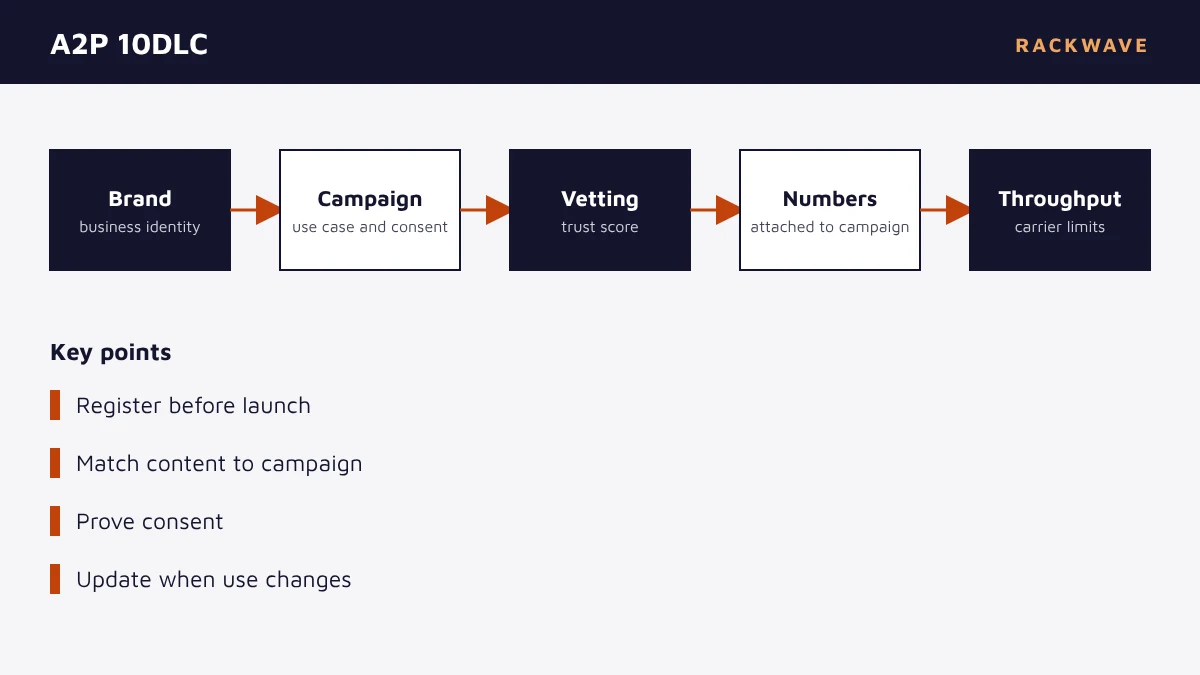
Key concepts
| Term | Meaning |
|---|---|
| Brand | The legal business identity, with company details such as legal name, tax or registration number, address, website and contact |
| Campaign | A described use case with sample messages, opt-in method and opt-out handling |
| Use case | The category of messaging, such as account notifications, customer care, marketing or mixed use |
| Trust score | A rating from the registry vetting that influences throughput limits |
| Messaging service | A Twilio object where you attach numbers and associate the campaign. See messaging services |
| Alternatives | Toll-free numbers with verification, short codes and, in some cases, other registered options |
Brand types and vetting options vary, such as a sole proprietor option with lower limits and a standard option for registered companies. Check the current options.
The registration process
- Gather business details. Collect legal name, entity type, tax or registration identifier, address, website and authorised contact.
- Register the brand. Submit through your provider and wait for verification, which can take time.
- Define the campaign. Choose the use case, write a clear description and prepare two or more realistic sample messages.
- Document consent. Describe exactly how recipients opt in and provide proof such as a form screenshot.
- Describe opt-out and help. Explain how STOP and HELP keywords work and show the reply text.
- Submit and attach numbers. Link your messaging service and numbers to the approved campaign.
- Monitor. Watch filtering and error codes and update the registration when your use changes.
Throughput and trust
Approved campaigns get message throughput limits based on the brand trust score and the use case. Higher-trust brands can send more messages per second and per day to each carrier. If you need higher volume than a registered long code allows, options include improving brand vetting, spreading traffic across compliant campaigns or moving high-volume programmes to a short code or toll-free number. Plan volume with realistic peaks, such as end-of-month reminders, and queue messages to stay within limits. See programmable SMS for queueing patterns.
Content and consent rules
- Get clear, documented consent before sending, and keep proof of when and how it was given.
- Make sample messages match the real ones. Carriers compare traffic with the registration.
- Include the brand name and opt-out instructions where required by the use case.
- Do not send prohibited content such as illegal goods or deceptive promotions, and treat some categories like lending, cannabis and gambling with extra care.
- Avoid link shorteners shared with other senders, because they hurt trust.
- Honour STOP quickly across all numbers for the brand. See SMS marketing.
Why registrations get rejected
| Reason | Fix |
|---|---|
| Brand details do not match official records | Use the exact legal name, address and identifier |
| Website missing or unclear | Provide a working site that shows the business and privacy policy |
| Vague campaign description | Explain who receives messages, what they contain and why |
| Sample messages do not fit the use case | Provide realistic examples with brand name and opt-out |
| Consent evidence missing | Show the form, checkbox or keyword flow and its wording |
| Mixed use hidden in a single use case | Register the right use case or separate campaigns |
Keep a record of what you submitted so that updates and resubmissions are consistent, and so that a new team member can understand the history.
Checklist before you register
- Confirm the legal business name, entity type and tax or registration number match official records.
- Make sure a public website shows the business, contact details and a privacy policy.
- Write down the exact opt-in flow, with screenshots or recordings.
- Prepare two or more sample messages that match the real content.
- Decide which numbers and messaging services will carry each campaign.
- Plan what happens to messages sent before approval, since unregistered traffic may be blocked, and prepare a fallback channel for critical notices such as email or push.
Registration alternatives and when to choose them
| Option | Good for | Consider |
|---|---|---|
| A2P 10DLC long codes | Conversational, moderate volume | Registration time and throughput limits |
| Toll-free numbers | Notifications and support | Verification needed and different filtering |
| Short codes | Very high volume, time-sensitive messages | Provisioning time and cost |
| Other channels such as WhatsApp or RCS | Rich, consented conversations | Channel rules and template approval |
Pick the sender type from the use case and volume, not from habit, and review the choice each year because carrier rules, filtering behaviour and pricing change over time. A reminder programme with modest volume suits a registered long code, while a large promotion programme may justify a short code.
Common mistakes
- Starting registration at the last minute before a launch.
- Using one campaign for different programmes with different consent.
- Buying lists, which breaks consent rules and damages reputation.
- Changing message content without updating the registration.
- Ignoring filtering errors until customers complain.
A worked example
A property management firm sends rent reminders and maintenance updates. It registers its brand with its legal details, creates one customer care campaign for maintenance and one account notification campaign for rent reminders, and shows the resident portal consent checkbox as proof. Numbers are attached to a messaging service for each campaign.
After approval, delivery rates stayed high, and when the firm added promotional offers it registered a separate marketing campaign instead of blending them. The example is illustrative.
Best practices and support
- Assign one owner for messaging compliance and keep registration documents in a shared folder.
- Review registrations when you add a new use case, brand or country.
- Track delivery, filtering and opt-out rates by campaign.
- Prepare a fallback channel such as email or push for critical notices. See push notifications.
Our CRM and lifecycle service sets up consent capture and messaging journeys, and our API development service builds compliant integrations.
Key takeaways
- US business texting from local numbers requires registration.
- Register the brand and each campaign with accurate details.
- Document consent and opt-out clearly.
- Throughput depends on trust score and use case.
- Keep content and registration aligned and monitor filtering.
Quick glossary
| Term | Meaning |
|---|---|
| A2P | Application-to-person messaging |
| 10DLC | 10-digit long code |
| Brand | Registered business identity |
| Campaign | A described messaging use case |
| Trust score | Vetting rating that affects throughput |
Read next: What Is API Management? Lifecycle, Features, Tools · What Is a Message Queue? Patterns and Best Practices · What Is RabbitMQ? Exchanges, Queues and Use Cases
Frequently asked questions
What is A2P 10DLC?
It is the US carrier framework for business text messages sent from 10-digit local numbers, requiring brand and campaign registration.
Do I have to register?
If you send application-to-person messages to US recipients from standard local numbers, registration is required, and unregistered traffic may be blocked or filtered.
What is the difference between brand and campaign?
The brand is your business identity, while the campaign describes a specific messaging use case and how consent works.
How long does registration take?
It varies from days to weeks depending on vetting, so start early.
What affects my throughput?
The brand trust score, the use case and carrier rules affect how many messages you can send.
Can I use toll-free or short codes instead?
Yes, as alternatives with their own verification or provisioning processes and different throughput.
Why was my campaign rejected?
Common reasons are mismatched business details, unclear descriptions, unrealistic samples or missing consent proof.
Do I need to update the registration later?
Yes, when your use case, content or business details change.