
What is Segment? Segment is a customer data platform from Twilio that collects event and profile data from websites, mobile apps and servers through one set of APIs, applies consistent naming and quality rules and delivers the data to analytics tools, marketing platforms, advertising tools and data warehouses. Instead of building a separate integration for every tool, a team instruments its product once and routes data wherever it is needed, while a tracking plan and privacy controls keep the data consistent and compliant. This guide explains what Segment is, its main components, how data flows through it, where it fits against other approaches, how to start and which mistakes to avoid. Capabilities and packaging change, so confirm details in current Segment documentation.
Short answer: Segment is a customer data platform that collects customer events once and routes them to many tools. It helps most when you plan a tracking plan, identity rules and governance first.
What is Segment?
Segment is part of the wider idea of a customer data platform and supports a single customer view. Its main parts are covered in sources and tracking plans, destinations and Unify profiles. For broader context, read what is data integration.
How Segment works
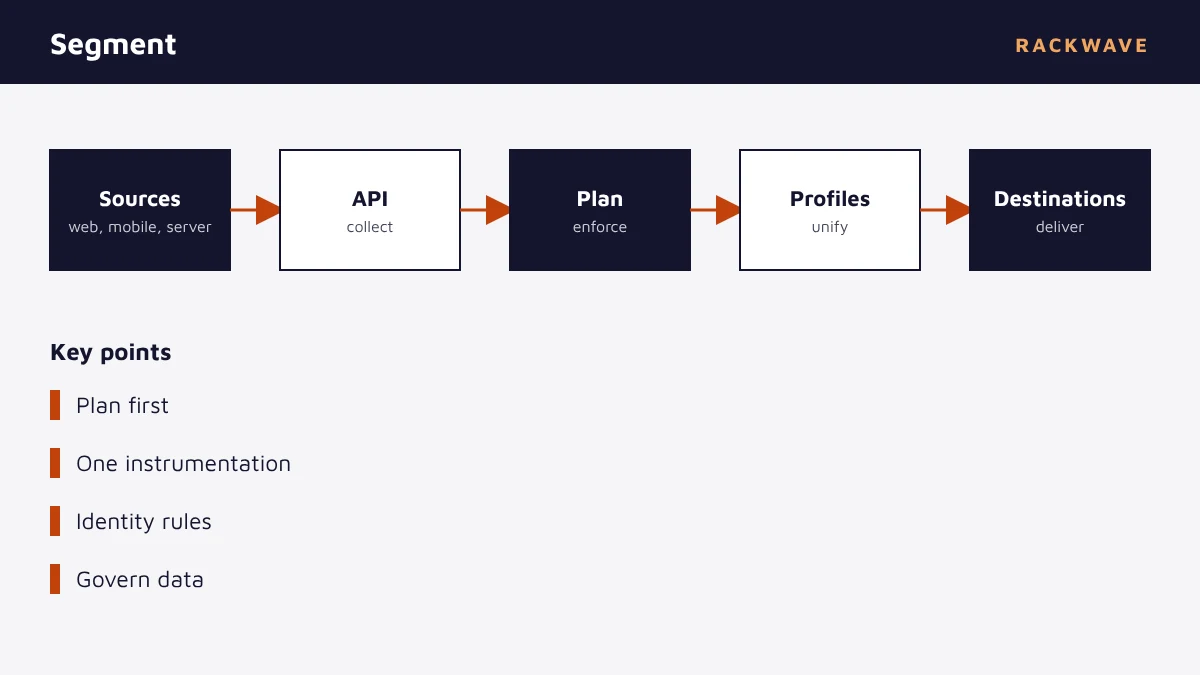
| Component | Purpose | Related guide |
|---|---|---|
| Sources | Where data originates: web, mobile, server, cloud apps | Sources and tracking plan |
| Tracking plan and Protocols | Define and enforce events and properties | Segment Protocols |
| Destinations | Tools that receive data | Segment destinations |
| Unify | Builds unified profiles and identity | Unify profiles |
| Engage | Audiences and journeys | Engage audiences |
| Reverse ETL | Sends warehouse data to tools | Segment reverse ETL |
| Functions | Custom code to transform or ingest data | Segment Functions |
The core API calls
| Call | Purpose | Example |
|---|---|---|
| Identify | Associates a user with traits | Plan, email, signup date |
| Track | Records an action with properties | Order Completed with revenue |
| Page and Screen | Records views | Pricing page viewed |
| Group | Associates a user with an account | Company and plan |
| Alias | Merges identities in some cases | Anonymous to known |
Why teams adopt a CDP like Segment
- One instrumentation instead of many separate tags and SDKs.
- Consistent event names and properties across tools.
- Faster onboarding of new marketing and analytics tools.
- Cleaner governance and privacy controls in one place.
- A single stream of events delivered to the warehouse.
- Better audiences that use the same data everywhere.
How to get started
- Define use cases. Write the analytics, marketing and product needs.
- Create a tracking plan. List events, properties and owners before coding.
- Add sources. Instrument web, mobile and server with the libraries.
- Choose destinations. Connect the tools that need the data and test each mapping.
- Set identity rules. Decide identifiers and how anonymous users merge.
- Govern. Apply Protocols, consent and access controls.
- Monitor. Watch delivery, errors and data quality.
Common mistakes
- Sending every possible event without a plan.
- Inconsistent naming across teams.
- No identity strategy.
- Forgetting consent and deletion flows.
- Connecting destinations without testing mappings.
- No owner for the tracking plan.
Our data analytics service designs tracking plans and our system integration service connects Segment to your stack.
A worked example: a SaaS company
A software company uses separate scripts for analytics, email marketing and advertising, and the numbers never agree. It adopts Segment, writes a tracking plan with about forty events, instruments the web app and back end once and connects analytics, the email platform and the warehouse as destinations.
Events now carry the same names and properties everywhere. Marketing builds audiences from warehouse data, product analyses funnels with trusted numbers and the team removes several duplicate tags that slowed the site. A named owner reviews the tracking plan every month and approves new events.
Segment compared with other approaches
| Approach | Strength | Limit |
|---|---|---|
| Direct integrations | Simple for one or two tools | Hard to maintain as tools grow |
| Tag manager only | Good for web tags | Weak for server and mobile data |
| Segment style CDP | Single pipeline and governance | Cost and need for planning |
| Open source pipelines | Control and flexibility | More engineering effort |
| Warehouse first | Strong analytics and ownership | Needs reverse ETL for activation |
For an open alternative, see Segment vs RudderStack.
Privacy, consent and governance
A CDP concentrates personal data, so governance matters. Store consent as part of the event or profile, and make sure destinations respect it. Control which fields are sent to which tool, avoid sending sensitive data unless needed and set retention rules. Prepare a process for access and deletion requests that covers the warehouse and every destination. See what is GDPR and what is data governance for principles.
Team roles and operating model
Assign owners for the tracking plan, identity rules and each destination. A data or analytics lead usually owns the plan, engineers own instrumentation and marketers own their destinations. Hold a short review each month for new events and changes, and keep documentation current. Clear ownership prevents the drift that makes many CDP projects lose trust, with duplicate events, unclear names and unused destinations.
Measuring the value of a CDP
Value shows up in faster launches of new tools, fewer data discrepancies, lower tag weight and better audiences. Track the time to connect a new destination, the share of events that pass the tracking plan and the number of teams that use shared audiences. Compare costs with the savings from fewer custom integrations. Share results with leaders so that the investment in data quality is understood.
Typical architecture around Segment
A common design places Segment between the places where customers act and the tools that use the data. Web and mobile libraries capture behaviour, server libraries capture events such as payments and subscription changes and cloud sources bring in data from support and billing tools. Segment applies the tracking plan and builds profiles, and then sends the stream to analytics, engagement, advertising and the warehouse. The warehouse becomes the long term record, and reverse ETL returns modelled attributes to operational tools, which closes the loop between analysis and action.
Costs and planning considerations
Pricing for customer data platforms usually depends on the number of tracked users or events, the modules in use and the number of sources and destinations. Estimate your volumes realistically, including bots and anonymous traffic, and ask which features are included at each tier. Plan for engineering time to instrument sources and maintain the tracking plan, since this effort often exceeds the licence cost in the first year. Compare the total cost with the savings from fewer custom integrations and cleaner data.
Data quality from the start
Quality is easier to build in than to repair. Validate events against the tracking plan before release, and use automated checks to find missing properties, wrong types and unexpected names. Watch volumes for sudden changes, and keep a staging environment for testing. See data quality for general practice. Teams that treat the tracking plan as a product, with owners and a review process, keep their data trustworthy as the business changes.
Key takeaways
- Segment is a customer data platform that collects events once and routes them to many tools.
- Core calls are identify, track, page, screen and group.
- A tracking plan, identity rules and governance determine success.
- Use destinations, Unify, Engage and reverse ETL as needs grow.
- Measure value through speed, data consistency and reduced engineering effort.
Quick glossary
| Term | Meaning |
|---|---|
| Customer data platform | A system that collects and unifies customer data and delivers it to tools |
| Source | A place where data originates |
| Destination | A tool that receives data |
| Tracking plan | A document that defines events and properties |
| Identity resolution | Linking activity from different devices to one person |
Read next: BigQuery vs Snowflake: Which Cloud Data Platform? · BigQuery Streaming Inserts: Real-Time Ingestion Guide · BigQuery Access Control: IAM, Policy Tags and Row Security
Frequently asked questions
What is Segment?
It is a customer data platform from Twilio that collects event data once and delivers it to many tools.
What are sources and destinations?
Sources send data into Segment, and destinations receive data from it.
What is a tracking plan?
It is a document that defines the events and properties to be collected.
Does Segment replace my data warehouse?
No, it delivers data to a warehouse and other tools, and can also read from a warehouse.
Can it help with privacy?
Yes, it offers controls for consent, field level handling and deletion, but you must configure them.
Who should own it?
A data or analytics lead, with engineering and marketing owners for their areas.
What are common alternatives?
Open source and warehouse first approaches, such as RudderStack and reverse ETL tools.
How do I start?
Define use cases, write a tracking plan, instrument sources and connect a small set of destinations.