
What is the difference between Segment and RudderStack? Segment and RudderStack are both customer data platforms that collect events from websites, apps and servers and route them to analytics, marketing and warehouse destinations through a common set of APIs. Segment, from Twilio, is a managed platform with a large catalogue of integrations and built in identity and audience features, while RudderStack positions itself as a warehouse first platform with an open source heritage, more control over where data is processed and a strong focus on sending data to your own warehouse. This Segment vs RudderStack guide compares them on architecture, features, hosting, pricing models and fit, explains how to run a fair evaluation and lists mistakes to avoid. Features and pricing change, so confirm details with each vendor.
Short answer: Both collect and route customer data. Choose by architecture, hosting and control needs, integrations, identity and audience features, team skills and total cost, and test with a real use case.
What is the difference between Segment and RudderStack?
Read the details on one side in what is Segment, Segment destinations and Segment reverse ETL. For the concept, see customer data platform and what is reverse ETL. Warehouse context is in what is a data warehouse.
Side by side comparison
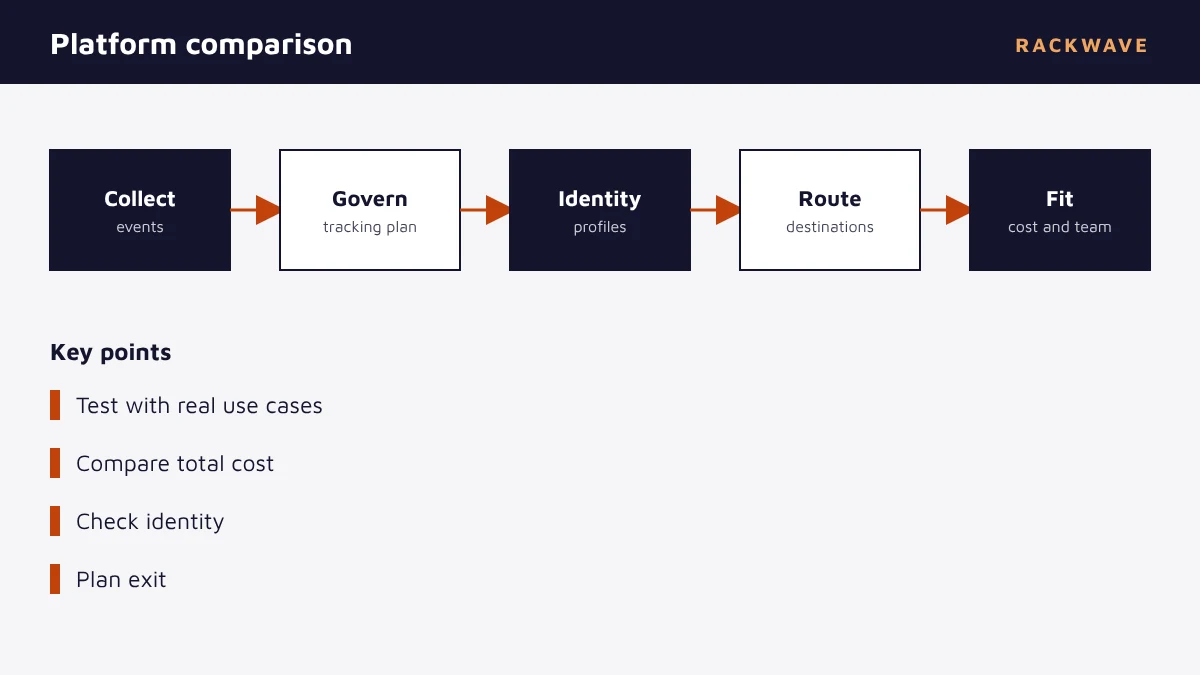
| Area | Segment | RudderStack |
|---|---|---|
| Positioning | Managed customer data platform | Warehouse first customer data platform with open source roots |
| Collection | Libraries for web, mobile, server and cloud sources | Similar libraries and sources |
| Destinations | Large catalogue of integrations | Large catalogue, plus custom transformations |
| Identity and profiles | Unify identity resolution and profiles | Profile and identity features, often built on the warehouse |
| Audiences | Engage audiences and journeys | Audience building through warehouse and reverse ETL |
| Reverse ETL | Available | Available |
| Hosting | Managed cloud | Managed cloud, with self hosting options |
| Governance | Protocols and tracking plans | Tracking plans and data governance features |
The table is a general view only. Both vendors release features often, so verify the current position in demos and documentation.
Where each tends to fit
- Segment suits teams that want a managed service with strong identity and audience features in one place.
- RudderStack suits teams that want the warehouse as the centre of data and more control over hosting.
- Both fit organisations that want one instrumentation and consistent event data.
- Regulated industries may lean towards options that keep data in their own environment.
- Small teams may value the simplicity of a managed service.
- Engineering heavy teams may value flexibility and control.
Evaluation criteria
| Criterion | Questions to ask |
|---|---|
| Architecture | Where is data processed and stored |
| Integrations | Are your tools and sources supported, and how deep |
| Identity | How are profiles resolved and who owns the logic |
| Governance | How are tracking plans enforced |
| Activation | How do audiences and reverse ETL work |
| Reliability | What are delivery guarantees, replay and monitoring |
| Cost | What drives price: events, users, sources or modules |
| Security and compliance | What certifications, data residency and controls exist |
How to run a proof of concept
- Choose use cases. Pick two or three real ones, such as warehouse delivery and an email audience.
- Instrument a small source. Send the same events to both platforms.
- Connect destinations. Set up the same tools in each and compare effort.
- Test identity and governance. Check merges, tracking plan enforcement and violations.
- Test reliability. Look at delivery rates, latency and replay.
- Estimate cost. Model volumes and modules over three years.
- Score and decide. Rate each platform with the whole team.
Common mistakes
- Choosing on feature lists without a hands on test.
- Ignoring engineering effort to run and maintain the platform.
- Underestimating volumes, including bots and anonymous traffic.
- Skipping governance and identity in the evaluation.
- Overlooking exit options and data portability.
- Choosing for one use case and ignoring the roadmap.
Our data analytics service helps teams select and implement customer data platforms, and our data warehousing service builds the warehouse that sits behind them.
A worked example: a marketplace choosing a platform
A marketplace with web, iOS and Android apps wants one event stream for analytics, email and its warehouse. The team lists use cases: send events to the warehouse, build a lapsed buyers audience and keep one tracking plan. They instrument a single source and send events to both platforms in a test environment.
They compare how long each connection takes, how identity behaves for users who sign in on several devices and how violations are reported. They model costs at current and doubled volumes and ask both vendors about security and data residency. The decision rests on the combination of control, effort and cost, not on any single feature, and the scoring is recorded so the choice can be explained.
Total cost and commercial terms
Pricing models differ and often depend on events, tracked users, sources or modules. Request a full quote that covers your expected volumes, the features you need and support, and model costs under growth. Include engineering time for installation, maintenance and monitoring, which can exceed licence costs, especially if you self host. Check contract terms, renewal conditions and what happens to your data and configuration if you leave.
Migration and switching
If you already use one platform, plan migration carefully. List sources, destinations, tracking plans, transformations and profiles, and decide what to rebuild. Run both in parallel for a period, compare counts and move sources one at a time. Keep write keys and routing documented, and plan a rollback. Remember that changing identity logic can change audience sizes, so tell downstream teams before the cut over.
Security, privacy and data residency
Check certifications, encryption, access control, data residency and how each vendor supports consent and deletion. Ask where data is processed, who the sub processors are and how incidents are handled. For regulated industries, a self hosted or region specific setup may matter, so raise these points early in the evaluation. See what is GDPR for the principles, and involve legal and security teams before choosing.
Team skills and operating model
The best tool is one your team can run well. Consider who will own the tracking plan, who will manage destinations and who will handle incidents. Managed services reduce operational work, while self hosting increases control and responsibility. Plan training, documentation and a review routine before launch, and decide how requests for new events and destinations will be handled. A clear operating model matters more than any single feature.
Questions to ask in vendor demos
Ask each vendor to demonstrate your own use cases rather than a standard script, and to show how they handle failures, such as a destination outage or a bad schema change. Ask for references from companies of your size and industry, and for details of support response times. Keep a shared scorecard so that the whole team compares like with like and personal impressions do not decide the outcome.
Key takeaways
- Segment and RudderStack both collect events once and route them to many tools.
- Segment is a managed platform with built in identity and audience features, and RudderStack is warehouse first with more hosting flexibility.
- Choose by architecture, integrations, identity, governance, reliability, cost and team skills.
- Run a proof of concept with the same sources and destinations in both.
- Plan for migration, exit options, security and residency.
Quick glossary
| Term | Meaning |
|---|---|
| Customer data platform | A system that collects, unifies and routes customer data |
| Warehouse first | An approach that treats the data warehouse as the central store |
| Self hosting | Running the software in your own environment |
| Data residency | The region where data is stored and processed |
| Proof of concept | A limited trial that tests a tool on real use cases |
Read next: BigQuery vs Snowflake: Which Cloud Data Platform? · BigQuery Streaming Inserts: Real-Time Ingestion Guide · BigQuery Access Control: IAM, Policy Tags and Row Security
Frequently asked questions
Are Segment and RudderStack similar?
Yes, both collect events and route them to analytics, marketing and warehouse tools.
Which is better?
It depends on your architecture, control needs, team and budget, so test both.
Can RudderStack be self hosted?
It offers self hosting options, but confirm the current packaging with the vendor.
Does Segment offer identity features?
Yes, Unify provides identity resolution and profiles, subject to current packaging.
How should I compare costs?
Model volumes, modules and engineering time over several years.
Can I send data to my warehouse with both?
Yes, warehouse delivery is a core use case for both.
How hard is migration?
It needs planning, parallel running and testing of identity and destinations.
What should I check for compliance?
Certifications, data residency, consent and deletion support and sub processors.