
Data quality is a measure of how well data fits its intended use: whether it is accurate, complete, consistent, timely, valid and unique enough for the decisions and processes that depend on it. Poor data quality causes failed deliveries, wrong reports, duplicate marketing and lost trust in every system built on the data. This guide explains what data quality is, the dimensions used to measure it, common causes of bad data, how to assess and improve it, the tools and metrics involved and how to build a lasting data quality programme.
Short answer: Good-quality data is fit for purpose. You define what "good" means for each important dataset, measure it, fix the root causes of problems and monitor continuously.
What is data quality?
Data quality describes the condition of data relative to the job it must do. The same dataset can be good enough for one purpose and useless for another. A customer list with approximate addresses may serve a marketing segment but fail for deliveries. That is why quality is defined by use, not in the abstract.
Quality problems rarely announce themselves. A duplicate customer, a transposed digit or a stale price looks like any other record until a report is wrong or a parcel is lost. Measuring quality makes these invisible problems visible.
The dimensions of data quality
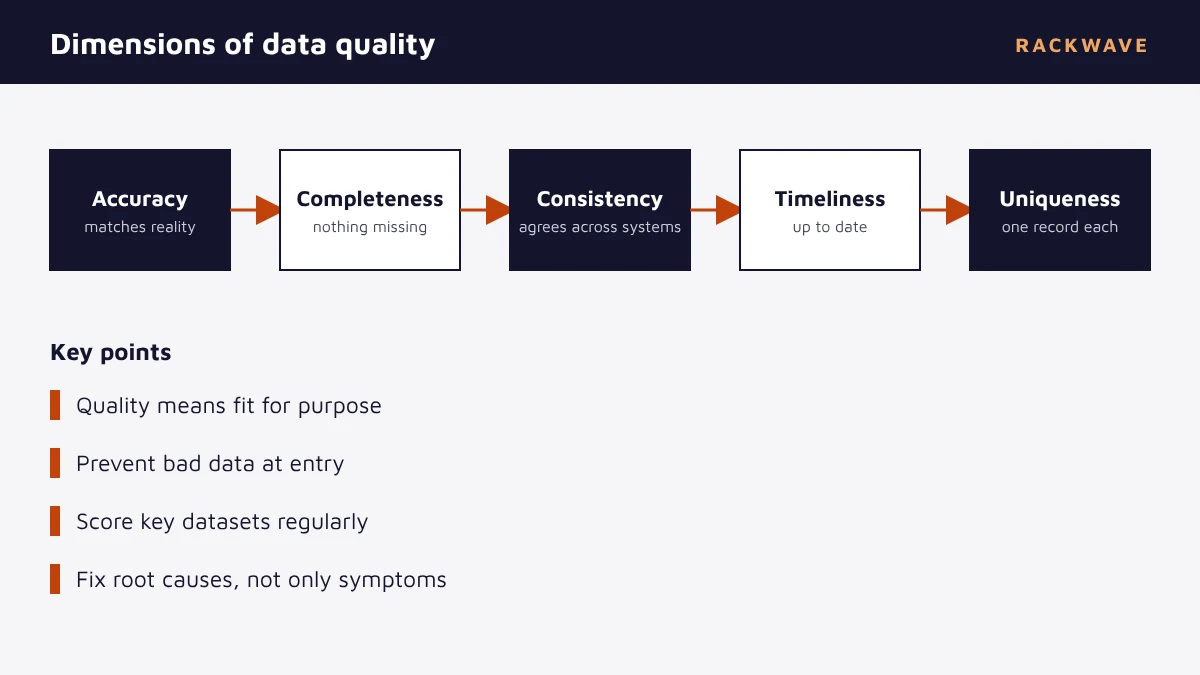
| Dimension | Question it answers | Example failure |
|---|---|---|
| Accuracy | Does the data reflect reality? | Customer phone number is wrong |
| Completeness | Is required data present? | Orders with no delivery postcode |
| Consistency | Does it agree across systems? | Same customer has two different addresses in CRM and ERP |
| Timeliness | Is it up to date when needed? | Stock levels updated only once a day |
| Validity | Does it follow the allowed format and rules? | Date entered as text, email without an @ sign |
| Uniqueness | Is each real-world entity recorded once? | Three records for the same company |
Why data quality matters
- Decisions: reports built on poor data lead to confident, wrong choices.
- Operations: bad addresses, prices and stock levels cause failed orders and rework.
- Customer experience: duplicate emails and wrong names damage relationships.
- Compliance: regulations expect accurate, minimal and deletable personal data.
- Analytics and AI: models learn from the data they are given, including its mistakes.
- Cost: staff spend time checking and correcting numbers instead of using them.
Common causes of poor data quality
- Manual entry errors and free-text fields where lists would do.
- Multiple systems holding the same data with no single owner.
- Weak validation at the point of entry.
- Poorly planned data migration or integration that carried old problems into new systems.
- Data that decays naturally, such as people changing jobs, addresses and phone numbers.
- No defined owner or process for fixing errors once found.
Cleaning data is necessary. Stopping bad data from entering is better, because cleaning never ends.
How to assess data quality
- Choose the critical data. Start with the data that supports key processes and decisions, such as customers, products and orders.
- Define rules for each dimension. For example, every customer must have a unique email, a valid country code and an owner.
- Profile the data. Measure completeness, formats, duplicates and outliers using queries or profiling tools.
- Score and report. Calculate the percentage of records meeting each rule and share the results with owners.
- Trace root causes. Find where each problem enters: a form, an integration, an import or a process.
- Prioritise by impact. Fix first what hurts customers or revenue most.
-- Example data quality checks
SELECT COUNT(*) AS missing_email
FROM customers WHERE email IS NULL OR email NOT LIKE '%@%';

SELECT email, COUNT(*) AS duplicates
FROM customers
GROUP BY email HAVING COUNT(*) > 1;
How to improve data quality
| Action | What it involves | Example |
|---|---|---|
| Standardise | Agree formats and reference lists | ISO country codes, one date format |
| Validate at entry | Prevent bad data in forms and integrations | Required fields, picklists, format checks |
| Cleanse | Correct or remove existing errors | Fix addresses, remove test records |
| Deduplicate | Match and merge duplicate records. See master data management | Merge duplicate accounts |
| Enrich | Fill gaps from trusted sources | Add missing industry or location |
| Monitor | Run automated checks and alert on drops | Daily completeness score on key fields |
In a CRM, much of this is configuration. Salesforce users can start with duplicate rules, validation rules and field-level settings. Cleansing during a move is covered in our guide to what is data migration.
Data quality metrics and targets
- Percentage of records passing each rule, by dataset and by dimension.
- Duplicate rate for customers, products and suppliers.
- Completeness of mandatory fields.
- Data freshness: time since the last successful update.
- Number and cost of incidents caused by bad data.
- Time to detect and time to fix an issue.
Set realistic targets by dataset. Customer contact data may need ninety-five percent completeness for marketing, while financial postings need to be exact. Review targets with the business owners who rely on the data.
Data quality and governance
Quality is a governance problem as much as a technical one. Someone must own each dataset, approve definitions and respond when checks fail. Data stewards, a catalogue of definitions and agreed escalation paths turn quality from a one-off clean-up into a routine. Our guide to what is data governance covers the roles and policies, and our data governance service sets them up.
The cost of poor data quality: a worked example
Imagine a company with 100,000 customer records, of which eight percent are duplicates. Marketing sends every campaign to those duplicates, so customers receive the same email twice, which raises unsubscribe and complaint rates. Sales calls the same prospect from two different representatives. Finance cannot tell whether two accounts are the same customer when assessing credit. Each issue is small on its own. Together they cost money in wasted sends, wasted time and lost goodwill, and they erode trust in every report. A one-time cleanse removes the symptoms, while a validation rule that blocks duplicates at entry stops them returning.
Data quality for AI and analytics
Models and dashboards both inherit the flaws in their inputs. A churn model trained on records with wrong cancellation dates will learn the wrong lessons, and a dashboard that counts duplicates will overstate customers. Before investing in advanced analytics or AI, check the data feeding them. Our AI and machine learning services start with a data readiness review for this reason.
Data quality tools
Options range from built-in platform features, such as validation and duplicate rules, to dedicated data quality and profiling tools, to tests embedded in transformation pipelines. Choose based on where your data lives and who will maintain the rules. Tools help detect and fix problems, but they cannot define what "good" means for your business. That still needs people. See what is a data pipeline for where automated checks sit in the flow.
Practical tip: Pick three to five critical datasets and ten rules, and report the score weekly. A small, visible programme beats an ambitious one that never starts.
Building a lasting data quality programme
- Secure sponsorship. Link quality to a business problem the sponsor cares about.
- Appoint owners and stewards. Make named people responsible for each domain.
- Embed checks in processes. Add validation to forms, integrations and pipelines.
- Report and review. Share scorecards in the meetings where decisions are made.
- Fix root causes. Change the process, form or integration that creates the error.
Key takeaways
- Data quality means data is fit for its intended use.
- Measure it across accuracy, completeness, consistency, timeliness, validity and uniqueness.
- Prevent bad data at entry; cleaning alone never ends.
- Assign owners, set rules, score regularly and fix root causes.
- Tools help, but definitions and ownership come from the business.
Quick glossary
| Term | Meaning |
|---|---|
| Data profiling | Analysing data to understand its structure and quality |
| Data steward | A person responsible for a dataset's quality |
| Deduplication | Finding and merging duplicate records |
| Data cleansing | Correcting or removing inaccurate data |
| Data decay | Data becoming outdated over time |
Read next: Lead Nurturing: Strategy, Tactics and Examples · What Is a Data Pipeline? Components, Types and Examples · What Is Business Intelligence? Components, Tools, Examples
Frequently asked questions
What is data quality?
Data quality is how well data suits its intended purpose, measured by dimensions such as accuracy, completeness, consistency, timeliness, validity and uniqueness.
What are the dimensions of data quality?
The main dimensions are accuracy, completeness, consistency, timeliness, validity and uniqueness. Some frameworks add integrity and relevance.
What causes poor data quality?
Common causes are manual entry errors, weak validation, duplicate systems of record, poor migrations and integrations, natural data decay and lack of ownership.
How do you measure data quality?
Define rules for each dimension on critical datasets, profile the data, calculate the percentage of records that pass each rule and track the scores over time.
How do you improve data quality?
Standardise formats, validate at entry, cleanse and deduplicate existing data, enrich gaps, monitor with automated checks and fix the root causes of recurring errors.
What is the difference between data quality and data governance?
Data governance defines ownership, policies and standards. Data quality is the measured condition of the data. Governance provides the framework that sustains quality.
What are examples of poor data quality?
Duplicate customer records, missing postcodes, inconsistent date formats, outdated phone numbers and the same product with different prices in two systems.
Who is responsible for data quality?
The business owns it. Data owners and stewards define rules and respond to issues, while IT and data teams provide the tools and processes.