
Lead nurturing is the practice of building relationships with prospects who are not ready to buy yet, by sending relevant, timely content and follow-up across channels until they are. Most leads are not ready on the day they arrive, so nurturing keeps your company present and useful while their need becomes clear. This guide explains what lead nurturing is, why it matters, the main tactics, how to build a nurture programme step by step, example sequences, the metrics to track and the mistakes that make nurturing feel like spam.
Short answer: Lead nurturing guides prospects from first interest to sales readiness with content matched to who they are and where they are in their decision. It combines segmentation, automation and a handoff to sales at the right moment.
What is lead nurturing?
Lead nurturing is part of the wider customer lifecycle. A person downloads a guide, signs up for a webinar or enquires about pricing, but is not ready for a sales call. Instead of dropping them or pushing early, you keep a useful conversation going: answering common questions, sharing examples and checking in when they show renewed interest.
Done well, nurturing shortens sales cycles and recovers leads that would otherwise be lost. Done badly, it is a stream of generic emails that teaches people to ignore you.
Why lead nurturing matters
- Timing: many buyers research for weeks or months before talking to sales.
- Efficiency: sales time goes to leads that are ready, not those still learning.
- Relevance: content matched to the stage builds trust.
- Pipeline recovery: past leads and lost deals can be revived.
- Customer value: the same approach extends after purchase into onboarding and expansion.
How lead nurturing works
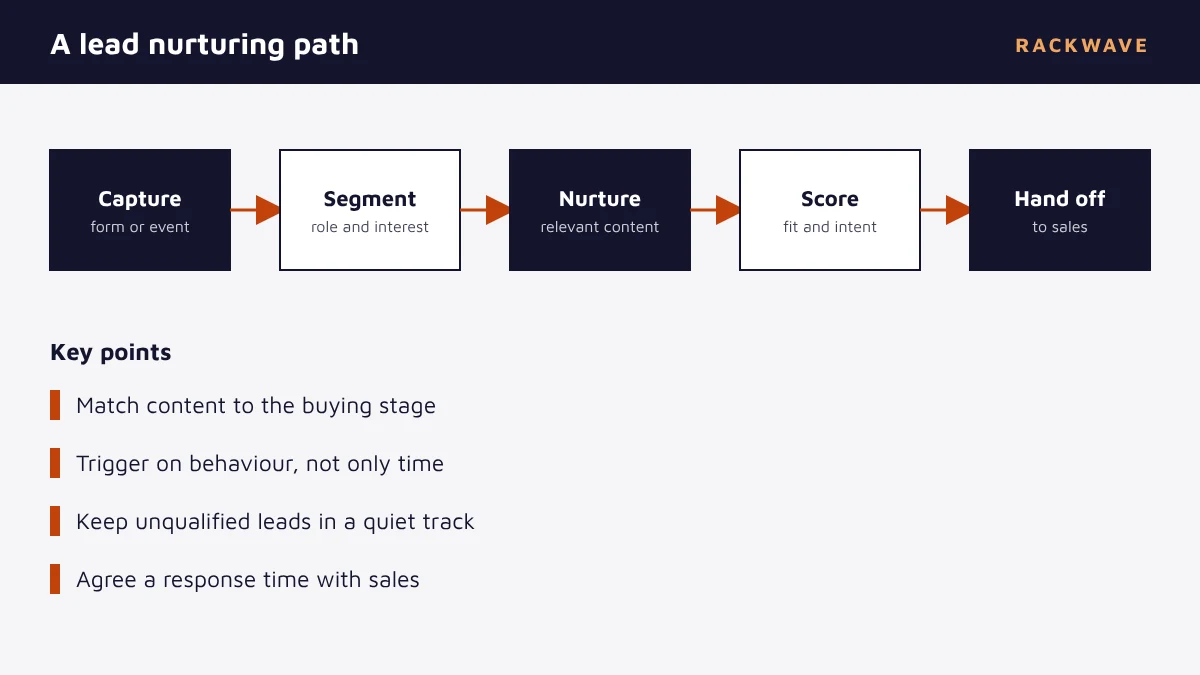
- Capture the lead. A form, event, chat or enquiry brings the contact into your CRM with source and consent recorded.
- Segment. Group leads by role, industry, interest and stage so that content fits.
- Nurture. Send a planned series of messages and content across email, web, social and sales touches.
- Score and monitor. Track engagement and fit. See lead scoring.
- Hand off. When the lead crosses the threshold, notify the owner with context.
- Continue or recycle. If sales declines, return the lead to nurture instead of discarding it.
Lead nurturing tactics
| Tactic | What it does | Example |
|---|---|---|
| Welcome series | Introduces your company and sets expectations | Three messages over two weeks after sign-up |
| Educational content | Answers questions at each stage | Guides, checklists, short explainers |
| Behaviour-triggered messages | Responds to actions | Follow-up after a pricing page visit |
| Retargeting | Reminds visitors on other channels | Ads for people who viewed a product page |
| Sales touches | Personal outreach at the right moment | A short call or note from the account owner |
| Re-engagement | Revives cold leads | "Still interested?" with a useful resource |
| Event and webinar follow-up | Converts attendance into conversation | Recording plus a relevant next step |
Match content to the buying stage
| Stage | Prospect's question | Content that helps |
|---|---|---|
| Awareness | What is my problem? | Educational guides, explainers, checklists |
| Consideration | What are my options? | Comparisons, webinars, case studies |
| Decision | Why you, and what happens next? | Demos, trials, pricing guidance, references |
Mapping the stages in detail is covered in our guide to customer journey mapping. The better you understand the stages, the less generic your nurturing will feel.
Nurturing is not about sending more. It is about sending the next useful thing, to the right person, at the right time.
How to build a lead nurturing programme
- Define the goal and audience. For example, convert webinar attendees to demo requests within sixty days.
- Segment the audience. Use role, industry, source and behaviour. See customer segmentation.
- Plan the content map. List the questions each segment has at each stage and the asset that answers each one.
- Design the sequence. Decide the number of steps, timing, channels and branching rules.
- Set entry, exit and goal criteria. Define who enters, who leaves and what counts as success.
- Build and test. Create it in your automation platform and test with sample contacts.
- Launch, measure and iterate. Review results monthly and improve the weakest step.
An example nurture sequence
| Day | Trigger or step | Message |
|---|---|---|
| 0 | Downloads a buyer's guide | Thank you and a short guide to using it |
| 3 | No further activity | A practical article on the most common mistake |
| 7 | Opens the article | A case study from a similar company |
| 10 | Visits the pricing page | Invitation to a short call, assigned to a representative |
| 21 | No response | A different resource and a softer question |
| 45 | Still no engagement | Move to a low-frequency newsletter list |
Notice the branching. A visit to the pricing page changes the path, and silence leads to a quieter track, not endless emails.
Tools and automation
Nurture programmes run in marketing automation and CRM platforms. In HubSpot, build them with workflows and lifecycle stages. In Salesforce Marketing Cloud, use Journey Builder. In Braze, use Canvas. Whatever the tool, success depends on clean data, clear segments and consent management. Our CRM and lifecycle services design and implement these programmes.
Lead nurturing for B2B and B2C
B2B nurturing is slower and involves several people. A single deal may need messages for the user, the manager who approves the budget and the technical reviewer, so content and sequences are often built per role, with account-level signals tying them together. B2C nurturing is usually faster and more behavioural, with shorter paths from interest to purchase and a stronger link to browsing and basket data. In both cases the principle is the same: help first, and ask for the next step when the signals support it.
Personalisation without being intrusive
Use what the lead has told you or done on your own properties: their role, the content they read, the product pages they viewed. Avoid references that feel like surveillance, such as quoting the exact pages someone visited. Offer a preference centre so people can choose topics and frequency, and respect it. Relevance builds trust; over-familiarity loses it. Make sure every message has a clear unsubscribe path and that you record the consent and the source for each contact, because regulations such as GDPR and similar laws elsewhere require it.
Aligning marketing and sales on nurturing
Nurturing sits on the boundary between two teams, which is where most programmes fail. Marketing runs the sequences, but sales owns the conversations. Agree on a shared definition of a qualified lead, a response-time commitment, a way for sales to send a lead back to nurture with a reason and a monthly review of leads that were accepted and rejected. When both teams look at the same dashboard, the arguments about lead quality become questions about specific steps that can be fixed.
Metrics for lead nurturing
- Conversion rate from lead to marketing qualified, and to sales accepted.
- Engagement by step: opens, clicks and replies.
- Time from first touch to sales readiness.
- Pipeline and revenue influenced by nurtured leads.
- Unsubscribe and complaint rates, as a health check.
- Recycled leads that later converted.
Common lead nurturing mistakes
- One generic sequence for every lead.
- Sending too often, or on a schedule that ignores behaviour.
- Content that is all promotion and no help.
- No handoff rule, so hot leads wait in an inbox.
- Discarding unqualified leads instead of keeping them in a lower-frequency track.
- Ignoring consent and preferences.
Practical tip: Agree a service level with sales: for example, every lead passed over is contacted within one working day. The fastest nurture programme fails if the handoff is slow.
Key takeaways
- Lead nurturing builds relationships with prospects who are not yet ready to buy.
- Segment leads and match content to their stage and interest.
- Combine behaviour triggers, scoring and a clear handoff to sales.
- Keep unqualified leads in a quieter track instead of discarding them.
- Measure conversion, speed and engagement, and refine monthly.
Quick glossary
| Term | Meaning |
|---|---|
| Nurture track | A planned series of messages for a segment |
| Trigger | An action that starts or changes a path |
| MQL | Marketing qualified lead |
| Re-engagement | Campaigns to revive inactive contacts |
| Handoff | Passing a lead from marketing to sales |
Read next: Data Quality: Dimensions, Causes and How to Improve It · What Is a Data Pipeline? Components, Types and Examples · What Is Business Intelligence? Components, Tools, Examples
Frequently asked questions
What is lead nurturing?
Lead nurturing is building relationships with prospects who are not yet ready to buy, by sending relevant content and follow-up until they are ready for a sales conversation.
What is the difference between lead generation and lead nurturing?
Lead generation attracts and captures new leads. Lead nurturing develops those leads over time, helping them progress towards a buying decision.
What are examples of lead nurturing?
Examples include a welcome email series, educational content after a download, behaviour-triggered follow-ups, webinar follow-up, retargeting and personal sales outreach.
How long should a lead nurturing sequence be?
It depends on your sales cycle. Many programmes run from a few weeks to a few months, with branching and a lower-frequency track for leads who remain quiet.
How often should I email leads in a nurture programme?
Set frequency by segment and behaviour. Active leads can receive more, while quiet ones should receive less. Watch unsubscribe and engagement rates to find the right pace.
What is the role of lead scoring in nurturing?
Lead scoring measures fit and engagement so you can tell when a nurtured lead is ready for sales, and route it with context.
What tools do I need for lead nurturing?
A CRM plus a marketing automation platform, such as HubSpot, Salesforce Marketing Cloud, Marketo or Braze, with clean data and consent tracking.
How do I measure lead nurturing success?
Track conversion to marketing qualified and sales accepted, engagement by step, time to sales readiness, influenced pipeline and revenue, and unsubscribe rates.