
What is EDI? Electronic data interchange is the standardised, computer to computer exchange of business documents, such as purchase orders, invoices, advance shipping notices and payment instructions, between trading partners in an agreed format. Instead of printing, emailing or re-keying documents, each company sends and receives structured messages that its systems can process automatically. EDI has been used for decades in retail, manufacturing, logistics, healthcare and finance, and it remains a requirement for trading with many large buyers. This guide explains how EDI works, the main standards, how it compares with APIs, how to implement it and what to look for in a provider.
Short answer: EDI replaces paper and email documents with standard electronic messages exchanged directly between business systems. Both partners agree on a format such as ANSI X12 or EDIFACT, and software translates between those formats and internal systems like ERP.
What is EDI?
The electronic data interchange article on Wikipedia defines it as the transfer of data between organisations in a standard format without human intervention. EDI is a specialised form of system integration, and modern platforms such as iPaaS and enterprise integration suites often include EDI capability alongside APIs.
How EDI works
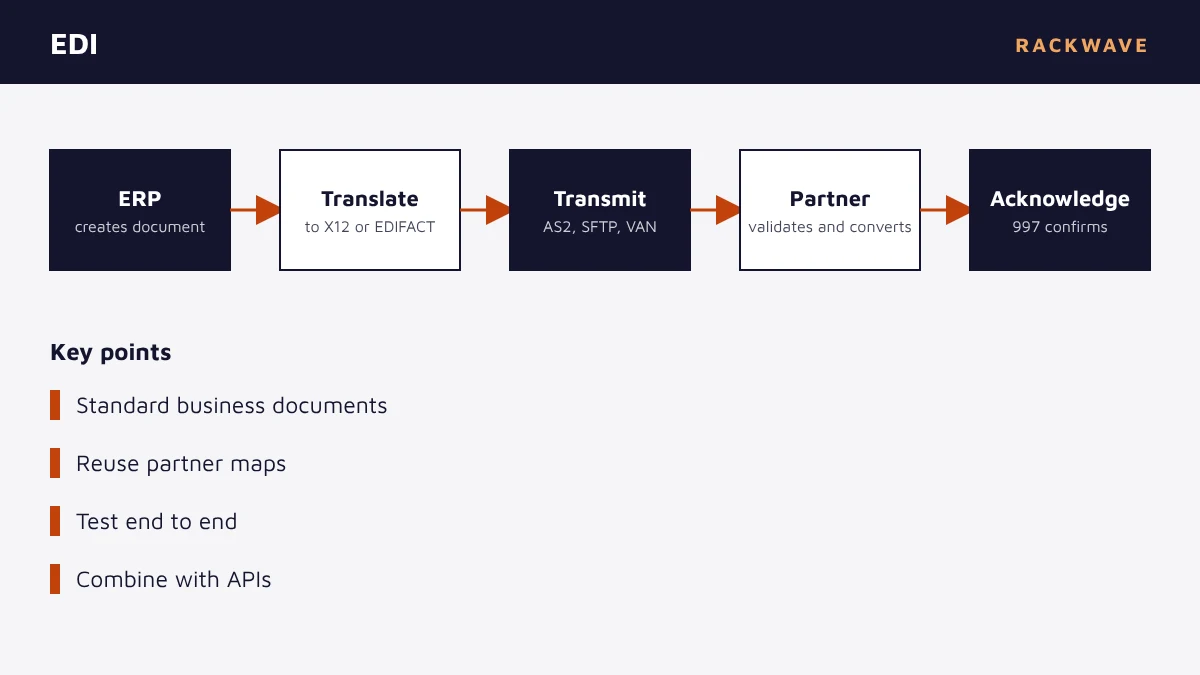
- Agree with the trading partner. Decide which documents, standard, version, identifiers and connection method will be used.
- Create the document. The sender ERP produces a purchase order or invoice in its own format.
- Translate. EDI software maps the internal data to the agreed standard, such as an X12 850 purchase order.
- Transmit. The message travels over a secure channel, such as AS2, SFTP or a value added network.
- Receive and translate. The partner software validates the message and converts it to its own format.
- Acknowledge. A functional acknowledgement confirms receipt and syntax validity.
- Process and monitor. The ERP creates the order or posts the invoice, and exceptions are handled by staff.
EDI standards and common documents
| Standard | Region and use | Notes |
|---|---|---|
| ANSI X12 | North America, retail, health, transport | Numbered transaction sets such as 850 and 810 |
| UN/EDIFACT | International trade, Europe, automotive | Messages such as ORDERS and INVOIC |
| TRADACOMS | Legacy UK retail | Mostly replaced by EDIFACT |
| HL7 and X12 837 | Healthcare | Claims, eligibility and clinical messages |
| Industry guides | Retailer or sector specific rules | Partners add their own requirements |
| Document | X12 code | Purpose |
|---|---|---|
| Purchase order | 850 | Buyer orders goods |
| PO acknowledgement | 855 | Seller confirms the order |
| Advance ship notice | 856 | Seller announces a shipment |
| Invoice | 810 | Seller bills the buyer |
| Remittance advice | 820 | Buyer sends payment details |
| Inventory advice | 846 | Stock levels shared with partners |
| Functional acknowledgement | 997 | Receipt and syntax confirmation |
EDI compared with APIs
| Aspect | EDI | Web APIs |
|---|---|---|
| Format | Standardised documents in X12 or EDIFACT | JSON or XML defined per API |
| Typical pattern | Batch or scheduled exchange of documents | Real time request and response. See what is an API gateway |
| Adoption | Mandated by many large buyers and sectors | Common for modern digital partners |
| Onboarding | Partner specific mapping and testing | Developer portals, faster for simple cases |
| Strengths | Mature, auditable, widely understood in supply chains | Flexible, real time and developer friendly |
Most companies run both. EDI handles the high volume transactional documents that partners demand, while APIs and webhooks serve real time and digital use cases.
Benefits of EDI
- Faster order to cash cycles because documents flow instantly.
- Fewer errors from re-keying and fewer disputes.
- Lower processing cost per document.
- Better visibility of shipments, inventory and payments.
- Stronger relationships and the ability to trade with large retailers and manufacturers that require EDI.
- Audit trails and compliance support.
How to implement EDI
- Identify requirements. List partners, documents, volumes and mandated standards and deadlines.
- Choose the model. Options include in-house software, a managed EDI service or a cloud platform with partner onboarding.
- Map the data. Define how each field maps between your ERP and each standard message, including codes and units.
- Connect securely. Set up AS2, SFTP or a network, with certificates and monitoring.
- Test with each partner. Exchange test documents, validate against the partner guide and fix issues before go live.
- Go live and monitor. Watch acknowledgements and exceptions, and set alerts for failed or late documents.
- Maintain and scale. Onboard new partners with reusable maps and keep track of standard version changes.
What to look for in an EDI solution
| Criterion | Questions to ask |
|---|---|
| Partner onboarding | How quickly can new partners be connected, and are maps reusable? |
| ERP integration | Does it connect cleanly to your ERP and other systems? |
| Monitoring and exceptions | Can business users see and resolve failures easily? |
| Security and compliance | Which protocols, certificates and audit controls are provided? |
| Scalability and pricing | How are documents or partners priced as you grow? |
| Support and expertise | Is help available for standards and partner specific rules? |
Common EDI mistakes
- Treating every partner as unique rather than reusing maps and templates.
- Skipping end to end testing, including error cases.
- No monitoring of acknowledgements, so failed documents go unnoticed.
- Hard coding partner rules deep in the ERP.
- Underestimating onboarding time and partner testing cycles.
- Ignoring master data quality, such as product and location codes.
Our system integration service implements EDI and B2B connectivity, and our MuleSoft practice delivers enterprise integration platforms that combine EDI with APIs.
A worked example: supplying a national retailer
A food manufacturer wins a contract with a national retailer that requires EDI for orders, advance ship notices and invoices. The manufacturer previously processed orders by email. It selects a managed EDI service, maps the retailer 850, 856 and 810 messages to its ERP and tests with the retailer for six weeks, including cases for short shipments and price changes.
After go live, orders arrive directly in the ERP, the warehouse prints pick lists automatically and the shipping system sends the advance ship notice when the truck is loaded. Invoices match the order and receipt data, so payment disputes fall. The reusable maps and monitoring dashboard let the company onboard two more retailers in weeks rather than months, and the sales team can accept larger contracts with confidence.
The future of EDI
EDI is not disappearing, but it is changing. Cloud platforms now handle partner onboarding and monitoring, APIs supplement batch exchange with real time status and many networks offer both. Standards bodies and industry groups are creating API based equivalents of traditional documents, and e-invoicing mandates in many countries are driving structured exchange between businesses and governments. The practical approach is to treat EDI as one channel within a broader B2B integration strategy, with common data quality, security and monitoring across all of them.
Data quality and master data for EDI
Most EDI problems are data problems rather than technical ones. Partners identify products, locations and units using agreed codes, and a mismatch such as an unknown item number or a wrong unit of measure causes rejections and chargebacks. Keep a clean cross reference between your product codes and those of each partner, validate addresses and location identifiers, and check prices and terms before documents are sent. Treat this as part of data quality management rather than a one time mapping task.
Build business rules into the process, not just the translator. For example, reject an outbound invoice that does not match the shipment, route inbound orders with unusual quantities to a person and alert the account team when a partner sends a change late. These controls reduce disputes and give you measurable service levels. For streaming style exchange between your own systems, see what is event driven architecture.
Key takeaways
- EDI exchanges standard business documents directly between partner systems.
- ANSI X12 and EDIFACT are the main standards, with partner specific guides on top.
- It speeds up order to cash, reduces errors and is required by many large buyers.
- EDI and APIs complement each other in a B2B strategy.
- Plan mapping, testing, monitoring and partner onboarding carefully.
Quick glossary
| Term | Meaning |
|---|---|
| Trading partner | A company you exchange documents with |
| Transaction set | An X12 document type such as 850 |
| AS2 | A secure protocol for transmitting EDI over the internet |
| VAN | Value added network, a managed EDI mailbox service |
| 997 | The X12 functional acknowledgement |
Read next: What Is API Management? Lifecycle, Features, Tools · What Is a Message Queue? Patterns and Best Practices · What Is RabbitMQ? Exchanges, Queues and Use Cases
Frequently asked questions
What is EDI in simple terms?
It is the automatic exchange of business documents such as orders and invoices between companies, in a standard format that computers can read without human re-keying.
What are examples of EDI documents?
Common examples are purchase orders, order acknowledgements, advance ship notices, invoices, remittance advice and inventory reports.
What is the difference between EDI and an API?
EDI uses standard document formats, often exchanged in batches, while APIs provide flexible real time interfaces. Companies commonly use both.
What are the main EDI standards?
ANSI X12 is common in North America and UN/EDIFACT is used internationally, with sector standards such as HL7 in healthcare.
What is AS2?
AS2 is a secure protocol for sending EDI and other business data over the internet using encryption, signatures and receipts.
Is EDI still relevant?
Yes. Many large retailers, manufacturers and healthcare payers still require it, though it is increasingly combined with APIs and cloud platforms.
How long does EDI implementation take?
Simple setups can take weeks, while multiple partners and complex mapping may take months, mostly because of testing and partner coordination.
Do I need a VAN for EDI?
Not always. You can exchange directly with partners using AS2 or SFTP, or use a VAN or managed service to simplify connectivity and monitoring.