
What is event driven architecture? It is a software design pattern in which systems communicate by producing and reacting to events, which are records that something happened, such as an order placed, a payment received or a sensor reading changed. Producers publish events without knowing who will use them, and consumers subscribe to the events they care about and react independently. This loose coupling makes systems more scalable, resilient and responsive than designs where services call each other directly. This guide explains the core concepts, the main patterns, the benefits and trade offs, the technology choices and how to adopt event driven architecture step by step.
Short answer: In event driven architecture, components communicate through events sent via a broker or log. Producers announce facts, consumers react in their own time, and new consumers can be added without changing producers. It suits real time, high scale and loosely coupled systems, but it adds complexity in design, testing and monitoring.
What is event driven architecture?
The event-driven architecture article on Wikipedia describes a pattern that has been used for decades in messaging systems and is now central to cloud native design. It contrasts with request and response designs, where one service calls another and waits. Event driven systems are often built on platforms such as Apache Kafka and complement serverless functions and real time analytics.
How event driven architecture works
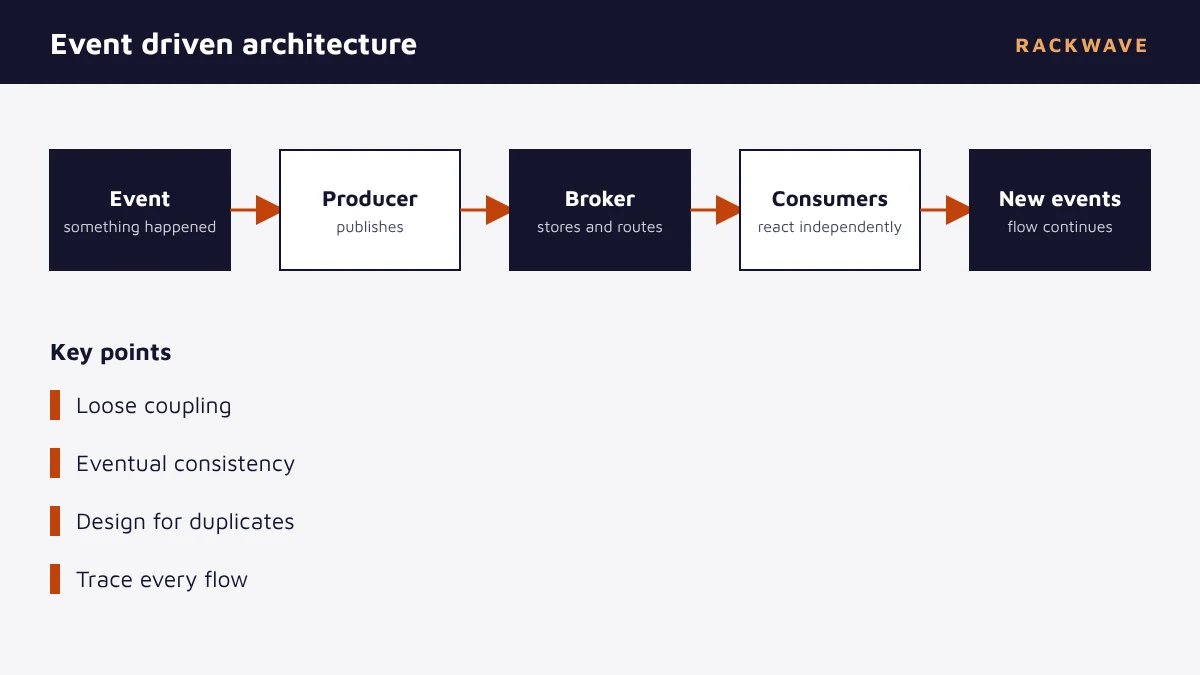
- Something happens. A business fact occurs, such as a customer places an order.
- A producer emits an event. The service publishes a small, immutable record describing what happened, with an identifier and timestamp.
- The broker stores and routes it. A message broker or event log keeps the event and makes it available to subscribers.
- Consumers subscribe. Inventory, billing, notifications and analytics each read the event independently.
- Consumers act. Each performs its own work and may publish new events in turn.
- Failures are handled. Retries, dead letter queues and idempotent handlers prevent loss and duplicates.
- Everything is observable. Tracing and monitoring follow an event across services.
Core concepts
| Concept | Meaning | Example |
|---|---|---|
| Event | A record that something happened | OrderPlaced with order id and items |
| Producer | The component that emits events | Order service |
| Consumer | A component that reacts to events | Billing service |
| Broker or log | Infrastructure that stores and delivers events | Kafka, RabbitMQ, cloud messaging |
| Topic or stream | A named channel of related events | orders |
| Event schema | The agreed structure of an event | JSON or Avro with versioning |
| Idempotency | Handling the same event twice safely | Ignore a duplicate payment event |
Common patterns
| Pattern | Idea | Use |
|---|---|---|
| Publish and subscribe | Many consumers receive each event | Notifications, analytics, integration |
| Event notification | Small event says something changed | Trigger downstream work |
| Event carried state transfer | Event includes the data consumers need | Reduce calls back to the source |
| Event sourcing | Store state as a sequence of events | Audit trails and rebuilding state |
| CQRS | Separate write and read models | Scale reads and writes independently |
| Saga | Coordinate a multi-service transaction with compensating steps | Order to payment to shipping flow |
| Stream processing | Continuous computation over events | Fraud detection and live metrics |
Benefits and trade offs
| Benefits | Trade offs |
|---|---|
| Loose coupling, so teams change services independently | Harder to see the whole flow and debug |
| Scales well and absorbs spikes through buffering | Eventual consistency instead of immediate |
| Real time reactions and richer analytics | Need to manage duplicates, ordering and replays |
| Easy to add new consumers | Schema evolution requires discipline |
| Resilience, because consumers can recover and replay | New skills and tooling for operations |
Event driven versus request and response
| Aspect | Request and response | Event driven |
|---|---|---|
| Coupling | Caller knows the callee | Producer does not know consumers |
| Timing | Synchronous, caller waits | Asynchronous, consumers act later |
| Failure impact | Failure can cascade to callers | Broker buffers, consumers recover |
| Best for | Queries and immediate answers. See what is an API gateway | Workflows, integration and streaming data |
| Consistency | Easier to reason about | Eventually consistent |
Most real systems use both: APIs for questions that need an immediate answer and events for notifying other parts of the business of what has happened.
How to adopt event driven architecture
- Find the right use cases. Look for places where many systems need to react to the same change, or where spikes and real time needs strain direct calls.
- Model events with the business. Use domain language and capture business facts, not technical database changes.
- Choose the platform. Pick a broker or log by volume, ordering needs, retention and team skills.
- Define schemas and governance. Register schemas, set naming rules and plan versioning from day one.
- Design for failure. Make consumers idempotent, add retries and dead letter handling and decide how to replay.
- Build observability. Add correlation identifiers, tracing and lag monitoring. See what is observability.
- Grow gradually. Start with one flow, learn, and then extend, rather than rewriting everything at once.
Common event driven mistakes
- Turning events into disguised remote procedure calls that demand a reply.
- Publishing every database change, which exposes internal structure.
- No schema management, so a change in one service breaks many consumers.
- Ignoring duplicates and out of order delivery.
- Having no way to trace an order through the event flow.
- Adopting events everywhere when simple calls would do.
Our system integration service designs event driven platforms, our DevOps service operates them reliably and our API development service complements them with the right synchronous interfaces.
A worked example: an online order flow
A retailer processes orders through a single large application that calls payment, stock, shipping and email services one after another. Peak sales cause timeouts, and adding a loyalty service means changing the order code. The retailer moves to events. The order service publishes OrderPlaced. Payment, stock, loyalty, email and analytics each subscribe and work independently, and they publish their own events such as PaymentConfirmed and StockReserved.
A saga coordinates the flow, so that if stock cannot be reserved, a compensating event refunds the payment. During a seasonal peak, the broker buffers the surge and consumers process at their own pace, so checkout stays responsive. Adding the loyalty service required only a new subscription. The team invested in schema registry, tracing and dashboards of consumer lag, which made it possible to find and fix a stuck consumer in minutes.
Data consistency and ordering
Event driven systems trade immediate consistency for flexibility, so design with that in mind. Partition events by a key, such as the customer or order identifier, to preserve order where it matters, and accept that there is no global order. Use the outbox pattern, writing the event and the database change in one transaction and publishing afterwards, to avoid losing events if a service fails between the two steps. Give every event a unique identifier so that consumers can detect duplicates, and design user interfaces to cope gracefully with changes that appear a moment later.
Key takeaways
- Event driven architecture connects systems through events that producers publish and consumers react to.
- It delivers loose coupling, scalability, resilience and real time behaviour.
- Key patterns include publish and subscribe, event sourcing, CQRS and sagas.
- Plan for eventual consistency, duplicates, ordering, schemas and observability.
- Combine events with APIs and adopt gradually on well chosen use cases.
Quick glossary
| Term | Meaning |
|---|---|
| Event | A record that something happened |
| Broker | Infrastructure that stores and delivers events |
| Saga | A sequence of local transactions with compensating actions |
| Outbox pattern | Writing events with data changes to avoid loss |
| Consumer lag | How far a consumer is behind the latest event |
Read next: What Is API Management? Lifecycle, Features, Tools · What Is a Message Queue? Patterns and Best Practices · What Is RabbitMQ? Exchanges, Queues and Use Cases
Frequently asked questions
What is event driven architecture in simple terms?
It is a design where systems announce things that happen as events, and other systems react to them independently, instead of calling each other directly and waiting.
What are the benefits of event driven architecture?
Loose coupling, easier scaling, resilience, real time reactions and the ability to add new consumers without changing existing producers.
What are the disadvantages?
It is harder to trace and debug, uses eventual consistency, needs careful handling of duplicates and ordering and requires new operational skills.
What is the difference between event driven architecture and microservices?
Microservices split an application into small services. Event driven architecture is a communication style that microservices often use, but each can exist without the other.
What technologies are used for events?
Common choices are Apache Kafka, RabbitMQ, cloud services such as Amazon SNS and SQS, Azure Service Bus and Google Pub/Sub, depending on throughput and features.
What is event sourcing?
Event sourcing stores the state of a system as a sequence of events, so you can rebuild current state and keep a complete audit trail. It adds complexity and suits specific cases.
What is the saga pattern?
A saga coordinates a business process across services as a series of steps, each with a compensating action if a later step fails, instead of one distributed transaction.
When should I not use event driven architecture?
Avoid it for simple systems, strictly synchronous queries needing instant answers or teams without the tooling and skills to operate it.