
What is deep learning? It is a branch of machine learning that uses neural networks with many layers to learn patterns directly from large amounts of data, such as images, speech, text and sensor readings. Instead of engineers writing rules or hand picking features, a deep learning model discovers its own representations, which is why it has driven breakthroughs in image recognition, translation, speech assistants and generative AI. This guide explains how deep learning works, the main network types, how it differs from other machine learning, what it needs in data and compute, and where businesses use it.
Short answer: Deep learning trains multi-layer neural networks on large datasets so they learn features automatically. It excels on unstructured data such as images, audio and text, but needs lots of data and computing power and can be hard to explain.
What is deep learning?
Deep learning is a subset of machine learning, which is itself part of artificial intelligence. The word deep refers to the number of layers in the network. The deep learning article on Wikipedia gives the research background. Each layer transforms its input into a slightly more abstract form, so early layers may detect edges in an image while later layers recognise faces or objects. The building block is the neural network.
How deep learning works
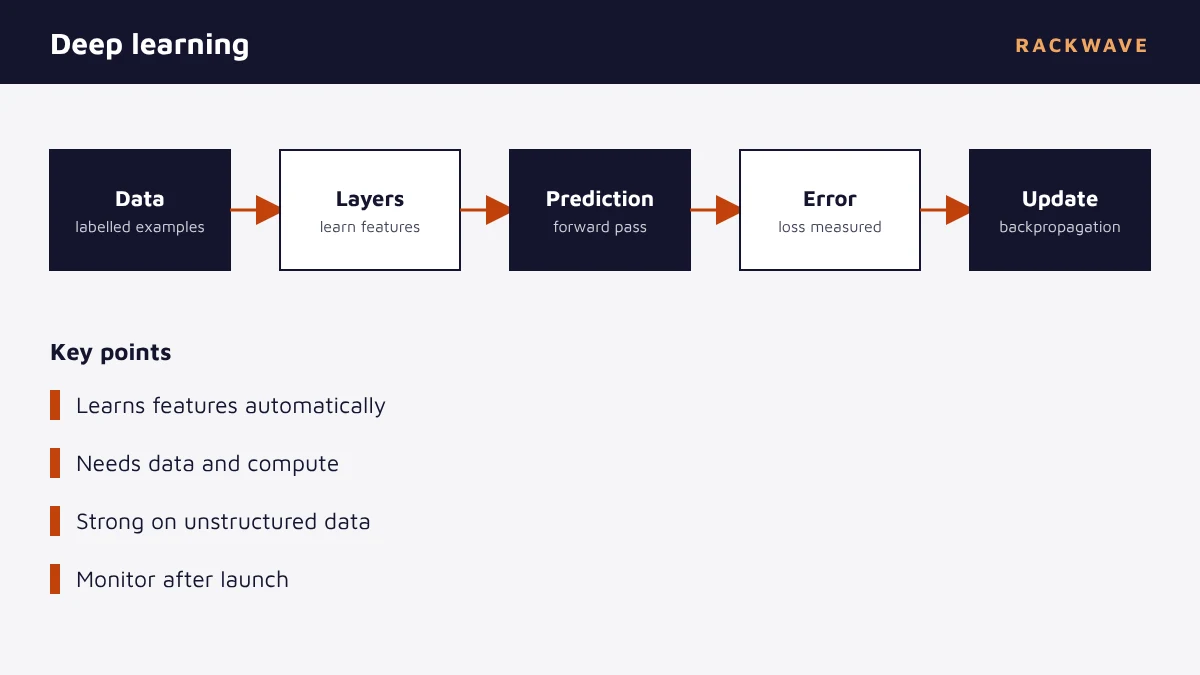
- Collect and label data. Gather many examples, such as images tagged with what they show.
- Forward pass. The network passes each input through layers of weighted connections to produce a prediction.
- Measure error. A loss function compares the prediction with the correct answer.
- Backpropagation. The error is propagated backward and an optimiser adjusts the weights to reduce it.
- Repeat many times. Training runs over the data for many passes, usually on GPUs or similar accelerators.
- Validate and test. The model is checked on data it has not seen to confirm it generalises.
- Deploy and monitor. The trained model serves predictions and is watched for drift. See what is MLOps.
Main types of deep learning networks
| Network type | Best at | Typical uses |
|---|---|---|
| Convolutional neural network (CNN) | Images and spatial data | Medical imaging, quality inspection, face recognition. See what is computer vision |
| Recurrent network (RNN, LSTM) | Sequences | Time series, older speech and text models |
| Transformer | Sequences with long range context | Language models and translation. See what is a large language model |
| Autoencoder | Compression and anomaly detection | Fraud and fault detection |
| Generative adversarial network | Creating realistic data | Image synthesis and data augmentation |
| Diffusion model | Generating images and audio | Creative and design tools |
| Graph neural network | Relationship data | Recommendations and molecule modelling |
Deep learning compared with traditional machine learning
| Aspect | Traditional machine learning | Deep learning |
|---|---|---|
| Features | Hand designed by experts | Learned automatically |
| Best data type | Structured tables | Images, audio, text, video |
| Data needed | Hundreds to thousands of rows can work | Often many thousands to millions of examples |
| Compute | Modest | High, usually accelerators |
| Explainability | Often easier | Harder, needs extra tools |
| Training time | Minutes to hours | Hours to weeks |
For many business problems on tables of customer or transaction data, gradient boosted trees and similar methods still match or beat deep learning with less effort, so the right choice depends on the data.
Business applications of deep learning
- Visual inspection of products on manufacturing lines.
- Reading documents, invoices and handwriting.
- Speech recognition and call analytics.
- Language assistants and search. See what is natural language processing.
- Fraud and anomaly detection in payments and logs.
- Demand forecasting and recommendation engines.
- Medical image support for clinicians, under strict oversight.
What deep learning needs
| Need | Why it matters | Practical tip |
|---|---|---|
| Quality labelled data | Models learn what the data shows | Invest in labelling guidelines and review |
| Compute | Training is intensive | Use cloud accelerators on demand |
| Pretrained models | Save data and time | Fine tune an existing model where possible |
| Evaluation | Accuracy alone can mislead | Test across groups and edge cases |
| Governance | Risk, privacy and fairness | See what is responsible AI |
| Operations | Models degrade as data changes | Monitor and retrain on a schedule |
Common deep learning mistakes
- Choosing deep learning when a simpler model would do.
- Training on too little or unrepresentative data.
- Leaking test data into training, which inflates results.
- Ignoring bias and fairness until after launch.
- Not planning how the model will be deployed, monitored and retrained.
- Treating the model as a black box with no explanation of important decisions.
Our AI and machine learning service builds and deploys deep learning systems, and our data analytics service prepares the data they need.
A worked example: visual inspection on a production line
A manufacturer of metal components relies on staff to inspect parts for surface defects, and fatigue causes missed faults at the end of shifts. The company installs cameras and trains a convolutional network on 40,000 labelled images of good and defective parts, starting from a pretrained model so that fewer labels are needed.
On a held out test set the model finds 97 percent of defects with a low false alarm rate. Rare defect types are weak, so the team gathers more examples of those and adds synthetic variations. In production, the model flags suspect parts for a person to confirm, and every confirmation becomes new training data. Escapes to customers fall, inspectors focus on judgement rather than staring at screens, and a monthly check watches for drift when suppliers change materials or lighting changes.
Choosing between building and buying
Many organisations do not need to train a network from scratch. Pretrained models and managed services for vision, speech and language cover common needs and can be adapted with a modest amount of your own data. Training from scratch makes sense when data is unique, accuracy is critical or the problem is highly specialised. In every case, decide up front how the model will be evaluated, who owns it and how it will be monitored after launch, because those operational questions determine whether it keeps delivering value.
Why deep learning took off
The ideas behind neural networks are decades old, but three changes made them practical. First, digital data grew enormously, giving models enough examples to learn from. Second, graphics processors and later purpose built accelerators made training thousands of times faster. Third, better techniques, including improved activation functions, regularisation, optimisers and the transformer architecture, made deep networks stable and trainable. Together these removed the barriers that held earlier attempts back.
Cloud platforms then made the technology accessible. A company can now rent a cluster for a few hours, start from a pretrained model and adapt it with its own data, instead of building a research lab. That shift moved deep learning from universities into everyday business systems such as search, customer service, fraud monitoring and quality control.
Limits to keep in mind
Deep learning models are statistical. They can be confidently wrong on inputs unlike their training data, can be fooled by small deliberate changes to an image, and can inherit bias from historical records. They are also expensive to train and to run at scale. Mature teams therefore combine them with business rules, confidence thresholds and human review, and they keep a record of training data, versions and test results so that decisions can be audited and models can be rolled back if something goes wrong.
Key takeaways
- Deep learning trains multi-layer neural networks that learn features automatically from data.
- It is strongest on images, audio, text and video, and powers modern generative AI.
- It needs large datasets, compute and careful evaluation, and can be hard to explain.
- Simpler methods often win on small structured datasets.
- Plan deployment, monitoring and governance from the start.
Quick glossary
| Term | Meaning |
|---|---|
| Neural network | A model of connected layers of simple units |
| Backpropagation | Method that adjusts weights using the error |
| CNN | A network suited to images |
| Transformer | A network using attention, basis of LLMs |
| Fine tuning | Adapting a pretrained model to a new task |
Read next: What Is Fine-Tuning? Methods, Data and Costs · What Is Feature Engineering? Techniques and Workflow · What Is Explainable AI? Methods, SHAP and LIME
Frequently asked questions
What is deep learning in simple terms?
It is a way for computers to learn from large amounts of data using many layered neural networks, so they can recognise images, speech and language without hand written rules.
What is the difference between AI, machine learning and deep learning?
AI is the broad goal of intelligent machines, machine learning is learning from data, and deep learning is machine learning using many layered neural networks.
Why is it called deep learning?
Because the neural networks have many layers between input and output. More layers allow the model to learn more abstract features.
Does deep learning need a lot of data?
Usually yes, but pretrained models can be fine tuned with far less data, which makes it practical for many businesses.
What hardware does deep learning use?
GPUs and other accelerators, because they perform the large matrix calculations in training quickly. Most companies rent them from cloud providers.
When should I not use deep learning?
When data is small, structured and tabular, when explainability is critical, or when a simpler model gives similar accuracy at lower cost.
Can deep learning be biased?
Yes. Models can reflect bias in training data, so test across groups, document limits and apply responsible AI practices.
What are common deep learning frameworks?
PyTorch and TensorFlow are widely used, with higher level libraries and managed cloud services built on top of them.