
What is artificial intelligence? Artificial intelligence, or AI, is the field of computer science concerned with building systems that perform tasks normally requiring human intelligence, such as understanding language, recognising images, making predictions, solving problems and learning from experience. It powers everything from spam filters and recommendations to chatbots, fraud detection and autonomous vehicles. This guide explains what AI is, how it works, the main types and techniques, real business applications, benefits and risks, and how an organisation can start using AI responsibly.
Short answer: AI is software that learns patterns from data and uses them to make predictions, decisions or content. Most AI in business today is narrow: it does one kind of task well, such as classifying support tickets or forecasting demand.
What is artificial intelligence?
Artificial intelligence is both a scientific field and a set of technologies. The term was coined in the 1950s, and the field has gone through cycles of enthusiasm and disappointment since. What changed in recent years is the combination of large datasets, cheap computing power and better algorithms, which made it practical to apply AI to everyday business problems.
It helps to separate the labels. AI is the broad goal. Machine learning is the main method used to reach it today, in which systems learn from examples rather than following hand-written rules. Deep learning is a subset of machine learning that uses neural networks with many layers. Generative AI is a recent branch that creates new content. Our guides to machine learning and generative AI explain those in detail.
How AI works
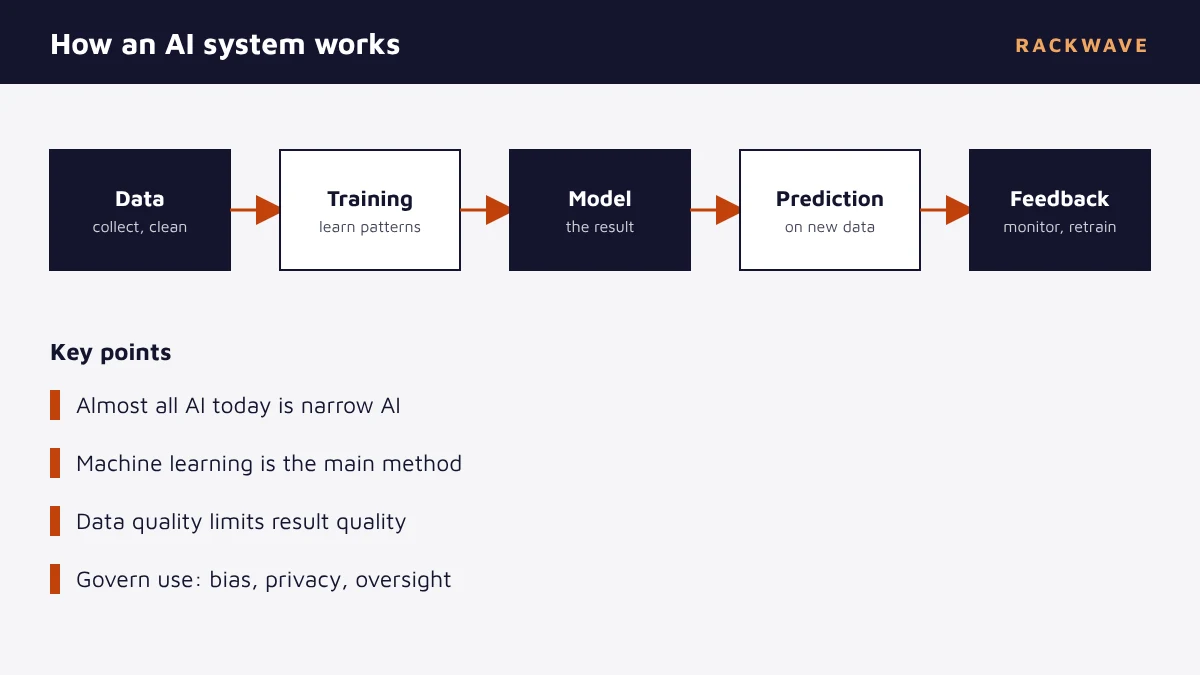
- Collect and prepare data. Examples are gathered and cleaned. The quality of the data limits the quality of the result.
- Choose and train a model. An algorithm adjusts its internal parameters so that its outputs match the known answers in the training data.
- Evaluate. The model is tested on data it has not seen to check that it generalises, not just memorises.
- Deploy. The model is placed into an application, an API or a business process where it makes predictions on live data.
- Monitor and improve. Performance is tracked, and the model is retrained as data and conditions change.
Types of artificial intelligence
| Type | Meaning | Status |
|---|---|---|
| Narrow AI | Designed for one task or a closed set of tasks | Everything in use today, including chatbots and recommenders |
| General AI | Would match human ability across any intellectual task | Not achieved; a research goal |
| Superintelligence | Would surpass human intelligence broadly | Hypothetical |
You may also see AI described by how it works. Reactive systems respond to inputs with no memory, systems with memory use past data to decide, and the speculative categories describe systems with understanding or self-awareness, which do not exist. For business planning, narrow AI is the only category that matters.
Core AI techniques
| Technique | What it does | Example use |
|---|---|---|
| Machine learning | Learns patterns from data to predict or classify | Predicting which customers will churn |
| Deep learning | Uses layered neural networks for complex patterns | Image and speech recognition |
| Natural language processing | Understands and generates human language | Support ticket classification, chat |
| Computer vision | Interprets images and video | Quality inspection on a production line |
| Recommendation systems | Suggest items based on behaviour | Product and content suggestions |
| Generative AI | Creates text, images, code and more | Drafting responses and summaries |
| Reinforcement learning | Learns by trial and reward | Route optimisation, game playing |
AI examples in everyday business
- Customer service: assistants that answer common questions and route cases. See Salesforce Agentforce.
- Sales and marketing: lead scoring, next-best-action and personalisation. See lead scoring.
- Finance: fraud detection, credit risk and invoice processing.
- Operations: demand forecasting, predictive maintenance and route planning.
- HR: screening support and workforce planning, with careful oversight.
- Healthcare: imaging support and administrative automation.
- Software development: code assistance and test generation.
AI does not replace the need for good data and clear process. It amplifies whatever you already have, good or bad.
Benefits of AI
- Productivity: automates repetitive tasks so people spend time on judgement and relationships.
- Scale: handles volumes of data and requests that people cannot.
- Insight: finds patterns in data that are hard to spot manually.
- Personalisation: tailors offers and service to each customer.
- Availability: works around the clock.
Risks and limitations
- Bias: models learn from historical data and can repeat or amplify unfair patterns.
- Errors and hallucination: AI can be wrong with confidence, especially generative models.
- Privacy and security: training and using AI can expose personal or confidential data.
- Explainability: some models are hard to explain, which matters in regulated decisions.
- Dependence on data quality: poor data produces poor results. See data quality.
- Regulation: rules such as the EU AI Act are evolving and may apply to your use.
Responsible AI: Keep a human in the loop for high-impact decisions, document what each model is for, test for bias, protect data and review results regularly. Responsible practice is not optional extra work. It is what makes AI safe to scale.
A short history of AI
Early AI in the 1950s and 1960s relied on hand-written rules and logic. Expert systems in the 1980s encoded specialist knowledge as rules, and they proved brittle outside their narrow domain. Machine learning gradually took over as data and computing grew, and from around 2012 deep learning achieved breakthroughs in image and speech recognition. Large language models and generative tools, from the early 2020s, brought AI to a mass audience. Each wave raised expectations beyond what the technology could deliver, which is a good reason to judge any AI proposal by its measurable result and not by its label.
How to start with AI in your organisation
- Pick a specific problem. Choose a task with a clear owner, measurable result and enough data, such as classifying support tickets.
- Check data readiness. Assess volume, quality, access and privacy. Fix gaps first.
- Decide build, buy or configure. Many needs are met by features inside existing platforms, such as CRM, before custom models are needed.
- Run a small pilot. Test with real users and measure against a baseline.
- Set governance. Define who approves use cases, how risks are assessed and how results are monitored.
- Integrate and scale. Connect the model to the processes and systems that use it, and train users.
Most value comes from integration, not from the model itself. A prediction nobody sees or acts on is worth nothing. Our AI and machine learning services cover use-case selection, data preparation, model development and integration, and our data analytics service builds the data foundation underneath.
AI and your existing platforms
Before building custom models, check what your current systems already offer. CRM platforms include prediction, summarisation and assistant features, for example Einstein AI in Salesforce. Using them lets you gain value quickly, with data already in place and permissions already defined. Custom development makes sense when your use case is distinctive, your data is a competitive asset or the built-in features do not meet your needs.
AI vs machine learning vs data science
| Term | Focus | Relationship |
|---|---|---|
| Artificial intelligence | Systems that perform intelligent tasks | The broad field |
| Machine learning | Learning patterns from data | The main approach used in modern AI |
| Data science | Extracting insight from data using statistics, programming and domain knowledge | Overlaps with and supports ML and analytics. See what is data science |
Key takeaways
- AI builds systems that perform tasks needing human-like intelligence; today all of it is narrow AI.
- Machine learning is the main method; deep learning and generative AI are subsets.
- Value comes from clear use cases, good data and integration into real processes.
- Risks include bias, errors, privacy and regulation, so govern use deliberately.
- Start small, measure against a baseline and scale what works.
Quick glossary
| Term | Meaning |
|---|---|
| Model | A trained system that makes predictions or generates output |
| Training data | Examples used to teach a model |
| Neural network | A model made of layers of connected units |
| Inference | Using a trained model to make a prediction |
| Hallucination | A confident but false output from a generative model |
Read next: Lead Nurturing: Strategy, Tactics and Examples · Data Quality: Dimensions, Causes and How to Improve It · What Is a Data Pipeline? Components, Types and Examples
Frequently asked questions
What is artificial intelligence in simple terms?
Artificial intelligence is software that can perform tasks that normally need human intelligence, such as understanding language, recognising images or making predictions, usually by learning patterns from data.
What are the main types of AI?
By capability: narrow AI, which does specific tasks and is all that exists today, general AI, which would match humans broadly, and superintelligence, which is hypothetical. By technique: machine learning, deep learning, natural language processing and computer vision.
What is the difference between AI and machine learning?
AI is the broad goal of intelligent behaviour in machines. Machine learning is a method within AI in which systems learn patterns from data instead of following fixed rules.
What are examples of AI?
Examples include recommendation engines, spam filters, virtual assistants, fraud detection, voice recognition, demand forecasting and generative tools that write text or create images.
How is AI used in business?
Businesses use it in customer service, sales and marketing personalisation, fraud detection, forecasting, process automation, document handling and software development.
Is AI safe?
AI can be used safely with good governance: quality data, testing for bias, human oversight of important decisions, privacy protection and ongoing monitoring. Unmanaged use creates risk.
Will AI replace jobs?
AI will automate many tasks and change many roles, while creating new ones. Organisations generally see the best results when AI supports people and removes routine work rather than replacing judgement.
How can a company start using AI?
Pick one specific problem with measurable value, check data readiness, use built-in platform features before custom builds, pilot with real users and set governance before scaling.