
What is a neural network? It is a computing model, loosely inspired by the brain, made of layers of connected units called neurons that learn to map inputs to outputs by adjusting the strength of their connections. Fed with many examples, a neural network can learn to recognise images, understand speech, predict demand or generate text without anyone writing explicit rules. Neural networks are the foundation of deep learning and of modern generative AI. This guide explains how they are built, how they learn, the main types, and how businesses use them responsibly.
Short answer: A neural network is a stack of layers. Each neuron takes weighted inputs, applies a simple function and passes the result on. Training adjusts the weights so that the network predicts correctly, using an algorithm called backpropagation. Many layers make a deep network.
What is a neural network?
The neural network article on Wikipedia traces the idea back to the 1940s. Today neural networks are a core technique in machine learning, and networks with many layers are the basis of deep learning. Unlike a traditional program, a neural network is not told how to solve a problem. It is shown examples and finds its own internal rules.
The structure of a neural network
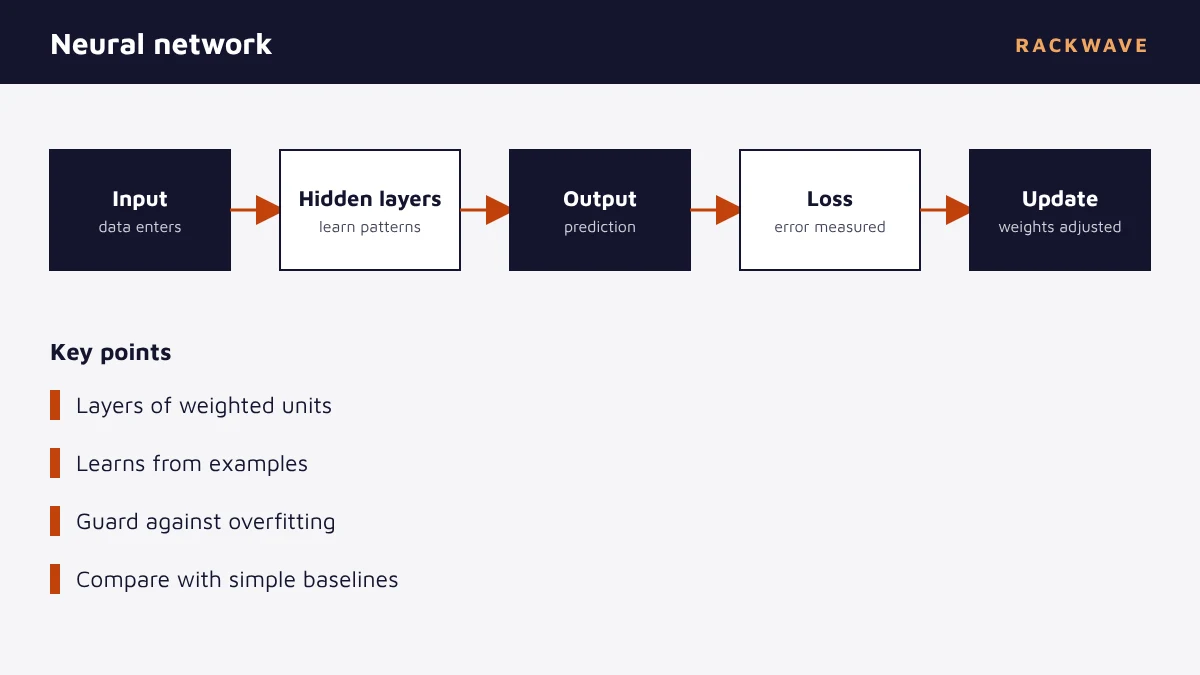
| Component | What it does | Notes |
|---|---|---|
| Input layer | Receives the raw data, such as pixel values or numeric features | One unit per input value |
| Hidden layers | Transform the data into more useful representations | More layers make the network deeper |
| Output layer | Produces the prediction, such as a class or a number | Shape depends on the task |
| Weights | Numbers that set the strength of each connection | Learned during training |
| Bias | An adjustable offset for each neuron | Lets neurons shift their output |
| Activation function | Adds non-linearity so the network can learn complex patterns | Examples are ReLU and sigmoid |
| Loss function | Measures how wrong a prediction is | Guides learning |
How a neural network learns
- Initialise. Weights start as small random numbers, so the first predictions are poor.
- Forward pass. An input moves through the layers and the network makes a prediction.
- Compute the loss. The prediction is compared with the known correct answer.
- Backpropagate. The algorithm works out how much each weight contributed to the error.
- Update the weights. An optimiser such as gradient descent nudges each weight to reduce the loss.
- Repeat. Many passes over the data steadily improve accuracy.
- Evaluate. Test on unseen data to check the network generalises rather than memorises.
Types of neural networks
| Type | Strength | Example use |
|---|---|---|
| Feedforward network | Simple prediction on tables of data | Credit scoring, demand forecasts |
| Convolutional network | Spatial patterns | Images and video. See what is computer vision |
| Recurrent network | Ordered sequences | Time series and early speech models |
| Transformer | Long range context through attention | Language models. See what is a large language model |
| Autoencoder | Learning compact representations | Anomaly detection |
| Generative network | Creating new content | Images, audio and synthetic data |
Overfitting and how to prevent it
A network that memorises its training data performs poorly on new examples. This is overfitting. Common defences include more and varied data, holding out a validation set to detect the problem early, regularisation that penalises overly complex weights, dropout that randomly switches off units during training and early stopping when validation scores stop improving. Simpler networks are also less prone to overfit, so start small and add capacity only when needed.
Business uses of neural networks
- Predicting churn, demand and credit risk from customer and transaction data.
- Classifying images in retail, manufacturing and insurance claims.
- Transcribing and analysing calls.
- Understanding text in emails and documents. See what is natural language processing.
- Detecting fraud and unusual behaviour.
- Powering recommendations and personalisation.
Common neural network mistakes
- Using a large network on a small dataset, which leads to overfitting.
- Leaking information from the test set into training.
- Judging only on overall accuracy when classes are imbalanced.
- Skipping data cleaning and normalisation of inputs.
- Ignoring explainability for decisions that affect people. See what is responsible AI.
- No monitoring after deployment, so drift goes unnoticed.
Our AI and machine learning service designs, trains and deploys neural network solutions, and our data analytics service prepares the data behind them.
A worked example: predicting customer churn
A subscription business wants to know which customers are likely to cancel in the next 60 days. Data engineers assemble a table with usage, billing, support and tenure features for 200,000 past customers, and mark who left. After scaling the inputs, a data scientist trains a small feedforward network with two hidden layers and compares it with a gradient boosted tree model.
The network and the tree model perform similarly, so the team chooses the simpler and more explainable tree model for the main score, and keeps the network as a challenger. This is a realistic outcome. Neural networks are powerful, but on tabular data they do not always beat simpler methods, and the decision should rest on measured results, explainability and operating cost. The retention team receives a weekly list of at risk customers with the main reasons, and results are tracked against a control group to prove the value of the interventions.
Practical tips for getting started
Begin with a clear question and a baseline, such as a simple rule or a linear model, so you know what the network must beat. Use a standard framework such as PyTorch or TensorFlow, start from a pretrained model when one exists, and train on a small sample first to check the pipeline before spending on compute. Track experiments, so you can reproduce results, and keep the data and code for each model version. These habits matter more than clever architectures.
Key hyperparameters and design choices
| Choice | What it controls | Practical guidance |
|---|---|---|
| Number of layers | Depth and capacity to learn complex patterns | Start small and add layers only if validation scores improve |
| Units per layer | Width of each layer | Wider layers learn more but overfit and cost more |
| Learning rate | Size of each weight update | Too high is unstable, too low is slow. Tune it first |
| Batch size | Examples used per update | Affects speed, memory and stability |
| Epochs | Passes over the training data | Stop when validation loss stops improving |
| Regularisation | Penalty or dropout against overfitting | Increase if training accuracy far exceeds validation accuracy |
| Optimiser | Method used to update weights | Adam is a common default |
Most of the gain usually comes from better data and a well tuned learning rate rather than exotic architectures. Record every experiment with its settings and results, so improvements can be reproduced and explained to reviewers and auditors later.
How neural networks differ from the brain
The brain inspired the vocabulary, but artificial networks are far simpler. A neuron in a network is a mathematical function, not a living cell, and learning happens through numerical optimisation rather than biological processes. Networks need far more examples than a child does to learn a concept, and they can fail in ways that people do not, such as being fooled by tiny changes in an image. Treat them as powerful pattern recognition tools with clear limits, not as thinking minds, and design the surrounding process with that in mind.
Key takeaways
- A neural network is a set of layers of connected neurons whose weights are learned from data.
- Training uses a loss function, backpropagation and an optimiser to reduce error.
- Different architectures suit images, sequences, language and tables.
- Prevent overfitting with more data, validation, regularisation and simplicity.
- Compare with simpler baselines and monitor models after deployment.
Quick glossary
| Term | Meaning |
|---|---|
| Neuron | A simple unit that combines weighted inputs |
| Weight | A learned number setting connection strength |
| Activation function | A non-linear function applied by each neuron |
| Backpropagation | Algorithm that computes how to adjust weights |
| Overfitting | Learning noise in training data instead of general patterns |
Read next: What Is Fine-Tuning? Methods, Data and Costs · What Is Feature Engineering? Techniques and Workflow · What Is Explainable AI? Methods, SHAP and LIME
Frequently asked questions
What is a neural network in simple terms?
It is a computer model made of layers of connected units that learns from examples to recognise patterns and make predictions, instead of following hand written rules.
How does a neural network learn?
It makes a prediction, measures the error with a loss function, uses backpropagation to see how each weight contributed and adjusts the weights to reduce the error, repeating over many examples.
What is the difference between a neural network and deep learning?
Deep learning is the use of neural networks with many hidden layers. A neural network with one or two layers is shallow, while deep learning refers to deeper ones.
What is an activation function?
It is a function applied to each neuron output that adds non-linearity, which lets the network learn complex relationships rather than only straight line ones.
What is overfitting?
Overfitting happens when a network memorises the training data and performs poorly on new data. Validation sets, regularisation and more data help prevent it.
Do neural networks always beat other models?
No. On small structured datasets, simpler models often perform as well and are easier to explain, so compare against baselines.
How much data does a neural network need?
It depends on the task. Training from scratch often needs a lot of data, but fine tuning a pretrained network can work with much less.
Are neural networks explainable?
They are harder to explain than simple models, but techniques such as feature importance and example based explanations help, and they are important for high stakes decisions.