
What is natural language processing? Natural language processing, or NLP, is the field of artificial intelligence that enables computers to read, understand, interpret and generate human language, in text and in speech. It powers search engines, chatbots, translation, spam filters, sentiment analysis, document summarisation and voice assistants. Modern NLP is built on machine learning and especially on large language models, which have made tasks that once needed teams of linguists possible with a few lines of code. This guide explains how NLP works, its main tasks, the techniques behind it, and how organisations apply it to real business problems.
Short answer: NLP turns unstructured language into structured information that software can use. It breaks text into pieces, represents meaning numerically, and applies models to tasks such as classification, extraction, translation, summarisation and question answering.
What is natural language processing?
NLP combines linguistics, computer science and machine learning. The natural language processing article on Wikipedia outlines its history, from hand written rules in the 1950s, through statistical methods, to the neural approaches of today. The most recent step is the large language model, which handles many NLP tasks with one general purpose system.
How NLP works
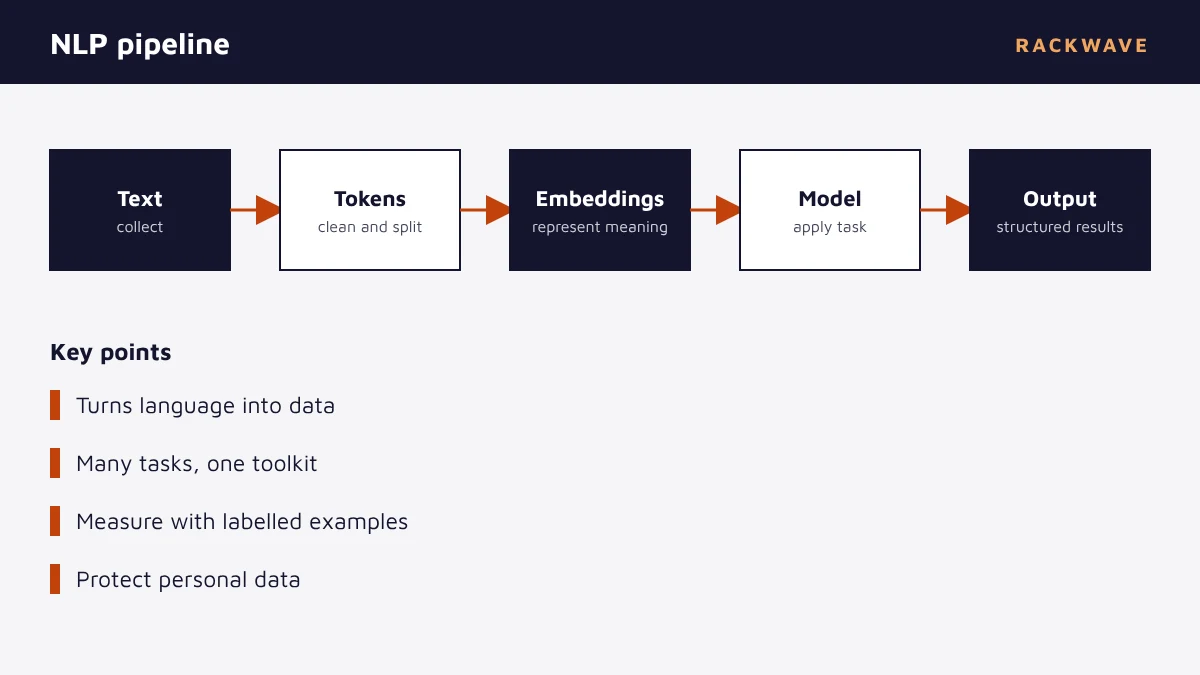
- Collect text or speech. Sources include emails, tickets, reviews, documents, chats and call recordings. Speech is first converted to text.
- Clean and normalise. Remove noise, fix encoding and standardise case and spacing where useful.
- Tokenise. Split text into words or sub-word pieces.
- Represent meaning. Convert tokens into vectors, called embeddings, that capture meaning and context.
- Apply a model. A trained model performs the task, such as labelling sentiment or extracting entities.
- Post process. Convert the model output into fields, scores or text that systems can use.
- Evaluate and improve. Measure accuracy on labelled examples and refine with new data.
Common NLP tasks
| Task | What it does | Business example |
|---|---|---|
| Text classification | Assigns labels to text | Route support tickets, filter spam |
| Sentiment analysis | Detects opinion and emotion | Track customer reviews and social posts |
| Named entity recognition | Finds people, companies, dates and amounts | Extract details from contracts and invoices |
| Summarisation | Condenses long text | Briefings from reports and call transcripts |
| Machine translation | Converts between languages | Multilingual support and content |
| Question answering | Answers from text. See what is RAG | Internal knowledge assistants |
| Speech recognition | Converts speech to text | Call analytics and voice commands |
| Text generation | Writes new text | Drafting replies and reports |
NLP techniques: from rules to large models
| Era | Approach | Strengths and limits |
|---|---|---|
| Rule based | Hand written patterns and dictionaries | Transparent but brittle and costly to maintain |
| Statistical | Models learned from word counts and features | More flexible but needs feature engineering |
| Neural | Embeddings and sequence networks | Captures context, needs more data |
| Transformers | Attention based models pretrained on huge text | State of the art, adaptable with little data |
| LLMs and prompting | Instructing a general model in plain language. See what is prompt engineering | Fast to build, needs evaluation and guardrails |
Why language is hard for computers
- Ambiguity: the same word can have many meanings depending on context.
- Variation: people phrase the same idea in endless ways, with slang, typos and abbreviations.
- Context: meaning depends on earlier sentences and shared knowledge.
- Sarcasm and tone: literal words can mean the opposite.
- Many languages: models perform differently across languages and dialects.
- Domain vocabulary: legal, medical and technical terms need specialist handling.
How to start an NLP project
- Pick a specific task. For example, classify incoming emails into six categories.
- Gather and label examples. Collect a few hundred real texts and have experts label them consistently.
- Try a baseline. Test a prompted language model or a small classifier and record accuracy.
- Improve where it fails. Review errors, add examples or definitions and consider fine tuning.
- Add safeguards. Handle low confidence cases by sending them to a person and protect personal data.
- Integrate. Connect results to your CRM, ticketing or workflow systems through APIs.
- Monitor. Track accuracy and language drift over time. See what is MLOps.
Common NLP mistakes
- Starting without labelled examples to measure accuracy.
- Ignoring languages and dialects your customers actually use.
- Processing personal data without clear controls.
- Treating model scores as facts when confidence is low.
- Overlooking bias in training data. See what is responsible AI.
- Building a one-off script with no owner or monitoring.
Our AI and machine learning service builds NLP solutions, and our system integration service connects them to the systems your teams already use.
A worked example: analysing customer feedback
A retailer collects 50,000 reviews, survey comments and support messages each month in six languages, and managers read only a small sample. The company builds an NLP pipeline that detects the language, translates to a working language, classifies each comment by topic such as delivery, price and product quality, scores sentiment and extracts product names.
The team validates the pipeline against 1,500 comments labelled by staff and finds that sarcasm and mixed topics cause most errors, so they add examples and let the system assign more than one topic. A dashboard now shows which topics drive negative sentiment by region and product, and alerts the operations team when complaints about a carrier spike. Managers move from anecdotes to measurable trends, and the human review is focused on the low confidence cases where it matters most.
NLP and data privacy
Text often contains personal data, from names and addresses to health or financial details. Before processing, decide what is necessary, remove or mask identifiers where you can, and use services and storage that meet your regulatory obligations. Keep an audit trail of what was processed and by which model version, and make sure retention rules apply to the text and to its derived outputs. Clear governance lets teams use NLP at scale without creating legal or reputational risk.
Measuring NLP quality
Different tasks need different measures. For classification, track precision, recall and the confusion between categories, because overall accuracy hides weak classes. For extraction, check that the right span of text is found and correctly normalised, for example that a date is converted to a standard format. For summarisation and generation, combine automatic scores with sampled human review against criteria such as accuracy, completeness and tone. For translation, have native speakers review a sample in each language.
Always evaluate on text that looks like real production data, including typos, mixed languages and unusual formats, rather than only on clean examples. Keep a fixed test set so that results are comparable over time, and add new failures to it as they appear. When scores fall, check whether the language in your inputs has changed, for instance a new product name or campaign, before assuming the model itself has degraded.
For deeper background on the models behind these tasks, read what is deep learning and what is a neural network.
Key takeaways
- NLP lets computers process, understand and generate human language in text and speech.
- Common tasks are classification, sentiment analysis, entity extraction, summarisation, translation and question answering.
- Modern NLP relies on transformers and large language models, which adapt to many tasks quickly.
- Measure accuracy with labelled examples and keep humans in the loop for low confidence cases.
- Protect personal data and monitor performance over time.
Quick glossary
| Term | Meaning |
|---|---|
| Token | A word or piece of a word processed by a model |
| Embedding | A numeric vector that captures meaning |
| Named entity | A person, place, organisation, date or amount in text |
| Sentiment analysis | Detecting positive, negative or neutral opinion |
| Transformer | A model architecture using attention |
Read next: What Is Fine-Tuning? Methods, Data and Costs · What Is Feature Engineering? Techniques and Workflow · What Is Explainable AI? Methods, SHAP and LIME
Frequently asked questions
What is natural language processing in simple terms?
It is the technology that lets computers read, understand and write human language, so they can search, translate, summarise and answer questions from text and speech.
What are examples of NLP?
Examples include chatbots, spam filters, translation tools, voice assistants, search engines, sentiment analysis of reviews and automatic summaries of documents.
How is NLP related to large language models?
Large language models are the latest and most capable NLP technology. They perform many NLP tasks, such as summarising and classifying, with one general model.
What is the difference between NLP and NLU?
Natural language understanding focuses on interpreting meaning and intent. It is part of NLP, which also covers generation and speech processing.
What is sentiment analysis?
It is an NLP task that identifies whether text expresses a positive, negative or neutral opinion, often used for reviews, surveys and social media.
Do I need labelled data for NLP?
You need some, at least to evaluate accuracy. Modern models need fewer examples to train, but a labelled test set is still essential.
Can NLP work in multiple languages?
Yes. Many models support dozens of languages, but accuracy varies, so test each language and dialect that matters to your business.
Is NLP safe for sensitive data?
It can be, if you minimise and protect personal data, use approved services, control access and keep audit logs of processing.