
What is a large language model? It is an artificial intelligence system trained on very large amounts of text so that it can understand and generate human language. Given a prompt, a large language model, or LLM, predicts what text should come next, and by doing that well at huge scale it can answer questions, summarise documents, write and explain code, translate, classify and hold conversations. LLMs power assistants such as ChatGPT, Claude and Gemini, and many business applications. This guide explains how LLMs work, what they can and cannot do, the main techniques for using them, the risks, and how organisations apply them safely.
Short answer: A large language model is a neural network, usually a transformer, trained on vast text data to predict the next token. That simple objective, repeated across billions of examples, produces models that can follow instructions, reason over text and generate fluent language, but they can also make confident mistakes, so they need grounding, evaluation and oversight.
What is a large language model?
LLMs are a type of generative AI and a product of deep learning. The large language model article on Wikipedia describes the field. They became widely known after 2022, when chat interfaces made them easy for anyone to use. They sit within the wider discipline described in what is artificial intelligence and what is machine learning.
How large language models work
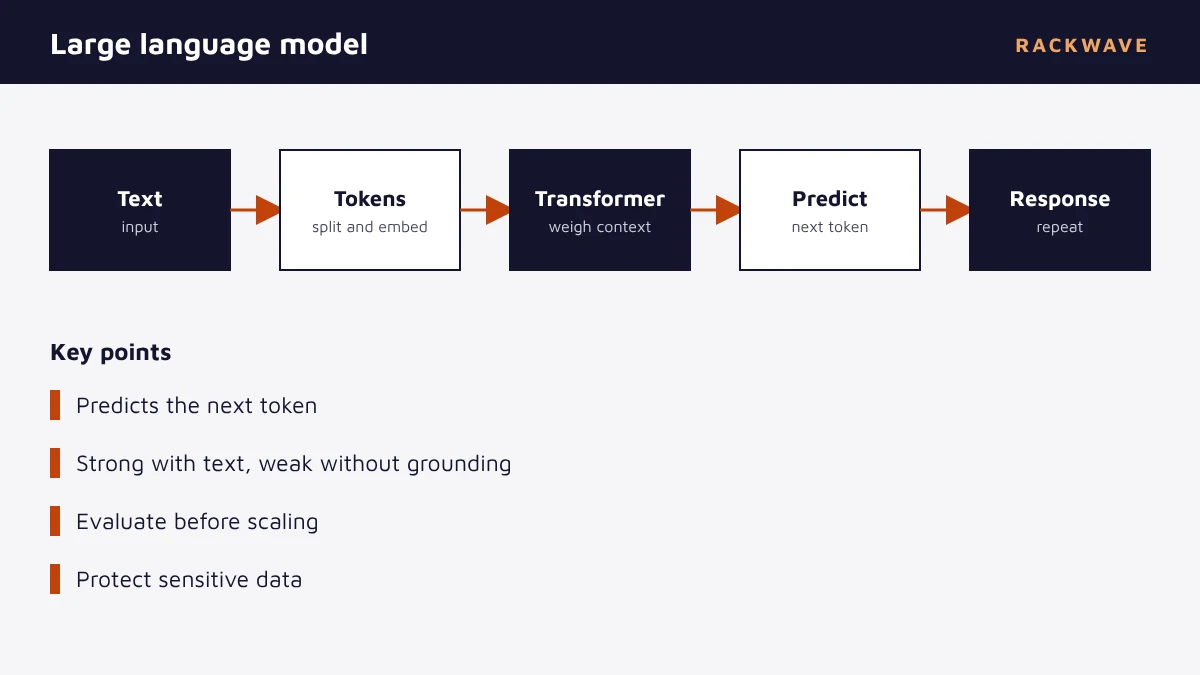
- Tokenisation. Text is split into tokens, which are pieces of words or characters, and each token is mapped to a number.
- Embeddings. Each token becomes a vector that captures aspects of its meaning, so related words sit close together.
- Transformer layers. Attention mechanisms let the model weigh which earlier tokens matter most for each new token, capturing context across long passages.
- Next token prediction. The model outputs a probability for every possible next token and one is chosen. The process repeats to produce a whole response.
- Pretraining. The model learns language, facts and patterns from vast text collections by predicting masked or next tokens.
- Fine tuning and alignment. Further training on instructions and human feedback makes the model more helpful, safe and consistent.
Key concepts
| Concept | Meaning | Why it matters |
|---|---|---|
| Token | A unit of text such as a word piece | Costs and limits are measured in tokens |
| Context window | How much text the model can consider at once | Limits document length and conversation memory |
| Parameters | The learned weights inside the model | Often billions, linked to capability and cost |
| Temperature | A setting that controls randomness | Low for factual tasks, higher for creative work |
| Hallucination | A fluent but false or invented statement | Needs grounding and verification |
| Prompt | The instructions and context given to the model. See what is prompt engineering | Strongly affects quality |
| Inference | Running the trained model to produce output | Drives latency and running cost |
What LLMs are good at
- Drafting and editing text, from emails to reports.
- Summarising long documents and extracting structured data from them.
- Answering questions over provided material. See what is RAG.
- Writing, explaining and reviewing code.
- Classifying and routing messages such as support tickets.
- Translation and tone adjustment.
- Acting as the reasoning core of tools that take actions. See what is agentic AI.
Limits and risks
| Limit | Explanation | Mitigation |
|---|---|---|
| Hallucination | The model can state falsehoods fluently | Ground answers in trusted sources, ask for citations, add review |
| Outdated knowledge | Knowledge stops at the training date | Retrieve current information at query time |
| Bias | Training data contains human bias | Test for fairness. See what is responsible AI |
| Privacy and data leakage | Sensitive data may be sent to or exposed by a model | Use approved services, redact data and set access controls |
| Prompt injection | Malicious text can try to override instructions | Validate inputs and limit what the model can do |
| Cost and latency | Large models are expensive and slower | Choose model size by task and cache results |
| Reasoning errors | Mistakes in maths, logic or multi-step tasks | Use tools, verification and human checks |
Ways to use an LLM in a business
| Approach | What you do | Best for |
|---|---|---|
| Prompting | Give clear instructions and examples | Fast start and many tasks |
| Retrieval augmented generation | Retrieve company documents and include them in the prompt | Answers grounded in private, current data |
| Fine tuning | Train further on your examples | Consistent style, format or specialised behaviour |
| Tool use and agents | Let the model call APIs and systems | Workflows that take actions |
| Custom or small models | Use a smaller model tuned for one job | Cost, latency or privacy needs |
How to start an LLM project safely
- Pick a narrow, valuable use case. Choose a task with clear success criteria, such as answering internal policy questions.
- Check the data. Decide what data the model may see and clean the knowledge sources.
- Prototype quickly. Test with real examples and measure accuracy, not just impressions.
- Build evaluation. Create a test set with expected answers and re-run it after every change.
- Add guardrails. Filter inputs and outputs, limit permissions and keep humans in the loop for risky actions.
- Deploy and monitor. Track quality, cost, latency and user feedback. See what is MLOps.
- Improve continuously. Update knowledge sources, prompts and models as needs change.
Common LLM mistakes
- Trusting outputs without verification in high stakes settings.
- Sending confidential data to services that are not approved for it.
- Building a demo that works on five examples and calling it production ready.
- Choosing the largest model for every task, which wastes money.
- Ignoring evaluation, so quality changes go unnoticed.
- No plan for who owns the system after launch.
Our AI and machine learning service designs and builds LLM applications with evaluation and guardrails, and our data analytics service prepares the data they depend on.
A worked example: an internal policy assistant
A professional services firm has hundreds of policy documents and staff spend hours asking colleagues about expenses, travel and contracts. The firm builds an assistant that answers questions in plain language. Rather than relying on what the model remembers, it retrieves the most relevant policy passages, passes them to the LLM with an instruction to answer only from them and shows the source links next to each answer.
The team creates two hundred test questions with approved answers, and scores the assistant on every change. Early versions sometimes gave a plausible but wrong amount for a travel allowance, so the team added a rule to quote figures directly from the source and to say when the policy does not cover a question. Staff time spent on policy questions falls substantially, and the human resources team reviews a weekly list of unanswered questions to improve the documents. The trust came from citations, testing and a clear way to escalate.
Choosing the right model for the task
Not every task needs the largest model. Smaller models respond faster and cost far less, and they often perform well on narrow jobs such as classification, extraction and routing. Larger models tend to be stronger at open ended reasoning, long documents and complex instructions. A practical approach is to test two or three model sizes on the same evaluation set and choose the cheapest one that meets your quality bar.
Also consider where the model runs. Hosted services are quick to adopt and improve constantly, while models run inside your own cloud account give tighter control over data location and access. Regulated organisations often choose the second option for sensitive workloads, and may use the first for lower risk tasks. Whatever you choose, record the decision, the data involved and the owner, so that audits and future changes are straightforward.
Key takeaways
- A large language model predicts the next token using a transformer trained on huge text data.
- LLMs write, summarise, classify, translate and reason over text, and can power assistants and agents.
- They can hallucinate, show bias and leak data, so grounding, evaluation and guardrails are essential.
- Prompting, retrieval, fine tuning and tools are the main ways to apply them.
- Start with a narrow use case and measure quality before scaling.
Quick glossary
| Term | Meaning |
|---|---|
| LLM | A large model trained to understand and generate language |
| Token | A piece of text processed by a model |
| Context window | The amount of text a model can use at once |
| Hallucination | A confident but incorrect output |
| Fine tuning | Further training on specialised examples |
Read next: What Is Fine-Tuning? Methods, Data and Costs · What Is Feature Engineering? Techniques and Workflow · What Is Explainable AI? Methods, SHAP and LIME
Frequently asked questions
What is a large language model in simple terms?
It is an AI system trained on huge amounts of text that can understand prompts and generate human like language, such as answers, summaries, code and translations.
How do large language models work?
They split text into tokens, convert them to vectors, process them with transformer layers that weigh context, and predict the next token repeatedly to produce a response.
What is the difference between an LLM and generative AI?
Generative AI covers systems that create text, images, audio or code. An LLM is a generative model focused on language and is one important type.
What is a hallucination in an LLM?
A hallucination is an output that sounds plausible but is false or unsupported. Grounding answers in trusted sources and verifying results reduces the risk.
Can LLMs use my company data?
Yes, usually through retrieval augmented generation or fine tuning, with proper access controls. Data should be shared only with approved, secure services.
What is a context window?
It is the maximum amount of text, measured in tokens, that a model can consider at once, including your prompt, documents and its own response.
Do I need to fine tune an LLM?
Often not. Good prompts and retrieval solve many problems. Fine tuning helps when you need a consistent style, format or specialised behaviour.
Are LLMs safe for business use?
They can be, with the right controls: approved platforms, data protection, evaluation, human review of risky outputs and monitoring after launch.