
What is agentic AI? It is a form of artificial intelligence in which a system does not just answer a prompt but pursues a goal: it plans steps, uses tools such as search, databases and business applications, observes the results and adapts until the task is done. An agentic system built on a large language model can, for example, research a topic, update a CRM record, draft and send a reply, and escalate to a person when it is unsure. Agentic AI promises large productivity gains, but it also raises new risks because the system can take actions. This guide explains how agents work, their building blocks, use cases, and how to deploy them safely.
Short answer: Agentic AI combines a language model that reasons and plans with tools that act, memory that retains context and guardrails that limit risk. It moves from AI that talks to AI that does, so it needs clear scope, permissions, monitoring and human approval for important actions.
What is agentic AI?
The intelligent agent article on Wikipedia gives the long standing definition of an agent as something that perceives its environment and acts to achieve goals. Today the term usually means an agent whose reasoning is provided by a large language model. It extends generative AI from creating content to completing workflows, and it often uses retrieval augmented generation to find the facts it needs.
How an AI agent works
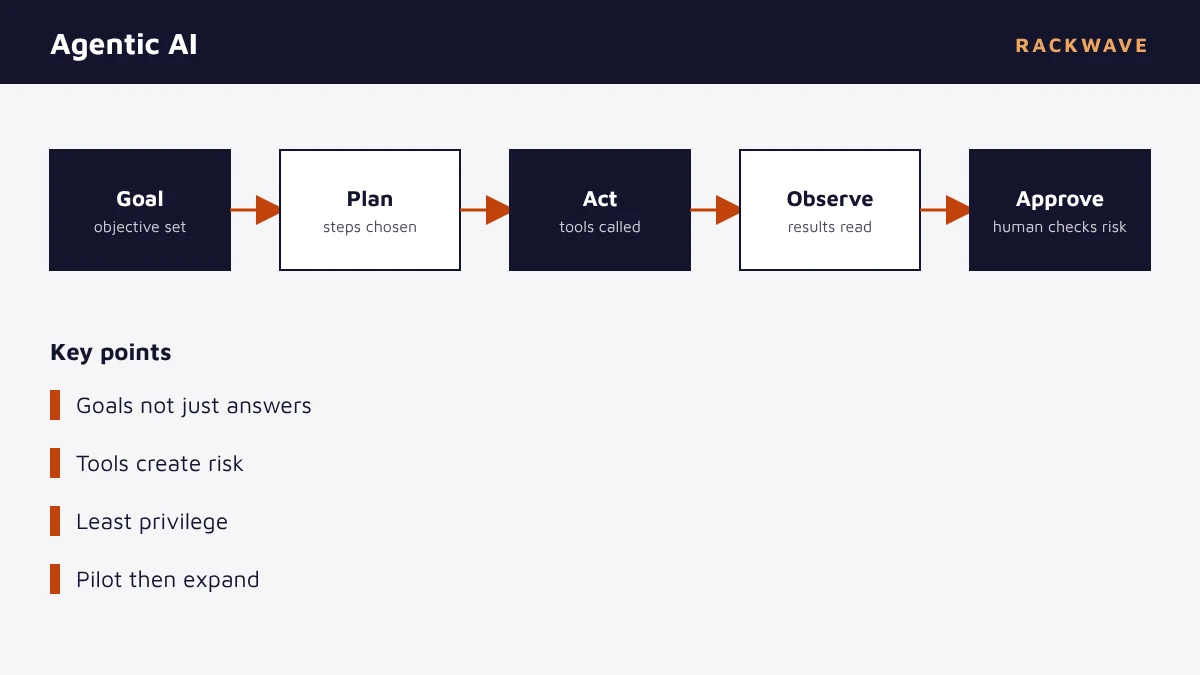
- Receive a goal. A user or system gives an objective, such as resolve this refund request.
- Plan. The model breaks the goal into steps and decides which tools to use.
- Act through tools. The agent calls APIs, queries databases, searches knowledge or runs code, within the permissions it has been given.
- Observe. It reads the result of each action, including errors.
- Reflect and adapt. It checks progress against the goal and revises the plan.
- Seek approval. For actions with risk or cost, it pauses and asks a person to confirm.
- Finish and log. It reports the outcome and records every step for audit.
Building blocks of an agentic system
| Component | Role | Design notes |
|---|---|---|
| Language model | Reasoning, planning and language | Choose size by task difficulty and cost |
| Tools and APIs | Let the agent act in business systems | Expose narrow, well described functions. See what is an API gateway |
| Knowledge and retrieval | Supplies facts and policies | Keep sources current and permissioned |
| Memory | Retains context across steps and sessions | Store only what is needed and protect it |
| Orchestration | Controls the flow and handoffs between agents | Prefer simple, testable workflows |
| Guardrails | Limit behaviour and validate outputs | Permissions, spend limits, content checks |
| Observability | Records prompts, tool calls and results | Essential for debugging and audit |
| Human oversight | Approval, review and override | Required for high impact actions |
Chatbot, workflow automation and agent compared
| Aspect | Chatbot | Fixed automation | Agent |
|---|---|---|---|
| Goal | Answer questions | Run a set sequence | Achieve an outcome |
| Flexibility | Limited to conversation | Rigid, rule based | Adapts steps to the situation |
| Uses tools | Rarely | Yes, as scripted | Yes, chosen dynamically |
| Predictability | High | Very high | Lower, needs guardrails |
| Best for | FAQs | Stable, repeatable processes | Variable tasks needing judgement |
Many tasks are better served by a fixed workflow with a language model at one or two steps than by a fully autonomous agent. Start with the simplest design that works and add autonomy only where it clearly pays.
Use cases for agentic AI
- Customer service: look up an order, check policy, issue a refund within limits and update the ticket.
- Sales and marketing: research accounts, draft outreach and update the CRM. See what is lead qualification.
- IT operations: investigate an alert, gather logs and propose or apply a fix.
- Finance operations: match invoices, flag exceptions and prepare approvals.
- Software engineering: write code, run tests and open pull requests for review.
- Research and analysis: collect sources, extract data and produce a structured summary.
Risks of agentic AI and how to manage them
| Risk | Example | Mitigation |
|---|---|---|
| Unintended actions | Agent deletes or sends the wrong thing | Least privilege, dry run mode, approval for irreversible actions |
| Prompt injection | Hidden text in a web page redirects the agent | Treat external content as untrusted, restrict tools |
| Hallucinated steps | Agent assumes a fact and acts on it | Require evidence from tools, verify before acting |
| Runaway cost or loops | Agent repeats calls endlessly | Step, time and spend limits |
| Data exposure | Agent reveals confidential data | Permission aware retrieval, output filters |
| Lack of accountability | Nobody owns an agent mistake | Named owner and full audit log |
How to deploy an agent step by step
- Pick a bounded process. Choose a task with clear steps, measurable outcomes and limited downside.
- Map the tools and permissions. List every system the agent touches and grant the minimum rights.
- Build a simple version. Begin with a workflow plus a model, and add autonomy gradually.
- Create an evaluation set. Use real cases with expected outcomes, including tricky and adversarial ones.
- Add guardrails and approvals. Set spending caps, allowed actions and human checks for sensitive steps.
- Pilot in shadow mode. Let the agent propose actions while people decide, and compare results.
- Go live and monitor. Track success rate, escalations, cost and incidents. See what is responsible AI.
Common agentic AI mistakes
- Giving an agent broad access because it is convenient.
- Launching without an evaluation set, so failures appear only in production.
- Using an agent where a simple rule based workflow would be cheaper and safer.
- Not logging tool calls, which makes incidents impossible to investigate.
- Forgetting that the agent reads untrusted content that may contain instructions.
- No plan for who maintains prompts, tools and knowledge after launch.
Our AI and machine learning service designs and builds governed agents, and our API development service creates the secure tools that agents call.
A worked example: a refund handling agent
An online retailer receives thousands of refund requests each week. Agents spend most of their time looking up orders, checking policy and updating records. The retailer builds an agent with four tools: order lookup, policy search, a refund function limited to a fixed amount and a ticket update. For refunds above the limit or with unusual patterns, the agent drafts a recommendation and routes it to a person.
In a four week shadow pilot, the agent proposes decisions for 2,000 requests and matches the human decision in 94 percent of cases. Most disagreements are edge cases in the policy, which the team clarifies. After launch, the agent resolves around two thirds of requests alone, and staff handle the rest with a complete case summary prepared for them. Every step is logged, a weekly sample is audited and the refund limit is raised gradually as confidence grows.
Multi-agent systems
Some solutions use several specialised agents that collaborate, for example one that researches, one that drafts and one that checks. This can improve quality and keeps each prompt focused, but it adds complexity, cost and more places for errors to hide. Define clear roles and hand off formats, limit the number of agents and steps, and trace the whole conversation so that you can see which agent made which decision. Start with one agent and split only when testing shows a clear benefit.
Key takeaways
- Agentic AI pursues goals by planning, using tools, observing results and adapting.
- It moves AI from producing text to taking actions in business systems.
- Value comes from variable tasks needing judgement, while stable processes may suit fixed automation.
- Manage risk with least privilege, approvals, limits, testing, logging and monitoring.
- Start small, pilot in shadow mode and expand autonomy as evidence builds.
Quick glossary
| Term | Meaning |
|---|---|
| Agent | A system that plans and acts to achieve a goal |
| Tool use | An agent calling APIs or functions to act |
| Guardrail | A control that limits what an agent can do |
| Shadow mode | Running an agent without letting it act, to compare with people |
| Orchestration | Coordinating steps, tools and agents |
Read next: What Is Fine-Tuning? Methods, Data and Costs · What Is Feature Engineering? Techniques and Workflow · What Is Explainable AI? Methods, SHAP and LIME
Frequently asked questions
What is agentic AI in simple terms?
It is AI that works toward a goal on its own, planning steps and using tools such as search and business applications, rather than only answering one question at a time.
How is agentic AI different from a chatbot?
A chatbot responds to messages. An agent plans, calls tools, takes actions and adapts to results until the task is complete.
Is agentic AI safe for business use?
It can be, with least privilege access, approvals for risky actions, spending limits, testing, logging and monitoring, and with named owners who are accountable.
What tools do AI agents use?
They use APIs, databases, search, code execution and business apps such as CRM, ticketing and finance systems, exposed as narrow, well described functions.
What is the difference between agentic AI and RPA?
Robotic process automation follows fixed scripted steps. Agentic AI reasons about the situation and chooses steps, so it handles variable, text heavy tasks better but needs stronger guardrails.
What is prompt injection in agents?
It is when untrusted content, such as a web page or email, contains hidden instructions that try to redirect the agent. Treat external content as untrusted and limit tool access.
Do I need multiple agents?
Not usually at first. Start with one agent or a workflow with model steps, and add more only when testing shows a clear benefit.
How do I measure an AI agent?
Track task success rate, accuracy against expected outcomes, escalation rate, cost per task, time saved and incidents, using a fixed evaluation set and live monitoring.