
What is lead qualification? It is the process of evaluating prospects to decide whether they are likely to become customers, so that sales teams spend their time on the right people. A qualified lead has a real need, the authority or influence to buy, a budget or a way to fund the purchase and a realistic timeline. Lead qualification sits between lead generation and the sales pipeline, and it protects revenue teams from wasting effort on poor fits while making sure strong prospects get fast, relevant attention. This guide explains the main qualification frameworks, how to build criteria and a scoring model, how marketing and sales should hand over leads and how to measure and improve the process.
Short answer: Lead qualification scores and screens prospects against agreed criteria, such as need, authority, budget, timing and fit, then routes qualified leads to sales and nurtures the rest. Clear definitions shared by marketing and sales are what make it work.
What is lead qualification?
The lead qualification article on Wikipedia (also known as sales qualification) describes it as the step that determines the quality of a prospect. It follows lead generation and feeds lead management and the sales pipeline. Good qualification reduces wasted calls, shortens the sales cycle and improves forecast accuracy.
The lead qualification process
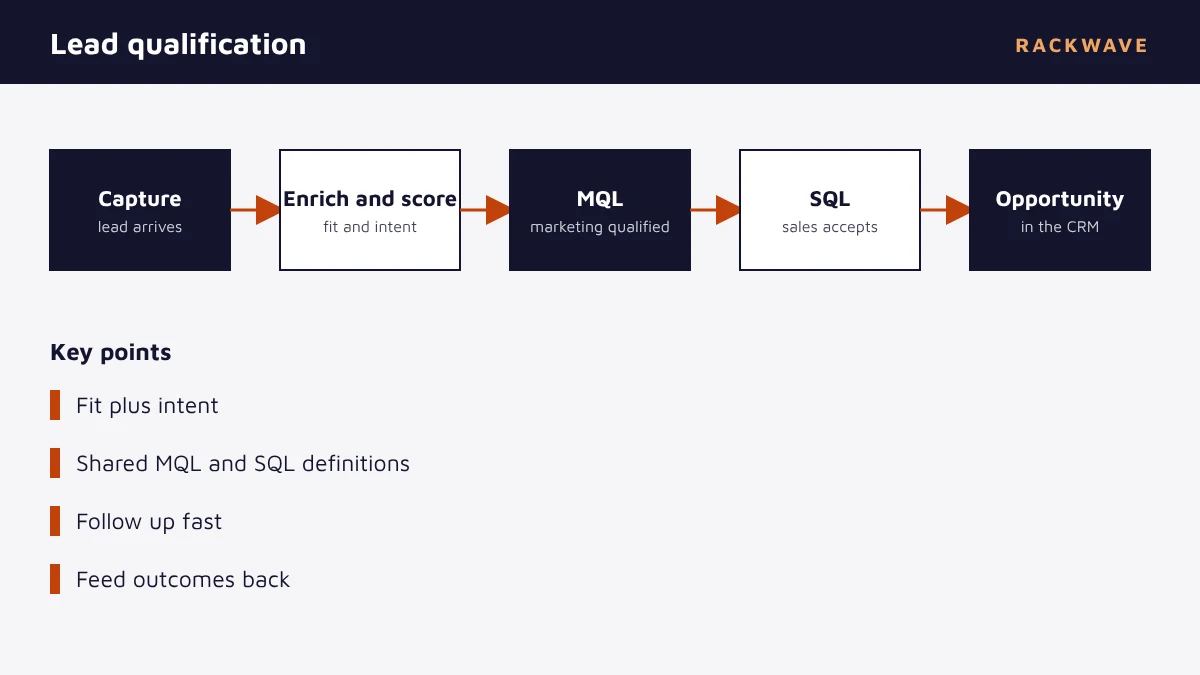
- Capture the lead. Collect contact details and context from forms, events, campaigns and referrals.
- Enrich and clean. Add company size, industry and role, and remove duplicates and invalid contacts.
- Score. Apply fit and engagement scoring. See lead scoring.
- Marketing qualifies. Leads that reach the threshold become marketing qualified leads, or MQLs.
- Sales reviews. A salesperson or development team contacts the lead and checks need, authority, budget and timing.
- Accept or return. Sales accepts a sales qualified lead, or SQL, or returns the lead to nurture with feedback. See lead nurturing.
- Convert to opportunity. Qualified leads become opportunities in the CRM with an owner and next step.
Popular qualification frameworks
| Framework | What it checks | Best for |
|---|---|---|
| BANT | Budget, authority, need, timeline | Simple, transactional or mid market sales |
| CHAMP | Challenges, authority, money, prioritisation | Pain led selling |
| MEDDICC | Metrics, economic buyer, decision criteria, decision process, identify pain, champion, competition | Complex enterprise deals |
| GPCTBA/C&I | Goals, plans, challenges, timeline, budget, authority, consequences, implications | Consultative, multi-stakeholder sales |
| FAINT | Funds, authority, interest, need, timing | Flexible alternative to BANT |
| ICP fit scoring | Match with the ideal customer profile | Account based and data driven teams |
Fit and intent: the two dimensions
| Dimension | Signals | Example |
|---|---|---|
| Fit (who they are) | Industry, size, role, region, technology used | Finance firm with 500 to 2,000 employees, IT director |
| Intent (what they do) | Pricing page visits, demo requests, repeat visits, content downloads | Visited pricing three times and asked for a demo |
| Timing | Trigger events, contract renewals, hiring, funding | New CIO in the last 90 days |
| Source quality | Channel and campaign | Referral versus cold list |
A high fit, high intent lead goes to sales immediately. High fit and low intent suggests nurturing. Low fit with high intent may need disqualifying or routing to a partner, and low on both is not worth sales time.
How to build lead qualification criteria
- Analyse won and lost deals. Find the attributes shared by customers who bought quickly and stayed.
- Define the ideal customer profile. Write down the industries, sizes, roles and needs you serve best.
- Choose a framework. Pick one that matches your sales motion, and adapt the questions to your product.
- Set scoring and thresholds. Assign points to fit and behaviour, and agree the score for an MQL.
- Write the service level agreement. Define how fast sales follows up and what feedback marketing receives.
- Automate in the CRM. Build scoring, routing and alerts into your CRM. See CRM implementation.
- Review monthly. Compare scores with outcomes and adjust the model.
Metrics for lead qualification
| Metric | What it shows |
|---|---|
| Lead to MQL rate | How well marketing attracts good fits |
| MQL to SQL rate | Agreement between marketing and sales |
| SQL to opportunity and win rate | Quality of qualified leads |
| Speed to lead | Time from capture to first contact |
| Sales cycle length | Whether qualification shortens the cycle. See sales cycle |
| Pipeline from qualified leads | Revenue impact |
Common lead qualification mistakes
- Passing every form fill to sales, flooding reps with weak leads.
- Rigid rules that reject good prospects who do not match one criterion.
- No shared definition of MQL and SQL between marketing and sales.
- Slow follow up that lets interested leads go cold.
- Never feeding sales outcomes back into the scoring model.
- Poor data quality, so scores are based on wrong information.
Our CRM and lifecycle service builds scoring, routing and nurture programmes, and our CRM implementation service configures them in your CRM.
A worked example: a software company
A B2B software company receives 2,000 leads a month, but sales complain that most are students and small businesses. Marketing and sales analyse two years of deals and find that wins concentrate in companies with 200 to 5,000 employees where the buyer is an operations or IT leader. They create fit scoring from company size, industry and role, and intent scoring from demo requests, pricing visits and product trial usage.
Leads scoring above the threshold become MQLs, and a development team calls them within one hour. Others enter a nurture programme. In three months, MQL to SQL conversion rises from 9 percent to 24 percent, sales spends fewer hours on poor fits and the win rate improves. A monthly review compares scores with outcomes, and the team lowers the weight of ebook downloads, which had little link to purchase, and raises the weight of trial usage.
Lead qualification in account based marketing
In account based approaches, qualification starts with the account rather than the individual. Teams score accounts on fit and on combined engagement from several contacts, because enterprise purchases involve committees. A single enthusiastic user does not make a qualified opportunity unless the account fits and a buying group is forming. Track the roles engaged, such as users, influencers and economic buyers, and prioritise outreach to missing roles. This keeps qualification aligned with how large organisations actually buy.
Handoff between marketing and sales
Most qualification failures happen at the handoff. Marketing believes it delivered strong leads, sales believes they were poor and nobody can prove which is right. Fix this with a written agreement that defines the lead stages, the information every handed over lead must carry, the maximum time for follow up and the reasons sales may return a lead. Make rejection reasons mandatory and structured, such as wrong industry, no budget or no response, so that marketing can see patterns and adjust campaigns and scoring.
Hold a short joint review each month with the same dashboard for both teams, covering volumes, conversion, speed and rejection reasons. Shared numbers turn blame into improvement. Add qualified leads to the sales forecast only after they pass agreed criteria, which keeps the pipeline honest and supports better sales forecasting.
Finally, train new reps on the framework and the questions behind it, and record calls or notes so that managers can coach. Qualification is a skill as well as a process, and consistent conversations produce reliable data in the CRM.
Key takeaways
- Lead qualification decides which prospects deserve sales attention based on fit, need, authority, budget and timing.
- Frameworks such as BANT and MEDDICC give structure, and ICP fit scoring adds data.
- Combine fit and intent signals and agree MQL and SQL definitions between marketing and sales.
- Automate scoring and routing in the CRM, with fast follow up and clear feedback loops.
- Measure conversion by stage and adjust the model with real outcomes.
Quick glossary
| Term | Meaning |
|---|---|
| MQL | Marketing qualified lead, ready for sales review |
| SQL | Sales qualified lead accepted by sales |
| ICP | Ideal customer profile |
| BANT | Budget, authority, need, timeline |
| Speed to lead | Time taken to contact a new lead |
Read next: What Is Lead Routing? Methods, Rules and Metrics · What Is a Sales Playbook? Contents and How to Build · What Is Account Planning? Template and Best Practices
Frequently asked questions
What is lead qualification in simple terms?
It is deciding which prospects are most likely to buy, using agreed criteria, so that salespeople focus on the best opportunities and others are nurtured.
What is the difference between an MQL and an SQL?
An MQL is marketing qualified, based on fit and engagement. An SQL has been reviewed and accepted by sales as a real sales opportunity.
What is BANT?
BANT stands for budget, authority, need and timeline, a classic framework for judging whether a prospect is worth pursuing.
How is lead qualification different from lead scoring?
Scoring assigns points to leads automatically. Qualification is the wider process that uses scores and human conversations to decide whether a lead is sales ready.
What is a good lead qualification framework for enterprise sales?
MEDDICC is popular for complex enterprise deals because it covers metrics, economic buyer, decision process, pain and champion, not only budget.
How fast should sales follow up on qualified leads?
As fast as possible. Many teams aim for minutes to one hour for high intent leads, because response speed strongly affects conversion.
What do you do with unqualified leads?
Nurture them with relevant content and monitor engagement, and re-qualify them when their behaviour or circumstances change.
How do you improve lead qualification?
Analyse won and lost deals, refine the ideal customer profile and scoring, agree service levels, fix data quality and review conversion rates every month.