
What is account planning? Account planning is the structured process of researching a customer or target account, understanding its goals, stakeholders and challenges, and creating a documented plan to grow the relationship, win new business and retain existing revenue. It is used mainly in B2B and enterprise sales, key account management and customer success, where a few large accounts represent a big share of revenue. A good account plan sets objectives, maps decision makers, identifies opportunities and risks, defines actions with owners and dates and is reviewed regularly. This guide explains what an account plan contains, how to build one step by step, the tools and CRM data that support it, how to measure results and the mistakes that make plans shelfware.
Short answer: Account planning turns knowledge of a customer into a shared, actionable plan: who matters, what they need, where we can add value and what we will do next, reviewed on a regular cadence.
What is account planning?
Account planning is a core practice of strategic selling and relates closely to account based marketing, customer success and customer lifecycle management. It informs the sales pipeline and sales forecasting, and sits alongside a sales playbook and territory management.
What an account plan contains
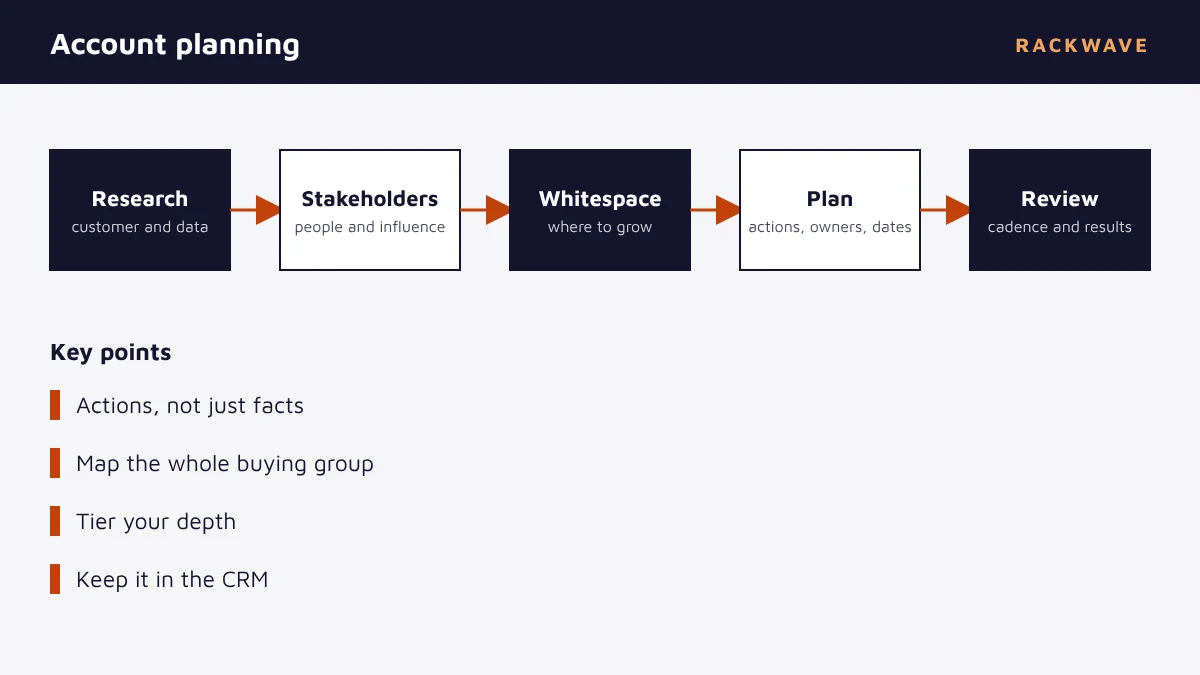
| Section | Content |
|---|---|
| Account snapshot | Industry, size, structure, revenue history, products owned |
| Customer goals and challenges | Strategic priorities, initiatives, pain points |
| Stakeholder map | Decision makers, influencers, champions, blockers and relationship strength |
| Whitespace analysis | Products, teams and regions not yet served |
| Opportunities | Specific deals with value, stage and timing |
| Competitive landscape | Rival vendors and our position |
| Risks | Renewal, budget, leadership change, service issues |
| Value proposition | How we help them achieve their goals |
| Action plan | Steps, owners, dates and success measures |
| Governance | Review cadence, executive sponsor, reporting |
Which accounts need a plan?
| Tier | Typical criteria | Planning depth |
|---|---|---|
| Strategic accounts | Top revenue or potential, complex buying groups | Full plan, executive sponsor, quarterly review |
| Key accounts | Large or growing customers | Standard plan, reviewed twice a year |
| Growth accounts | High potential but under served | Focused whitespace plan |
| Scale accounts | Many smaller customers | Lightweight, playbook and automation driven |
How to build an account plan
- Choose the account and the objective. Decide whether the aim is to win, expand, retain or defend the account.
- Research the customer. Review annual reports, news, strategy, technology and organisation, and combine with CRM history.
- Map stakeholders. Identify roles, influence, interests and the strength of each relationship.
- Find whitespace and opportunities. Compare their needs and structure with what they buy from you today.
- Define the value proposition. Link your offer to their goals with measurable outcomes.
- Assess risks and competitors. List threats and how to reduce them.
- Write the action plan. Set specific actions, owners, dates and executive support.
- Review and update. Check progress regularly and share results with the account team.
Using the CRM and data for account planning
- Account hierarchies and contact roles show who is involved and where.
- Opportunity history reveals buying patterns and cycle times.
- Product and usage data highlights adoption and expansion signals. See customer health score
- Support history and satisfaction flag risk. See customer satisfaction
- Enriched firmographic data adds structure and news. See what is data enrichment
- Dashboards show account coverage, penetration and pipeline. See what is CRM analytics
Measuring account planning success
| Metric | What it shows |
|---|---|
| Revenue growth per planned account | Impact of planning |
| Net revenue retention | Expansion minus churn and contraction |
| Whitespace penetration | Share of potential covered |
| Number of engaged stakeholders | Relationship breadth |
| Plan completion and review rate | Process discipline |
| Win rate and cycle time on account opportunities | Sales effectiveness |
Common mistakes
- Treating the plan as a one off document that is never updated.
- Filling it with facts about the customer and no actions.
- Mapping only one champion instead of the whole buying group.
- Planning every account at the same depth.
- Keeping the plan in a private file instead of the CRM and team review.
- Ignoring risks until the renewal is already in trouble.
Our CRM implementation service sets up account hierarchies, planning templates and dashboards, and our CRM and lifecycle service aligns sales and customer success plans.
A worked example: growing a strategic account
A technology vendor has a manufacturing customer that buys one product for one plant, worth about 400,000 a year. The account team builds a plan: they map twelve stakeholders across operations, IT and finance, find that three other plants and a new digital programme are not served and discover that the chief operating officer wants faster reporting across sites.
They agree a value proposition around plant to plant visibility, line up an executive sponsor, schedule a workshop and build a roadmap of three phased opportunities. Within eighteen months the account grows to 1.6 million a year, with a multi year agreement. Quarterly reviews update the stakeholder map after a leadership change and add a risk plan for a competitor visiting the customer.
Account planning for customer success and renewals
Account planning is not only a sales tool. Customer success managers use it to align on the customer outcomes that justify renewal, to schedule business reviews and to track adoption milestones. A joint plan shared with the customer, often called a success plan or mutual action plan, builds accountability on both sides and makes renewals a review of delivered value rather than a negotiation about price.
Cadence, governance and team roles
Plans work when they are discussed. Set a review rhythm that matches the tier of the account, give each plan an executive sponsor for strategic accounts and make one person accountable for keeping it current. Use short account review meetings with a consistent agenda: what changed, what moved, what is blocked and what help is needed. Keep the plan in the CRM so sales, success, services and leadership see the same information.
Questions that deepen an account plan
- What are the customer top three business priorities for the next twelve months, and how do we help with each?
- Who funds, who decides, who uses and who can block a purchase?
- Which executive on our side has a real relationship with someone senior on theirs?
- What would make the customer renew early or expand without a competitive process?
- What could cause us to lose the account in the next year, and what are the early warning signs?
- Which success stories from similar customers would resonate most?
Use these prompts in team workshops. The answers expose gaps in knowledge, and the gaps become the first actions in the plan, such as arranging an executive introduction or running a discovery session with a neglected department.
Account planning in a CRM: practical setup
Make the plan visible where the team already works. Create fields or a related object for objectives, risks and next steps, use contact roles for the stakeholder map, link opportunities to plan initiatives and build a dashboard that shows plan status, last review date and pipeline per strategic account. Automated reminders for overdue reviews, and a simple scoring of relationship strength, keep the process light while still giving leadership an honest view across the account base.
Key takeaways
- Account planning is a structured, documented plan to win, grow and retain important customers.
- It combines customer research, stakeholder maps, whitespace, opportunities, risks and dated actions.
- Focus depth on strategic and key accounts and use lighter plans for the rest.
- Keep plans in the CRM and review them on a regular cadence.
- Measure revenue growth, retention, whitespace penetration and stakeholder coverage.
Quick glossary
| Term | Meaning |
|---|---|
| Whitespace | Potential revenue not yet captured in an account |
| Stakeholder map | A view of the people involved in decisions and their influence |
| Mutual action plan | A shared plan of steps agreed with the customer |
| Net revenue retention | Revenue from existing customers including expansion and churn |
| Executive sponsor | A senior leader responsible for an account relationship |
Read next: What Is Lead Routing? Methods, Rules and Metrics · What Is a Sales Playbook? Contents and How to Build · What Is Sales Operations? Roles, Metrics and Tools
Frequently asked questions
What is account planning in simple terms?
It is creating a written plan for an important customer that sets goals, maps the people involved, finds opportunities and lists the actions the team will take.
What should be in an account plan?
An account snapshot, customer goals, stakeholder map, whitespace, opportunities, competitors, risks, value proposition and a dated action plan.
Which accounts need an account plan?
Strategic and key accounts that carry high revenue or potential, with lighter plans for growth accounts and automated approaches for smaller ones.
How often should account plans be reviewed?
Strategic accounts are usually reviewed quarterly, others twice a year, with updates whenever something significant changes.
What is the difference between account planning and territory planning?
Territory planning allocates accounts and coverage across reps. Account planning develops a detailed strategy for individual accounts.
How does account planning relate to account based marketing?
ABM focuses marketing programmes on target accounts. Account planning ensures sales and success actions for those accounts are coordinated.
What tools help with account planning?
A CRM with account hierarchies and contact roles, enrichment data, analytics dashboards and shared planning templates.
How do I measure account planning success?
Look at revenue growth and retention in planned accounts, whitespace penetration, stakeholder coverage and review discipline.