
What is data enrichment? Data enrichment is the process of improving and extending the records you already hold by adding missing, updated or additional information from internal and external sources. A contact record that only has an email address can be enriched with job title, company, industry, size, location and technology use. Enrichment makes customer and prospect data more complete, accurate and useful for segmentation, lead routing, scoring, personalisation, analytics and compliance. It is a core part of CRM data management, marketing operations and master data programmes. This guide explains how data enrichment works, the main types and sources, how it differs from data cleansing, how to implement it responsibly and how to measure its value.
Short answer: Data enrichment adds missing or fresher attributes to existing records from reliable sources, so teams can segment, route, score and personalise with confidence. Done well, it improves both data quality and revenue outcomes.
What is data enrichment?
Enrichment complements data cleansing and supports data quality and master data management. It feeds lead scoring, customer segmentation and lead routing, and is a common step in data integration and CRM data migration.
Types of data enrichment
| Type | Attributes added | Used for |
|---|---|---|
| Firmographic | Industry, size, revenue, ownership, headquarters | B2B segmentation and territory assignment |
| Demographic | Job title, seniority, department, location | Persona targeting and routing |
| Technographic | Technology stack and tools in use | Fit scoring and messaging |
| Behavioural and intent | Website activity, content interest, buying signals | Prioritising outreach |
| Geographic | Address standardisation, region, coordinates | Territory and logistics |
| Contact validation | Email and phone validity, deliverability | Protecting sender reputation |
| Social and public | Public profiles and news | Context for conversations |
| Hierarchy and relationships | Parent and subsidiary links | Account based programmes |
Data enrichment versus data cleansing and data appending
| Term | What it does |
|---|---|
| Data cleansing | Fixes errors, removes duplicates and standardises existing values |
| Data enrichment | Adds or updates attributes to make records more complete and useful |
| Data appending | Adds specific fields, such as phone numbers, from external sources |
| Data validation | Checks whether values are correct and usable |
| Data matching | Links records across sources so enrichment applies to the right entity |
Sources of enrichment data
- First party data from forms, product usage, support and billing.
- Second party data shared by partners under agreement.
- Third party providers of firmographic, contact and intent data.
- Public registries, company filings, domain and web data.
- Internal systems such as ERP, finance and marketing platforms.
- AI based extraction and classification from websites and documents.
How to implement data enrichment
- Define the use case. Decide which decisions need better data, such as routing, scoring or segmentation.
- Audit current data. Measure completeness, accuracy and duplicates in key objects and fields.
- Choose fields and sources. Select a small set of valuable attributes and evaluate providers on coverage, accuracy and freshness.
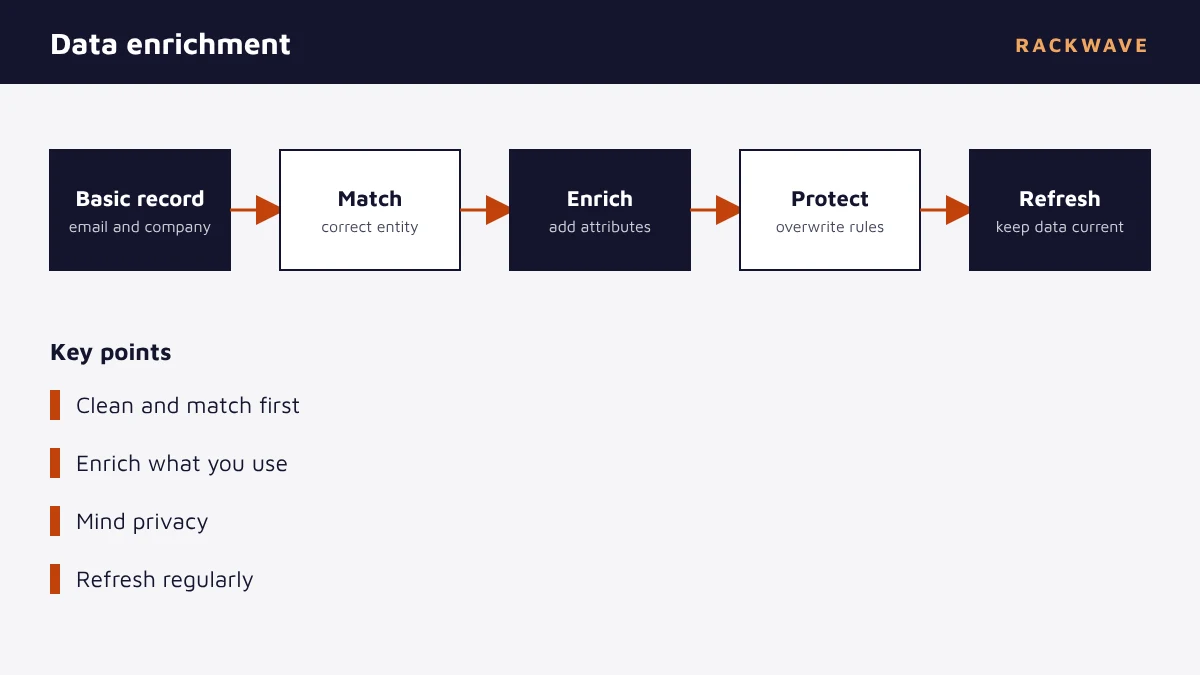
- Match and clean first. Deduplicate and standardise so enrichment attaches to the correct record.
- Set rules for overwriting. Define which source wins, what is protected from change and how conflicts are logged.
- Automate and schedule. Enrich on capture and refresh periodically, with monitoring for failures and costs.
- Measure and review. Track fill rates, accuracy, bounce rates and conversion impact.
Privacy, consent and compliance
| Consideration | Practice |
|---|---|
| Lawful basis and consent | Confirm you may process and enrich personal data under applicable law. See what is GDPR |
| Transparency | Describe enrichment in your privacy notice |
| Data minimisation | Add only attributes you need and will use |
| Provider diligence | Check how providers collect data and whether it is lawful |
| Opt outs and deletion | Honour requests across enriched copies |
| Retention | Set refresh and deletion schedules |
Common mistakes
- Enriching before cleaning and matching, which attaches data to the wrong records.
- Buying large volumes of fields nobody uses.
- Letting enrichment overwrite values that reps or customers entered correctly.
- Treating third party data as always accurate without sampling.
- Ignoring decay: contact and company data goes stale every year.
- Neglecting privacy and consent requirements.
Our data governance service defines quality and privacy rules for enrichment, and our CRM implementation service builds the matching and automation in your CRM.
A worked example: enrichment for lead routing
A software company receives form leads with only name, email and company. Reps cannot tell which are enterprise prospects, and routing is manual. The team defines the fields it needs: company size, industry, country and technology stack. It cleans and matches records by domain, enriches new leads at capture from a provider and fills gaps for existing accounts overnight.
Rules protect fields that reps have edited. With size and country available instantly, routing and scoring work automatically, enterprise leads reach senior reps within minutes and personalised messages reflect the lead technology. Sample checks find 92 percent accuracy for size and industry, and the team reviews provider performance each quarter before renewal.
Keeping enriched data fresh
Data decays as people change jobs, companies merge and addresses move. Plan refresh cycles by data type, for example quarterly for firmographics and more often for contact validity, and prioritise active accounts and open opportunities. Track the age of enriched fields, store source and timestamp with each value and monitor bounce rates and returned mail as early warnings. Freshness is as important as completeness, and a field that looks full but is a year old can mislead.
Measuring the value of enrichment
Connect enrichment to outcomes. Measure the change in field completeness, the accuracy of sampled values, email bounce rates, lead response time, conversion from lead to opportunity and revenue influenced by enriched segments. Compare enriched and non enriched groups where possible, and include provider cost and maintenance effort in the return calculation. If a field does not change a decision or an outcome, stop paying for it.
Choosing an enrichment provider
Evaluate providers with a test, not a demo. Send a representative sample of your own records, including hard cases such as small companies and non US contacts, and measure match rate, accuracy against a verified sample and the age of the data returned. Ask how data is sourced, how often it is refreshed, what consent and compliance controls exist and how deletion requests are handled. Compare pricing models, such as per record, per credit or subscription, against your realistic volumes, and check how easily the service connects to your CRM and data warehouse.
Avoid lock in by storing source and timestamp for each enriched field and keeping your own matching keys, so that you can switch or combine providers without rebuilding your data.
Enrichment with AI and web data
AI can read company websites, job pages and public documents to classify industries, extract products and summarise what a company does, filling gaps that databases miss. These methods are flexible but need validation: sample outputs, record confidence levels and keep a human review step for high value accounts. Respect website terms and privacy rules when collecting data, and store the source of each extracted fact so that errors can be traced and corrected.
Key takeaways
- Data enrichment adds missing or updated attributes to existing records from reliable sources.
- It powers segmentation, routing, scoring, personalisation and analytics.
- Clean and match records first, set overwrite rules and refresh data regularly.
- Respect privacy, consent and minimisation requirements.
- Measure accuracy and business impact, and drop fields that do not drive decisions.
Quick glossary
| Term | Meaning |
|---|---|
| Firmographic data | Facts about companies such as industry and size |
| Technographic data | Information about the technology a company uses |
| Data decay | The gradual loss of accuracy as real world details change |
| Entity matching | Linking records that refer to the same person or company |
| Intent data | Signals that show interest in a topic or purchase |
Read next: What Is Lead Routing? Methods, Rules and Metrics · What Is a Sales Playbook? Contents and How to Build · What Is Account Planning? Template and Best Practices
Frequently asked questions
What is data enrichment in simple terms?
It is adding useful information, like job title or company size, to the records you already have so they are more complete and accurate.
How is data enrichment different from data cleansing?
Cleansing fixes errors and duplicates in existing data. Enrichment adds new or updated attributes from other sources.
What are the types of data enrichment?
Firmographic, demographic, technographic, behavioural and intent, geographic and contact validation data are the main types.
Why is data enrichment important?
It improves segmentation, lead routing, scoring and personalisation, and reduces manual research and wasted outreach.
Is data enrichment legal?
It can be, but you must have a lawful basis, be transparent, minimise data and respect rights under laws such as GDPR. Check provider practices too.
How often should I enrich data?
Enrich at capture and refresh on a schedule based on how quickly each attribute changes, often quarterly or more frequently for active accounts.
How accurate is enriched data?
It varies by provider and field. Sample and test accuracy, and set rules for how to handle conflicts with existing values.
How do I measure the ROI of enrichment?
Track completeness, accuracy, bounce rate, response time and conversion changes, and compare against provider and maintenance costs.