
What is explainable AI? Explainable AI, often shortened to XAI, is a set of methods and practices that make the decisions of machine learning models understandable to humans. Instead of treating a model as a black box that outputs a score, explainability shows which inputs drove a prediction, how the model behaves overall and where it is likely to be wrong. It supports trust, debugging, regulatory compliance and fair outcomes, especially in lending, hiring, healthcare, insurance and public services. This guide explains why explainability matters, the main techniques such as SHAP and LIME, how global and local explanations differ, how to apply XAI in a project and its limits.
Short answer: Explainable AI makes model decisions transparent by showing which factors influenced an output and how the model works. It helps teams debug models, meet regulation, detect bias and earn user trust.
What is explainable AI?
The explainable artificial intelligence article on Wikipedia describes methods that let people understand and trust the results of machine learning. It is a pillar of responsible AI and applies to machine learning models, including neural networks and large language models, where internal logic is hard to read.
Why explainability matters
- Trust: users and staff accept recommendations they can understand.
- Debugging: explanations reveal wrong features, leakage and spurious patterns.
- Compliance: regulations such as the EU AI Act and GDPR rules on automated decisions expect meaningful information about logic. See what is GDPR
- Fairness: explanations help detect bias and proxy variables.
- Accountability: reviewers can challenge and correct decisions.
- Adoption: front line teams act on scores when they see reasons.
Interpretable models versus post hoc explanations
| Approach | Examples | Strength | Limit |
|---|---|---|---|
| Interpretable by design | Linear and logistic regression, decision trees, rule lists, scorecards | Transparent logic | May be less accurate on complex data |
| Post hoc, model agnostic | LIME, SHAP, partial dependence, permutation importance | Works with any model | Approximations, can mislead |
| Model specific | Attention maps, gradient methods, tree path analysis | Uses model internals | Tied to one model type |
| Counterfactual explanations | What minimal change would flip the outcome | Actionable for individuals | Must be realistic and fair |
| Example based | Similar past cases, prototypes | Intuitive | Needs good similarity measures |
Global and local explanations
| Level | Question answered | Typical output |
|---|---|---|
| Global | How does the model behave overall? | Feature importance, partial dependence plots |
| Local | Why did the model decide this for this case? | SHAP values, LIME weights, reason codes |
| Counterfactual | What would change the decision? | Minimum changes to inputs |
| Data level | Is the training data sound? | Data documentation, drift and bias reports |
Common explainability techniques
| Technique | Idea | Good for |
|---|---|---|
| SHAP | Shapley values give each feature a fair share of a prediction | Consistent local and global views |
| LIME | Fits a simple model around one prediction | Quick local explanations |
| Permutation importance | Measures drop in accuracy when a feature is shuffled | Global ranking |
| Partial dependence and ICE | Shows effect of a feature on predictions | Understanding relationships |
| Saliency and attention | Highlights input regions used | Images and text, with caution |
| Model cards | Document purpose, data, performance and limits | Governance and communication |
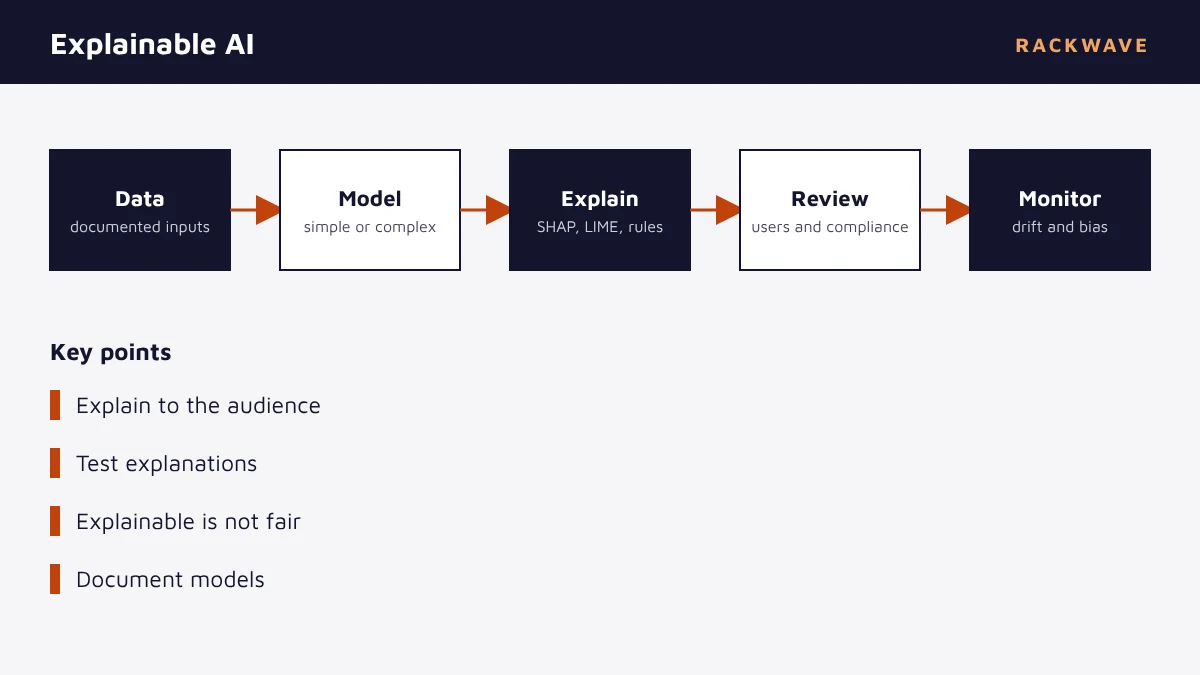
How to apply explainable AI in a project
- Decide who needs which explanation. Regulators, customers, analysts and engineers need different detail.
- Prefer simple models where they are enough. Start with an interpretable baseline before using complex models.
- Add explanation methods. Use SHAP or similar for complex models and validate them for stability.
- Test explanations with users. Check that reason codes make sense and lead to correct action.
- Check fairness. Compare outcomes and explanations across groups.
- Document and monitor. Keep model cards, log decisions and track drift in explanations.
Limits and risks of explanations
- Post hoc explanations approximate the model and can be unstable or misleading.
- Correlated features split credit in confusing ways.
- Explanations can create false confidence if not validated.
- Revealing too much can expose the model to gaming.
- Generative models need different approaches, such as source citations and evaluation. See what is AI hallucination
- Explainability is not fairness: a clear model can still be biased.
Our AI and machine learning service builds models with explanation and monitoring from the start, and our data governance service covers documentation and accountability.
A worked example: explaining a credit decision
A lender uses a gradient boosted model to score loan applications. Regulators and customers require clear reasons for declines. The team computes SHAP values for each decision and maps the top contributing features, such as high utilisation, short credit history or recent missed payments, to plain language reason codes reviewed by compliance. Applicants receive these reasons, and underwriters see the same view when reviewing referrals.
Global analysis finds that one postcode derived feature acts as a proxy for a protected attribute, so the team removes it and retrains with little loss of accuracy. Counterfactual guidance tells declined applicants which realistic changes, such as lower utilisation, would improve eligibility. Explanations are logged with each decision and reviewed quarterly for drift.
Explainability for generative AI
Large language models do not offer simple feature attributions, so explainability looks different. Practical approaches include retrieval with source citations so users can verify claims, structured outputs that expose intermediate steps, evaluation against curated test sets and clear statements of limitations. Logging prompts, retrieved documents and outputs supports audit. Be careful with model written explanations of their own reasoning, because they may sound convincing without reflecting the true internal process.
Governance, regulation and documentation
Explainability requirements depend on risk. High impact decisions about credit, employment, insurance and healthcare usually demand stronger transparency, human oversight and records than low risk recommendations. Maintain model cards and data sheets, assign an accountable owner, define when a human can override the model and review explanation quality as part of regular model validation. Treat explanations as a product for real users, tested for clarity and usefulness, not only as a technical report.
Choosing the right level of explanation for each audience
| Audience | Needs | Format |
|---|---|---|
| Customer or applicant | Plain reasons and what they can change | Short reason codes and next steps |
| Front line agent | Why the score is high or low | Top factors in the workflow screen |
| Risk and compliance | Evidence of fairness and stability | Validation reports, model cards |
| Data scientist | Feature behaviour and errors | SHAP plots, partial dependence, error slices |
| Regulator or auditor | Documentation and decision logs | Full model documentation and records |
One explanation rarely fits everyone. Build a small library of explanation formats and test each with real users. A reason that satisfies a data scientist may confuse a customer, and a simplified message must still be faithful to what the model actually did.
Monitoring explanations in production
Models and data change, and so do explanations. Track the distribution of feature contributions over time. A sudden shift, such as a feature that never mattered becoming dominant, often signals a data pipeline fault, drift or an attack. Sample decisions for periodic human review, compare outcomes across groups and keep explanation logs long enough to answer complaints and audits.
Key takeaways
- Explainable AI shows why a model made a prediction and how it behaves overall.
- Use interpretable models where they suffice and SHAP, LIME or counterfactuals for complex ones.
- Tailor explanations to regulators, customers and engineers, and test them with users.
- Explanations are approximations and do not guarantee fairness.
- Document models and monitor explanations over time.
Quick glossary
| Term | Meaning |
|---|---|
| XAI | Explainable artificial intelligence |
| SHAP | Shapley value based feature attribution |
| LIME | Local interpretable model agnostic explanations |
| Counterfactual | A minimal change that would alter the outcome |
| Model card | A document describing a model purpose, data and limits |
Read next: What Is Fine-Tuning? Methods, Data and Costs · What Is Feature Engineering? Techniques and Workflow · What Is an Embedding? Vectors, Similarity, Use Cases
Frequently asked questions
What is explainable AI in simple terms?
It is making AI decisions understandable, so people can see why a model produced a result and judge whether to trust it.
Why is explainable AI important?
It builds trust, helps debug models, supports regulation and reveals bias, which is vital for decisions that affect people.
What is the difference between interpretable and explainable AI?
Interpretable models are understandable by design, such as decision trees. Explainable AI also covers methods that explain complex models after training.
What are SHAP and LIME?
Both are model agnostic techniques. SHAP uses Shapley values to attribute a prediction to features, and LIME fits a simple local model around one prediction.
Does explainability make a model fair?
No. It helps to detect unfairness, but fairness requires separate testing, data review and governance.
Is explainable AI required by law?
Some rules, such as GDPR provisions on automated decisions and the EU AI Act for high risk systems, expect transparency, depending on use case and region.
Can large language models be explained?
Only partly. Practical methods include source citations, structured outputs, evaluation and logging rather than simple feature attributions.
Do explanations reduce accuracy?
Post hoc methods do not change the model. Choosing a simpler interpretable model may lower accuracy slightly, so test both on your data.