
What is an ESB? An enterprise service bus is a middleware architecture that connects applications by acting as a central communication layer, routing messages between systems, transforming data formats, applying business rules and handling protocols so that each application does not have to connect directly to every other. For many large organisations, an ESB was the backbone of service oriented architecture, linking ERP, CRM, billing, mainframes and partner systems. Today, API led connectivity, event streaming and iPaaS platforms have changed how integration is done, but ESBs still run critical workloads. This guide explains how an ESB works, its strengths and weaknesses, how it compares with modern alternatives, and how to decide whether to keep, modernise or replace one.
Short answer: An ESB is a central integration hub that routes, transforms, secures and monitors messages between applications. It reduces point to point connections, but a heavily centralised bus can become a bottleneck, so many organisations are moving to distributed, API and event based integration.
What is an ESB?
The enterprise service bus article on Wikipedia describes the pattern, which grew in the 2000s with service oriented architecture. Instead of building many direct links between applications, each system connects once to the bus, which handles delivery and translation. It is one of several approaches described in what is system integration.
How an ESB works
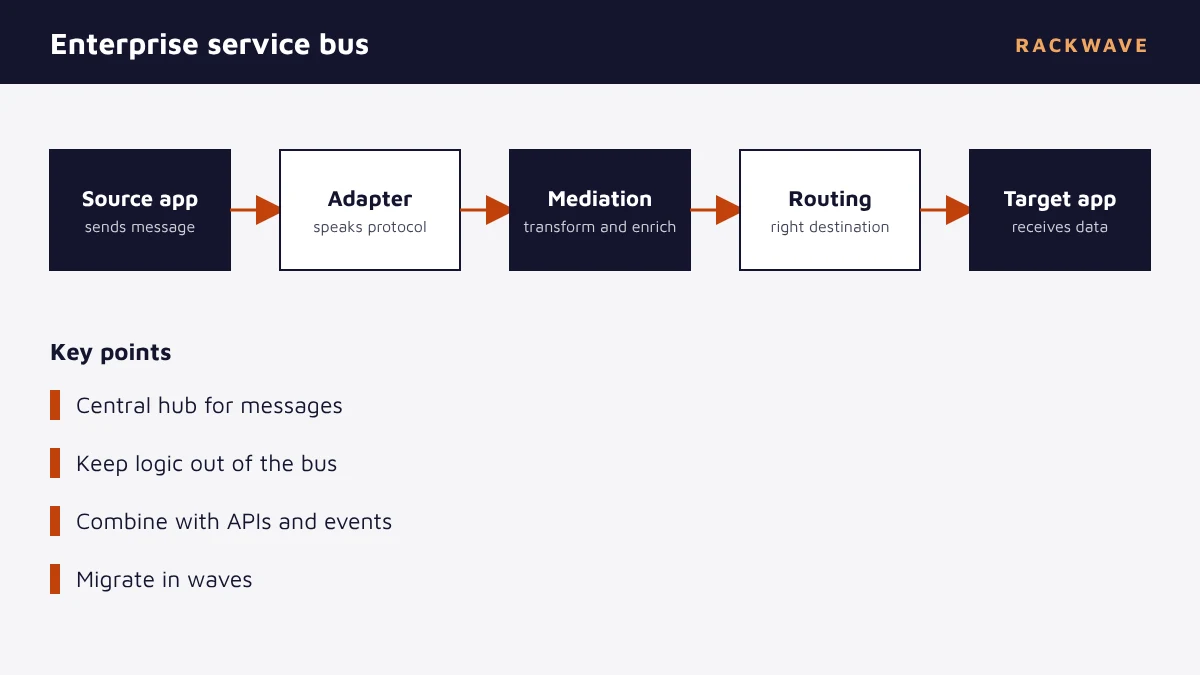
- A source application sends a message. For example, the CRM publishes a new order in its own format.
- The bus receives it through an adapter. Adapters or connectors speak the protocol of each system, such as REST, SOAP, JMS or files.
- Mediation applies. The bus validates, enriches and transforms the message into the format the target needs.
- Routing decides the destination. Rules route the message to one or several systems based on content.
- Delivery with reliability. Queues, retries and acknowledgements make sure that messages are not lost.
- Security and policy are enforced. Authentication, authorisation and encryption are applied centrally.
- Monitoring records the flow. Logs and dashboards show message status and errors.
Core capabilities of an ESB
| Capability | What it does | Example |
|---|---|---|
| Routing | Sends messages to the right destination | Orders above a limit go to approval |
| Transformation | Converts formats and structures | XML to JSON, field mapping |
| Protocol mediation | Bridges different protocols | SOAP service to REST client |
| Orchestration | Coordinates multi-step processes | Order to cash flow |
| Reliable messaging | Guarantees delivery | Queues, retries, dead letters |
| Security | Central authentication and policy | Token validation, encryption |
| Monitoring | Tracks and audits flows | Message tracing and alerts |
ESB compared with modern integration approaches
| Aspect | ESB | API led and gateway | iPaaS | Event streaming |
|---|---|---|---|---|
| Style | Central hub | Reusable APIs. See what is an API gateway | Cloud service. See what is iPaaS | Publish and subscribe. See what is Apache Kafka |
| Deployment | Often on premises | Hybrid | Cloud managed | Cluster or managed |
| Strength | Mediation and legacy connectivity | Reuse and developer experience | Speed and pre-built connectors | Real time and scale |
| Weakness | Central bottleneck, heavy change process | Needs design discipline | Vendor dependency and cost model | Operational skills needed |
Benefits and drawbacks of an ESB
| Benefits | Drawbacks |
|---|---|
| Fewer point to point connections | Single point of failure and performance bottleneck if not clustered |
| Central security and monitoring | Central team becomes a change bottleneck |
| Strong legacy and protocol support | Licences and infrastructure can be costly |
| Reusable services and mappings | Business logic buried in the bus is hard to maintain |
| Reliable messaging and audit | Slower to adapt to cloud native and event driven needs |
Keep, modernise or replace: a decision guide
- Inventory the flows. List every integration through the bus, its owner, volume, criticality and business purpose.
- Classify each flow. Mark flows as stable and valuable, needing change, or obsolete and ready to retire.
- Separate logic from plumbing. Move business rules out of the bus into the services that own them.
- Introduce new patterns beside the ESB. Expose APIs and events for new work, and avoid adding more complexity to the bus.
- Migrate in waves. Move flows by business domain, starting with low risk, high value ones, and run old and new in parallel before cutting over.
- Retire what is unused. Switch off flows nobody needs and reduce licence cost.
- Govern the target. Agree standards for APIs, events, security and monitoring, so the new estate does not become another tangle.
Common ESB mistakes
- Putting business logic in the bus so that every change needs the integration team.
- Treating the ESB as a database or a long running process engine.
- Having no ownership or documentation for flows, so nobody dares to change them.
- Replacing an ESB with many unmanaged point to point connections.
- Starting a migration without an inventory and test strategy.
- Underestimating the monitoring and support effort of a central platform.
Our system integration service modernises ESB estates and designs new integration architectures, and our MuleSoft practice delivers API led programmes. For modern APIs see our API development service.
A worked example: modernising a bank ESB
A regional bank runs an ESB with 600 flows connecting core banking, cards, CRM and channels. Release cycles take months because every change passes through one central team, and licence costs are rising. The bank inventories the flows and finds that 140 are unused, 300 are stable and simple, and 160 contain business rules that change often.
It retires the unused flows, leaves the stable ones on the ESB, and rebuilds the changing ones as domain APIs owned by the teams that understand the rules. New digital channels call these APIs through a gateway, and real time events about payments flow on a streaming platform. After eighteen months, change lead time falls from weeks to days, licence cost drops and the ESB footprint shrinks, while an architecture board keeps the new estate consistent.
When an ESB still makes sense
An ESB can remain the right tool when you have many legacy systems with older protocols, need strong central mediation and audit, and have a skilled team operating it. The key is to keep it thin: let it handle connectivity, transformation and routing, while business logic lives in applications and services. Combined with APIs for reuse and events for real time needs, a well run bus can still be a stable part of a hybrid integration landscape.
Designing integration flows that last
Whether you keep an ESB or move beyond it, good flow design is the same. Use a canonical data model only where it truly reduces mapping effort, because over engineered models slow teams down. Make flows idempotent, so that a repeated message does not create a duplicate order. Define clear error handling, with retries for temporary faults and queues for items that need human attention, and always carry a correlation identifier so that one transaction can be traced across every system it touches.
Document each flow with its purpose, owner, volumes and service levels, and test it automatically whenever a connected system changes. These habits turn an integration platform from a black box into an asset that business teams can rely on, and they make later migrations far cheaper. Related reading includes what is event driven architecture and what is a data pipeline.
Key takeaways
- An ESB is a central middleware layer that routes, transforms, secures and monitors messages between applications.
- It reduces point to point links and handles legacy protocols well.
- Central design can create bottlenecks and slow change.
- APIs, iPaaS and event streaming now complement or replace buses.
- Inventory flows, separate logic from plumbing and migrate in waves.
Quick glossary
| Term | Meaning |
|---|---|
| ESB | Enterprise service bus, a central integration layer |
| Adapter | A connector that lets the bus speak a system protocol |
| Mediation | Transforming and enriching messages in transit |
| SOA | Service oriented architecture |
| Dead letter queue | A holding queue for messages that could not be delivered |
Read next: What Is API Management? Lifecycle, Features, Tools · What Is a Message Queue? Patterns and Best Practices · What Is RabbitMQ? Exchanges, Queues and Use Cases
Frequently asked questions
What is an ESB in simple terms?
It is a central hub that lets different business applications exchange data by routing, translating and securing messages, so they do not each need direct connections.
What is the difference between an ESB and an API gateway?
An ESB mediates and orchestrates messages between systems behind the scenes. An API gateway exposes and protects APIs for consumers, handling security, traffic limits and routing at the edge.
Is an ESB obsolete?
Not entirely. Many enterprises still rely on them, but new projects often favour APIs, events and iPaaS. Most organisations run a hybrid of old and new.
What is the difference between an ESB and iPaaS?
An ESB is usually software you run yourself, while iPaaS is a cloud service with pre-built connectors. iPaaS is faster to start, ESBs may offer deeper control on premises.
What are examples of ESB products?
Examples include MuleSoft Anypoint, IBM Integration Bus, Oracle Service Bus, TIBCO and WSO2, though many have evolved toward API and cloud integration platforms.
What are the main problems with an ESB?
Typical problems are a central bottleneck, business logic hidden in the bus, heavy change processes, licence cost and difficulty supporting cloud native patterns.
How do I migrate away from an ESB?
Inventory flows, retire unused ones, move changing flows to domain APIs or events, migrate in waves with parallel running, and govern the new architecture.
Does an ESB support real time events?
Some support messaging and queues, but high volume streaming is usually better served by a dedicated platform such as Kafka alongside the bus.