
What is Segment Protocols? Segment Protocols is the data governance feature of Segment that lets a team define a tracking plan and then check incoming events against it, so that events with wrong names, missing properties or incorrect types can be flagged, blocked or transformed before they reach destinations and the warehouse. It turns a tracking plan from a document that people forget into a control that runs on every event. This guide explains how Protocols works, what it can enforce, how to set up a tracking plan and violation handling, how to roll it out without breaking reporting, how to monitor violations and which mistakes make governance either too weak or too strict. Capabilities and packaging change, so confirm details in current Segment documentation.
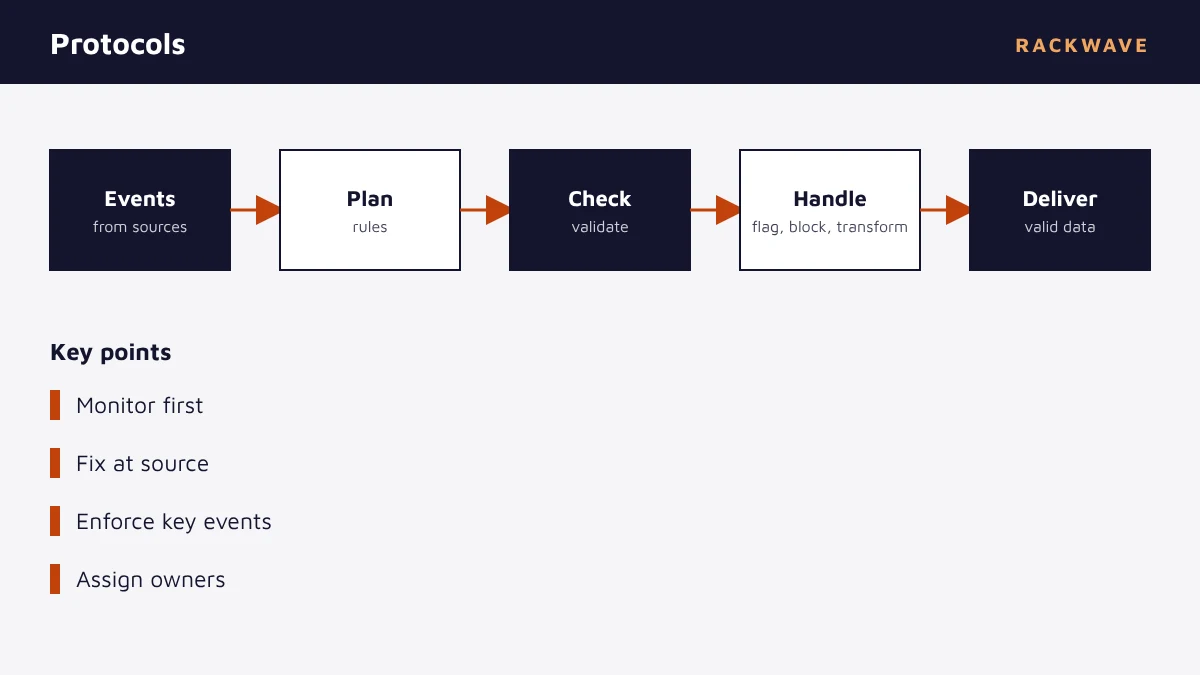
Short answer: Segment Protocols checks events against your tracking plan and flags or blocks violations. Roll out in monitoring mode first, fix sources, then enforce on critical events.
What is Segment Protocols?
Protocols builds on the sources and tracking plan and protects every destination. It is a part of what is Segment and supports wider data governance and data quality goals.
How Protocols works
| Capability | What it does | Why it matters |
|---|---|---|
| Tracking plan | Defines events, properties, types and rules | One agreed source of truth |
| Violation detection | Flags events that do not match | Finds errors early |
| Blocking | Stops invalid events from reaching tools | Protects downstream data |
| Transformations | Renames or adjusts events in flight | Fixes legacy tracking without code changes |
| Violation reports | Shows counts and sources of errors | Guides fixes |
| Schema controls | Limits unplanned events and properties | Prevents drift |
Types of violation
| Violation | Example | Typical fix |
|---|---|---|
| Unplanned event | A new event name not in the plan | Add to plan or remove from code |
| Missing property | Order Completed without order id | Fix the source |
| Wrong type | Price sent as text | Correct the data type |
| Invalid value | Currency code not allowed | Use the approved list |
| Naming mismatch | order_completed vs Order Completed | Rename in code or transform |
How to roll out Protocols
- Document the plan. Put events, properties and types into the tracking plan.
- Connect sources. Attach the plan to the relevant sources.
- Monitor only. Run in a non blocking mode and review violation reports.
- Fix at the source. Prioritise errors by volume and business impact.
- Use transformations. Apply temporary fixes for legacy apps that cannot change quickly.
- Enforce. Block or omit invalid events for critical sources once errors are low.
- Review. Check violations weekly and update the plan as the product changes.
Common mistakes
- Blocking events on day one and losing data.
- No owner for violation reports.
- A plan that is never updated, so valid new events are blocked.
- Using transformations as a permanent fix.
- Ignoring mobile builds that stay in the field for months.
- Tracking plans that are too strict for exploratory work.
Our data analytics service helps teams design governance and our data governance service covers wider policy and ownership.
A worked example: protecting revenue reports
A subscription business finds that revenue figures in its analytics tool and its warehouse disagree. Violation reports show that one mobile version sends the amount as text and another omits the currency. The team enables monitoring on the revenue events, and the mobile team fixes the next release.
While old app versions remain in use, a transformation converts the text value to a number so reports stay consistent. After errors fall below an agreed threshold, the team enables blocking for new violations on revenue events only, and keeps looser rules for exploratory events. Revenue numbers now match across tools.
Balancing strictness and flexibility
Too little governance lets bad data spread, and too much slows teams down. Apply strict rules to events that drive revenue, compliance and key reports, and looser rules to experiments. Give teams a fast way to propose new events, with a short review, so that the plan does not become a bottleneck. Review blocked events regularly, because a spike in blocks may signal a legitimate new feature that needs a plan update.
Working with engineering teams
Governance succeeds when engineers see it as help, not policing. Share violation reports in the tools they already use, show examples of correct calls and add checks to the release process. Where possible, validate events in development and in continuous integration before they reach production. Agree who fixes each type of violation and how quickly, and celebrate improvements in data quality so the practice becomes part of normal work.
Monitoring and reporting
Track the number and share of violating events, the sources and versions that cause them and the time taken to fix. Set thresholds that trigger a review, and include data quality in regular reports to product and analytics leaders. Compare counts between Segment and downstream tools to detect delivery problems, since a clean source does not guarantee clean outcomes. Keep a log of major changes to rules so that unusual numbers can be explained.
Privacy controls and Protocols
Protocols can help privacy by limiting which properties may be sent, so that unplanned fields such as free text with personal data do not reach tools. Combine it with consent management, field level controls and deletion processes. Review the plan with legal and security teams, and record which properties contain personal data and which destinations may receive them. See what is GDPR for the principles behind these controls.
Scaling governance across many sources
As the number of sources grows, create shared plans for common events, and allow source specific extensions. Use naming and ownership conventions that make it clear who is responsible for each plan. Review plans quarterly, retire unused events and merge duplicates. Keep documentation current, and train new team members. A scalable approach prevents the situation where each team keeps its own rules and data cannot be compared across products.
Handling legacy apps and long lived versions
Mobile apps stay in the field for months, so errors from old versions continue long after a fix is released. Use version information in violation reports to see how much of the problem is historical. Apply transformations to keep reports consistent, and plan a retirement date for the transformation once usage of the old version drops. Where possible encourage updates, and document known issues so that analysts know which periods need special care.
Reporting data quality to leaders
Leaders rarely read violation reports, but they care about trust in numbers. Summarise the share of clean events, the trend over time and the business reports that depend on key events. Show how fixes removed discrepancies between tools. Linking data quality to decisions, such as budget or product choices, gives the work visibility and keeps it resourced. A short monthly note is usually enough to maintain support.
Testing rules before enforcement
Before turning on blocking, test the plan with sample events and with recent real traffic. Check that valid events pass, that expected violations are caught and that rules do not block legitimate variations such as optional properties or new platforms. Run the test in a staging source first, and review results with engineering. This small step prevents the painful case where a new rule silently drops useful data for several days before anyone notices.
Key takeaways
- Segment Protocols checks events against the tracking plan and flags, blocks or transforms violations.
- Roll out in monitoring mode, fix sources, then enforce on critical events.
- Use transformations as a temporary fix for legacy versions.
- Balance strict rules for key events with flexibility for experiments.
- Combine with privacy controls, monitoring and clear ownership.
Quick glossary
| Term | Meaning |
|---|---|
| Protocols | The Segment feature for enforcing a tracking plan |
| Violation | An event that does not match the plan |
| Transformation | A rule that changes an event in flight |
| Schema | The structure of events and properties |
| Blocking | Stopping an invalid event from reaching destinations |
Read next: BigQuery vs Snowflake: Which Cloud Data Platform? · BigQuery Streaming Inserts: Real-Time Ingestion Guide · BigQuery Access Control: IAM, Policy Tags and Row Security
Frequently asked questions
What is Segment Protocols?
It is the governance feature that checks events against a tracking plan and handles violations.
What can it do with invalid events?
It can flag them, block them or transform them, depending on configuration.
Should I block events immediately?
No, start in monitoring mode and fix sources first.
What are transformations for?
They fix legacy tracking in flight, for example renaming an event, without a code release.
Who should own violation reports?
A named data owner with engineering support.
Does it help with privacy?
Yes, by limiting unplanned properties, though you still need consent and deletion processes.
How often should I update the plan?
Review it monthly and after major releases.
Can it slow teams down?
Only if rules are too strict or the review process is slow, so keep a fast path for new events.