
What is the difference between WhatsApp and SMS for business? WhatsApp vs SMS is a common channel decision, because both reach customers on their phone number but work in very different ways. SMS is carried by mobile networks, reaches almost any phone without an app or an internet connection and supports short text, while WhatsApp runs over the internet inside an app that the customer must have, and supports rich media, buttons, catalogues, forms and conversations with read receipts. They also differ in consent and approval rules, pricing, reach by country, security and measurement. This guide compares them across the factors that matter, explains which fits which use case, how to combine them with fallback logic and how to run a fair test. Rules and prices change, so confirm details with providers and platforms.
Short answer: Use SMS for reach and critical alerts, and WhatsApp for rich, conversational and commercial messaging where customers use the app. Combine them with consent and fallback logic, and compare cost per outcome.
What is the difference between WhatsApp and SMS for business?
Read more on each channel in what is the WhatsApp Business Platform, SMS marketing and WhatsApp pricing. Consent is covered in WhatsApp opt in and consent, and orchestration in customer engagement.
Side by side comparison
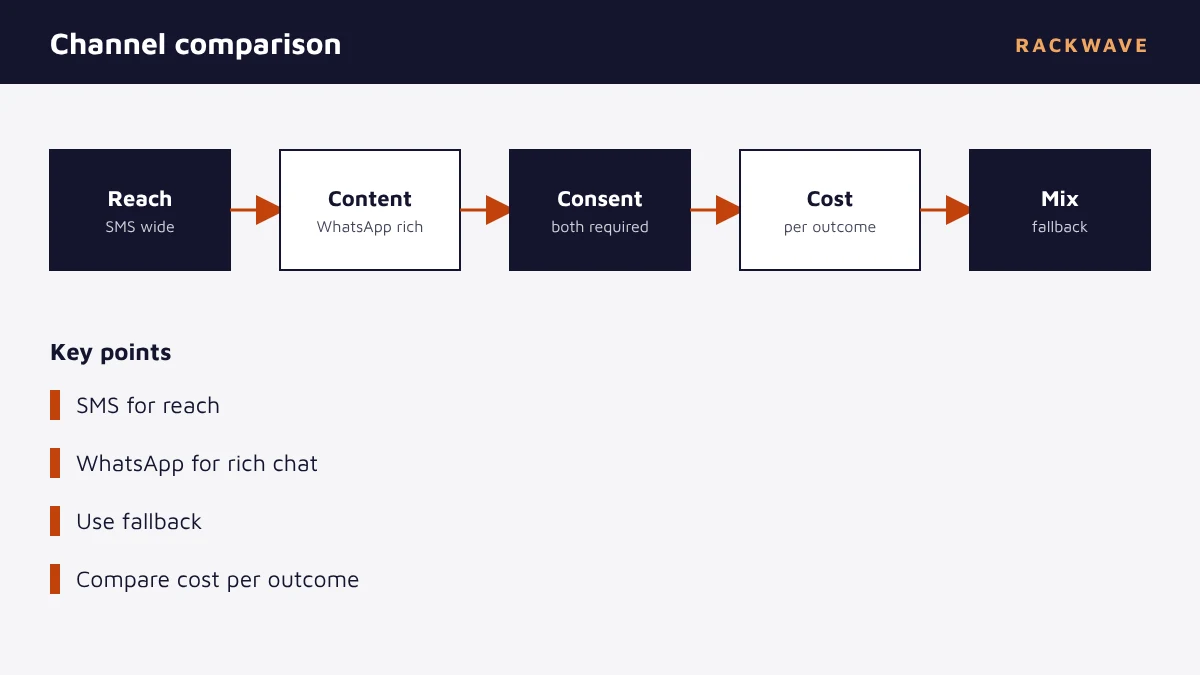
| Factor | SMS | |
|---|---|---|
| Reach | Customers with the app and internet access | Almost any mobile phone |
| Content | Text, images, video, documents, buttons, lists, catalogues, forms | Short text and links |
| Interaction | Rich two way conversation and flows | Basic replies |
| Consent | Opt in required by platform policy | Consent and local rules, with registration in many countries |
| Approval | Templates for business initiated messages | Sender and template registration in some countries |
| Cost | Varies by category and country | Varies by country and route |
| Delivery data | Sent, delivered, read | Delivered, limited read data |
| Security | End to end encryption between user and platform with business handling rules | Not encrypted end to end, so avoid sensitive content |
The table is a general view. Check current rules and prices before deciding.
Which channel for which use case
| Use case | Better fit | Reason |
|---|---|---|
| One time passwords | SMS, with WhatsApp as option | Universal reach and speed |
| Delivery updates | WhatsApp where customers use it, SMS fallback | Rich tracking and fallback reach |
| Customer support | Conversation and media | |
| Appointment reminders | Either, with confirm buttons on WhatsApp | Interactive confirmation |
| Product recommendations and commerce | Catalogue and rich messages | |
| Emergency alerts | SMS | Works without internet |
| Promotions | Depends on consent and cost | Test both and compare |
Combining the channels
- Ask customers which channel they prefer and store it as a preference.
- Send on WhatsApp first for opted in users, and fall back to SMS if delivery fails.
- Use SMS to invite customers to opt in to WhatsApp.
- Do not send the same message on both channels at once.
- Keep consent records separate for each channel.
- Apply frequency caps across both channels.
How to decide and test
- List use cases. Group messages by purpose and urgency.
- Check reach. Find out what share of your customers use WhatsApp in each market.
- Check rules. Review consent, template and registration requirements.
- Model cost. Compare cost per message and cost per outcome.
- Run a pilot. Test both channels with similar audiences and a control group.
- Measure. Compare delivery, response, conversion and satisfaction.
- Decide and combine. Set rules for which channel is used when.
Common mistakes
- Assuming every customer uses WhatsApp.
- Using SMS for long or rich content.
- Sending marketing on either channel without consent.
- Comparing cost per message and not cost per outcome.
- No fallback for critical notifications.
- Putting sensitive data in SMS.
Our CRM and lifecycle service designs multichannel messaging and our system integration service connects providers and data.
A worked example: delivery notifications
A logistics company sends delivery updates to customers in several countries. In markets where WhatsApp is widely used and customers have opted in, it sends a template with a tracking button, and customers can reply to reschedule. If a WhatsApp message fails or the customer has not opted in, a short SMS with a tracking link is sent instead.
The company compares both groups for a month. WhatsApp produces more replies and fewer support calls, while SMS provides the broadest coverage. It keeps both with clear rules, and uses SMS to invite people to opt in to WhatsApp. Cost per delivered update and cost per avoided call guide its decisions.
Cost and value comparison
Cost per message is only a starting point. Compare the cost of each channel per outcome, such as a confirmed appointment, a recovered order or a resolved question, and include extra costs such as provider fees, agent time and chatbot licences. A richer channel may cost more per message but save support calls or lift conversion. Run tests with a control group so that the value of each channel is based on evidence and not on assumption.
Regional differences
Channel popularity varies widely. In some countries WhatsApp is the default way to talk to businesses, while in others customers rely more on SMS, email or other apps. Rules on sender registration, content and consent also differ. Study each market before launch, ask local teams and partners and use data from pilots. Build your messaging so that channels can be switched on or off by country without rebuilding journeys.
Privacy, security and compliance
Both channels carry personal data and need clear consent and a way to opt out. SMS is not end to end encrypted, so avoid sensitive details, and WhatsApp conversations still need careful handling on the business side, including access control and retention. Follow platform policies and local laws, and review practices with legal advisers. See what is GDPR for principles that apply across channels.
Measuring results across channels
Use common metrics so that channels can be compared: delivery, response, conversion, revenue or savings, opt out and cost per outcome. Track results by use case and country, and use control groups. Share a monthly summary with marketing, support and operations, and revisit channel rules each quarter. As customer behaviour and platform rules change, regular review keeps your mix of channels effective and efficient.
Customer experience and trust
Customers judge a channel by how it feels. Messages that arrive from a recognisable sender, say clearly what they are for and offer an easy way to reply or stop build trust. Rich formatting on WhatsApp can help, but it can also feel intrusive if overused. SMS is brief, so every word counts. Test wording and timing on both channels, ask for feedback and watch opt out rates, because they show whether the experience matches expectations.
Preparing for changing rules
Both channels are shaped by outside rules, from platform policy to telecom regulation, and these change. Keep your consent records, templates and sender registrations organised, so that you can adapt quickly. Avoid building journeys that depend on a single channel, and keep a small amount of capacity on others. A flexible set up lets you move volume if prices rise, rules tighten or a route becomes unreliable.
Key takeaways
- SMS offers wide reach and simplicity, while WhatsApp offers rich content and conversation for customers who use the app.
- Choose by use case, customer reach, consent rules, cost per outcome and security needs.
- Combine channels with preferences, opt in and fallback logic, and avoid duplicate messages.
- Test both with a control group before deciding.
- Review regional differences and rules regularly.
Quick glossary
| Term | Meaning |
|---|---|
| SMS | A text message carried by mobile networks |
| WhatsApp Business Platform | An API for business messaging on WhatsApp |
| Fallback | A second channel used when the first fails |
| Cost per outcome | Total cost divided by results achieved |
| Opt in | Permission to receive messages on a channel |
Read next: What Is API Management? Lifecycle, Features, Tools · What Is a Message Queue? Patterns and Best Practices · What Is RabbitMQ? Exchanges, Queues and Use Cases
Frequently asked questions
What is the main difference between WhatsApp and SMS?
SMS works on any phone through mobile networks, while WhatsApp needs the app and internet and supports richer conversations.
Which is cheaper?
It depends on country, category and volume, so compare cost per outcome and not only per message.
Which has better reach?
SMS reaches almost any phone, while WhatsApp reach depends on how many customers use the app.
Do both need consent?
Yes, both need clear permission, and each has its own rules.
Can I use both together?
Yes, with preferences and fallback logic, and without sending the same message at once.
Which is better for one time passwords?
SMS is the common choice for universal reach, with WhatsApp as an option where available.
Is SMS secure?
It is not end to end encrypted, so avoid sensitive content.
How should I test?
Pilot both with similar audiences and a control group and compare outcomes.