
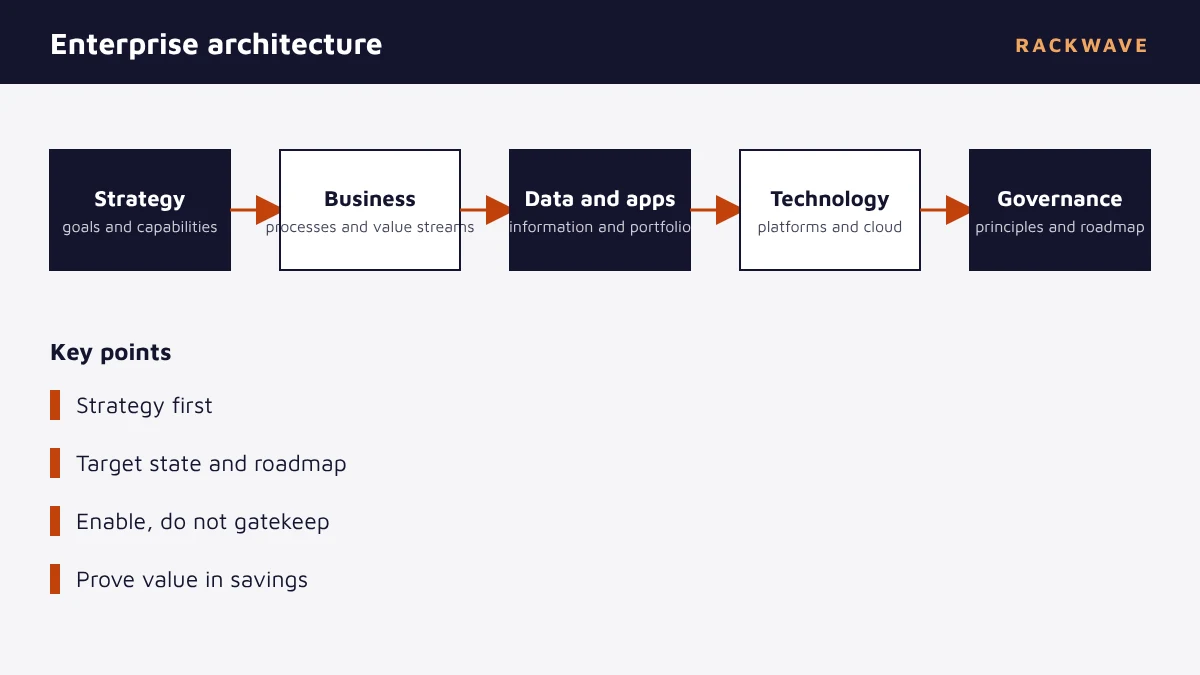
What is enterprise architecture? Enterprise architecture, or EA, is the discipline of designing and governing how an organisation business strategy, processes, information, applications and technology fit together, so that change can be planned, funded and delivered coherently. An enterprise architecture describes the current state, the target state and the roadmap between them, across business, data, application and technology layers. It helps leaders make better investment decisions, reduce duplication and complexity, manage risk and align IT with strategic goals such as growth, cost reduction, resilience and digital transformation. This guide explains what enterprise architecture is, its domains and frameworks such as TOGAF and Zachman, the deliverables and governance involved, how to start, how EA relates to cloud, integration and data strategy and the mistakes that make it irrelevant.
Short answer: Enterprise architecture is the practice of mapping and steering how business capabilities, data, applications and technology work together, using a target state and roadmap to guide investment and reduce complexity.
What is enterprise architecture?
The enterprise architecture article on Wikipedia describes it as a discipline for leading enterprise responses to disruptive forces. It guides digital transformation strategy, system integration, cloud migration and data governance, and shapes approaches such as microservices and platform engineering.
Enterprise architecture domains
| Domain | What it describes | Example artefacts |
|---|---|---|
| Business architecture | Strategy, capabilities, processes, organisation | Capability map, value streams |
| Data and information architecture | Data entities, flows, ownership and quality | Conceptual data model, data domains |
| Application architecture | Applications, their functions and relationships | Application portfolio, integration map |
| Technology architecture | Infrastructure, platforms, networks, cloud and security | Reference architectures, technology standards |
| Security architecture | Controls, identity and risk across all layers | Security patterns and zones |
| Solution architecture | Design of a specific project or system | Solution design, interface specifications |
Popular enterprise architecture frameworks
| Framework | Focus | Notes |
|---|---|---|
| TOGAF | Architecture development method and governance | Widely used, flexible and process oriented |
| Zachman Framework | Classification of architecture artefacts | A schema rather than a method |
| ArchiMate | Modelling language for architecture | Used for consistent diagrams |
| FEAF | Federal enterprise architecture in the United States | Government focused |
| Gartner EA approach | Outcome and business led planning | Strategy focused |
| Lightweight and agile EA | Principles, decision records and just enough models | Suits fast moving teams |
Key enterprise architecture deliverables
- Architecture principles that guide choices, such as buy before build or API first.
- Capability and value stream maps linking strategy to execution.
- Current state and target state views for each domain.
- A transition roadmap with dependencies, costs and benefits.
- Application and technology portfolios with lifecycle status.
- Standards, reference architectures and decision records.
Benefits of enterprise architecture
| Benefit | How EA delivers it |
|---|---|
| Strategic alignment | Connects technology investment to business goals |
| Lower cost and complexity | Reduces duplicate applications and inconsistent platforms |
| Faster change | Reusable patterns and clearer dependencies |
| Reduced risk | Visibility of security, resilience and compliance gaps |
| Better decisions | Fact based portfolio and investment choices |
| Smoother mergers and transformation | Clear view of what to integrate, retire or keep |
How to start with enterprise architecture
- Anchor in business strategy. Identify priorities and the capabilities needed to deliver them.
- Define scope and principles. Agree the architecture domains, principles and decision rights.
- Baseline the current state. Catalogue applications, data, integrations and technology with owners and costs.
- Design the target state. Describe where the organisation needs to be, by capability and domain.
- Build the roadmap. Sequence initiatives by value, risk and dependency.
- Establish governance. Create an architecture review for major changes with light, fast decisions.
- Measure and evolve. Track portfolio rationalisation, reuse, standards adoption and delivery outcomes.
Common mistakes
- Producing large documents and models that nobody uses.
- Disconnecting architecture from strategy and funding decisions.
- Acting as a gatekeeper that slows delivery instead of an enabler.
- Describing technology only, ignoring business capabilities and data.
- Never updating the current state, so decisions rely on stale information.
- Lacking executive sponsorship and clear decision rights.
Our system integration service and cloud migration service turn target architectures into delivered platforms, and our data governance service defines the information architecture and ownership.
A worked example: rationalising an application estate
After two acquisitions, a manufacturer runs four CRM systems, three ERP instances and dozens of point integrations. The EA team builds a capability map and an application portfolio with cost, usage and risk for each system. The analysis shows that three applications support the same order to cash capability and that most integrations flow through an unsupported legacy bus.
The target architecture defines a single CRM, a strategic ERP, an API layer and a shared data platform. The roadmap retires nine applications over three years, with benefits of reduced licences and support, simpler reporting and faster onboarding of future acquisitions. Quarterly architecture reviews check each project against the target and record exceptions with reasons.
Enterprise architecture in agile and cloud environments
Modern EA is lighter and closer to delivery teams. Instead of heavy upfront design, architects define principles, guardrails and reusable patterns, publish them as code and templates and support teams through communities of practice. Decisions are captured in short records, standards are enforced through pipelines and platforms and models are kept just detailed enough to guide choices. Cloud and platform engineering make this practical, because paved roads encode the architecture directly in the tooling developers use.
Measuring enterprise architecture value
Demonstrate value in business terms. Track application and infrastructure rationalisation savings, the share of projects using standard patterns, time to integrate a new business unit, the number of critical risks closed and the proportion of investments aligned with the roadmap. Share a few clear success stories with leadership each year. When architecture visibly saves money, reduces risk and speeds delivery, it earns the mandate to keep going.
Architecture principles that work in practice
- Reuse before buy, and buy before build, unless the capability is a source of competitive advantage.
- Expose capabilities through well governed APIs so that teams do not integrate by database access.
- Treat data as a shared asset with clear owners, definitions and quality standards.
- Design for security, privacy and resilience from the start rather than adding them later.
- Prefer standard platforms and patterns, and require a documented reason for exceptions.
- Make decisions visible and reversible, recording the context and alternatives considered.
Good principles are short, memorable and tied to a reason. Test each one by asking what decision it would change. If the answer is none, rewrite or remove it.
The role of the enterprise architect
Enterprise architects work as translators and advisors between executives, business leaders and technology teams. They understand strategy well enough to ask what capabilities it requires, and they understand technology well enough to explain what is feasible, risky or expensive. Their output is not diagrams for their own sake but clear options, trade offs and recommendations that leaders can act on. The strongest architects spend most of their time listening, facilitating decisions and building relationships, and they measure themselves by the quality of the choices the organisation makes.
Key takeaways
- Enterprise architecture aligns business strategy with data, applications and technology through current state, target state and roadmap.
- Frameworks such as TOGAF and ArchiMate offer structure, but outcomes matter more than documents.
- Principles, capability maps and portfolios guide investment and reduce complexity.
- Lightweight governance and reusable patterns make EA an enabler, not a gatekeeper.
- Measure savings, reuse, risk reduction and speed of change.
Quick glossary
| Term | Meaning |
|---|---|
| Capability map | A view of what the business can do, independent of how |
| Target state | The desired future architecture |
| TOGAF | The Open Group Architecture Framework |
| Architecture principle | A rule that guides technology and design decisions |
| Roadmap | A sequenced plan of initiatives to reach the target state |
Read next: What Is API Management? Lifecycle, Features, Tools · What Is a Message Queue? Patterns and Best Practices · What Is RabbitMQ? Exchanges, Queues and Use Cases
Frequently asked questions
What is enterprise architecture in simple terms?
It is a blueprint and plan for how an organisation business processes, data, applications and technology fit together and should evolve.
What are the four domains of enterprise architecture?
Business, data, application and technology architecture, often with security as a cross cutting concern.
What is the difference between enterprise architecture and solution architecture?
Enterprise architecture looks across the whole organisation and long term direction. Solution architecture designs a specific system or project within it.
What is TOGAF?
TOGAF is a widely used enterprise architecture framework from The Open Group, with a method for developing and governing architecture.
Why do organisations need enterprise architecture?
To align technology with strategy, reduce duplication and complexity, manage risk and make better investment and change decisions.
Is enterprise architecture still relevant with agile and cloud?
Yes, in a lighter form, focused on principles, guardrails, reusable patterns and decision records that teams can apply quickly.
Who does enterprise architecture?
Enterprise architects, often with domain, solution and security architects, working with business and IT leaders.
How do I measure enterprise architecture success?
Track rationalisation savings, standards adoption, reuse, time to integrate change, risk reduction and alignment of investment with the roadmap.