
What is platform engineering? It is the discipline of designing, building and running an internal developer platform: a self service layer of tools, services, templates and automation that lets product teams build, deploy and operate software quickly, safely and consistently, without each team having to master the underlying infrastructure. A platform engineering team treats the platform as a product, with developers as its customers, and measures success by developer productivity, reliability and security outcomes. The approach has grown rapidly as cloud and Kubernetes complexity increased the cognitive load on application teams. This guide explains what platform engineering is, how it relates to DevOps and SRE, what an internal developer platform contains, how to start and how to measure results.
Short answer: Platform engineering builds an internal developer platform that offers paved paths, golden templates and self service workflows for building, deploying and operating software. It reduces cognitive load and toil, raises consistency and security, and speeds delivery.
What is platform engineering?
The platform engineering article on Wikipedia describes the creation and maintenance of platforms that support software delivery. It grew out of DevOps and complements site reliability engineering. Platform teams commonly build on Kubernetes, CI/CD and infrastructure as code, and package them into a coherent experience for developers.
What an internal developer platform contains
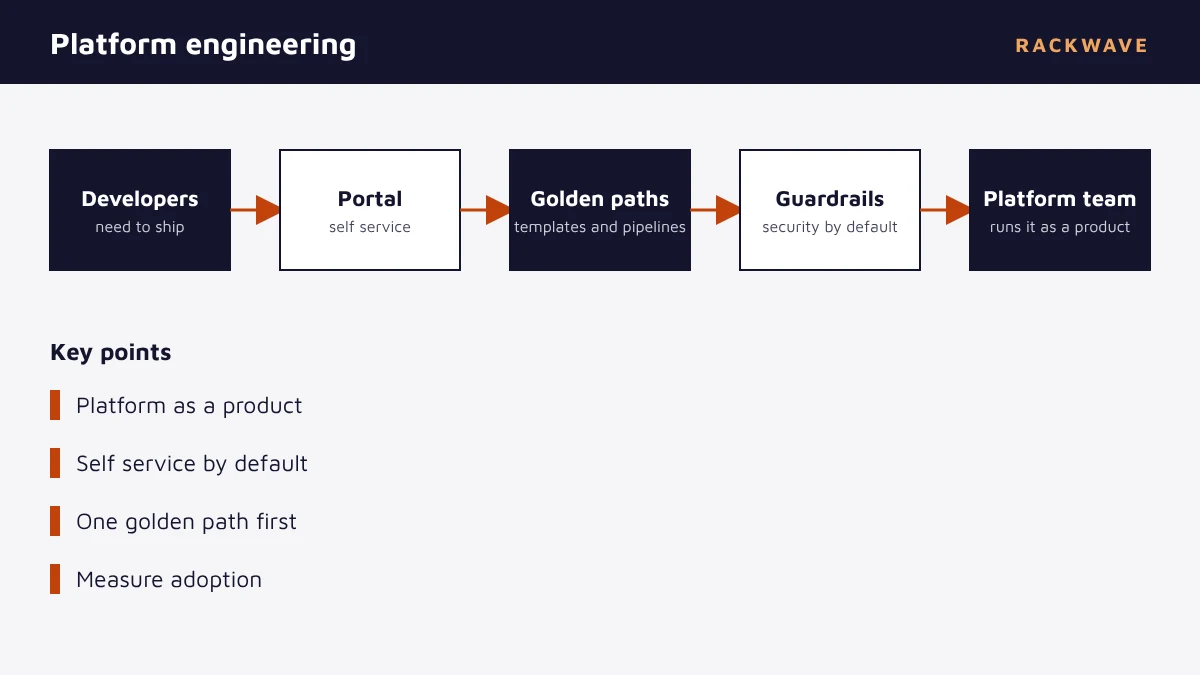
| Component | Purpose | Examples |
|---|---|---|
| Developer portal | One place to discover services, docs and actions | Backstage, Port, custom portals |
| Golden paths and templates | Pre-approved ways to start and build services | Service templates with CI, security and observability built in |
| Delivery pipelines | Automated build, test and deployment | GitHub Actions, GitLab CI, Argo CD |
| Infrastructure automation | Self service environments and resources | Terraform modules, Crossplane |
| Runtime platform | Where applications run | Kubernetes, serverless, managed services |
| Guardrails and policy | Security and compliance by default | Policy as code, image scanning, secrets management |
| Observability and cost | Visibility into health and spend | Dashboards, alerts, cost reports |
| Documentation and support | Help that developers actually use | Guides, office hours, chat channels |
Platform engineering, DevOps and SRE compared
| Discipline | Focus | Key question |
|---|---|---|
| DevOps | Culture and practices that unite development and operations | How do we deliver and run software together? |
| SRE | Reliability through engineering and error budgets | How reliable must this service be, and how do we keep it so? |
| Platform engineering | Building the internal product that enables both | How do we make the right way the easy way for all teams? |
| Developer experience | Making developers effective and satisfied | What slows developers down and how do we remove it? |
The three are complementary. Platform engineering gives DevOps practices and SRE standards a concrete, reusable form.
Principles of a good platform
- Treat the platform as a product, with a roadmap, research with users and clear ownership.
- Offer self service, so teams do not wait for tickets.
- Provide paved paths that are optional to leave but compelling to follow.
- Build security and compliance in, so the safe choice is the default.
- Keep abstractions honest, allowing teams to go deeper when they need to.
- Measure adoption and satisfaction, not just delivery of features.
- Document well and support users quickly.
How to start platform engineering
- Understand developer pain. Interview teams, map the journey from idea to production and find the biggest delays and sources of toil.
- Form a platform team. Staff it with engineers who care about developers and product thinking, and give it a clear mandate.
- Define the thinnest viable platform. Start with one golden path, such as a stateless web service with a pipeline, security checks and monitoring.
- Build it with early users. Co-design with a friendly team and iterate quickly on their feedback.
- Offer self service. Expose actions through a portal or simple commands, backed by automation and policy.
- Onboard teams gradually. Show real benefits, migrate volunteers first and gather success stories.
- Measure and expand. Track adoption, lead time and satisfaction, then add paths for data, mobile or machine learning.
Metrics for platform success
| Metric | What it shows |
|---|---|
| Deployment frequency and lead time | Delivery speed for teams on the platform |
| Time to first deployment for a new service | How quickly new work gets started |
| Change failure rate and time to restore | Reliability of delivery |
| Developer satisfaction and survey scores | Whether the platform is liked and useful |
| Adoption rate | Share of teams and services on golden paths |
| Ticket volume to the platform team | Whether self service is working |
| Cost and security findings per service | Governance outcomes |
Common platform engineering mistakes
- Building a platform nobody asked for, without talking to developers.
- Mandating the platform with no product quality, which creates resentment.
- Renaming an operations team and keeping a ticket queue.
- Hiding so much that teams cannot debug their own applications.
- Trying to build everything at once instead of one valuable path.
- Neglecting documentation, onboarding and communication.
Our DevOps service designs and builds internal developer platforms, and our cloud migration service prepares applications to run on them.
A worked example: from ticket queues to self service
A financial services firm has forty product teams. Creating a new service takes six weeks and involves tickets to networking, security, infrastructure and monitoring teams, and every team ends up with slightly different pipelines. A new platform team interviews developers and discovers that most delay is waiting and rework. It builds one golden path for containerised services: a template that creates the repository, pipeline, security scans, runtime configuration and dashboards in one step.
The portal lets developers request a database or queue from approved modules, and policy checks run automatically. Within a year, thirty teams use the path, time to first deployment falls from six weeks to two days and audit findings drop because controls are identical everywhere. The platform team holds monthly office hours, publishes a roadmap and tracks satisfaction, treating developers as customers rather than ticket submitters.
Team topology and funding
Platform teams work best when they are small, stable and cross functional, combining infrastructure, software engineering, security and product management skills. Fund them as a long lived product team rather than a project with an end date, and give them a share of leadership attention, since the platform affects every engineer. Avoid making the team a bottleneck by investing in self service and good defaults, and by letting teams contribute improvements back. As the platform grows, split it into focused areas, such as runtime, delivery and data, each with clear owners and interfaces.
Build, buy or assemble
Most organisations assemble a platform from open source and commercial components rather than building everything or buying one product. Choose widely adopted building blocks, wrap them with templates and policy that reflect your standards, and keep the portal thin, so that swapping a component later is possible. Review the portfolio yearly to retire tools that are not used, and resist adding features that only one team needs. A smaller platform that people trust beats a large one they avoid.
Key takeaways
- Platform engineering builds an internal developer platform that gives teams self service paths to production.
- It treats developers as customers and the platform as a product.
- It complements DevOps and SRE by making good practice the easy default.
- Start with one golden path, build with early users and measure adoption and satisfaction.
- Fund a stable platform team and keep the platform thin and well documented.
Quick glossary
| Term | Meaning |
|---|---|
| Internal developer platform | A self service layer of tools and automation for developers |
| Golden path | A recommended, supported way to build and deploy |
| Cognitive load | The mental effort required to do a task |
| Developer portal | A single interface for services, docs and actions |
| Toil | Repetitive manual work that automation could remove |
Read next: What Is Container Orchestration? Kubernetes and Beyond · What Is a Service Mesh? Istio, Linkerd and How It Works · What Is Cloud Security? Shared Responsibility and Controls
Frequently asked questions
What is platform engineering in simple terms?
It is building an internal platform with tools and templates that lets development teams ship and run software themselves quickly, safely and consistently.
What is an internal developer platform?
It is a self service layer built by a platform team, including a portal, templates, pipelines, infrastructure automation and guardrails for developers to use.
How is platform engineering different from DevOps?
DevOps is a culture and set of practices. Platform engineering is the discipline of building a product that makes those practices easy and repeatable.
What is a golden path?
A golden path is a pre-built, supported route for common tasks, such as creating a service, that includes security, monitoring and delivery by default.
Do small companies need platform engineering?
Often not a dedicated team. They can adopt managed services and a few shared templates, and form a platform team as the number of teams and complexity grows.
What tools are used in platform engineering?
Common tools include Backstage for portals, Terraform or Crossplane for infrastructure, Argo CD for delivery, Kubernetes and policy engines.
How do you measure a platform?
Use delivery metrics, time to first deployment, adoption, developer satisfaction, support ticket volume and security and cost outcomes.
Should platform use be mandatory?
Most successful platforms win through quality and convenience. Mandates can work for security baselines, but the experience must be good enough that teams want to use it.