
What is Python? Python is a general-purpose programming language known for its readable, English-like syntax and its enormous ecosystem of libraries. It is used to build websites and APIs, automate repetitive tasks, analyse data, train machine learning models and glue systems together, which makes it one of the most widely taught and widely used languages in the world. This guide explains what Python is, why it became so popular, where it is used in business, how it compares with other languages, a few short examples, the main libraries to know and how a newcomer can start learning it sensibly.
Short answer: Python is a high-level, interpreted language that favours clarity. You write short, readable code and rely on mature libraries for the heavy lifting in areas such as data analysis, web development, automation and AI.
What is Python?
Python was created by Guido van Rossum and first released in 1991. Its design philosophy puts readability first: blocks of code are marked by indentation rather than braces, and common tasks usually take fewer lines than in older languages. The language is open source and governed by the Python Software Foundation, with a large volunteer community.
Python is interpreted, which means you can run code immediately without a separate compile step, and dynamically typed, which means you do not have to declare the type of every variable. These traits make it quick to experiment with and forgiving for beginners. The trade-off is that raw execution speed is lower than in compiled languages, which matters for a small number of workloads and is usually solved by using optimised libraries written in faster languages underneath.
Why Python is so popular
- Easy to read and learn: the syntax is close to plain language, so teams can review each other's code.
- A vast ecosystem: hundreds of thousands of packages are available through the Python Package Index.
- Strong in data and AI: the dominant tools for analysis and machine learning are Python libraries.
- Versatile: the same language can power a script, a web service and a model.
- Good glue: it integrates easily with databases, APIs, spreadsheets and other languages.
- Large community: answers, tutorials and talent are easy to find.
What Python is used for in business
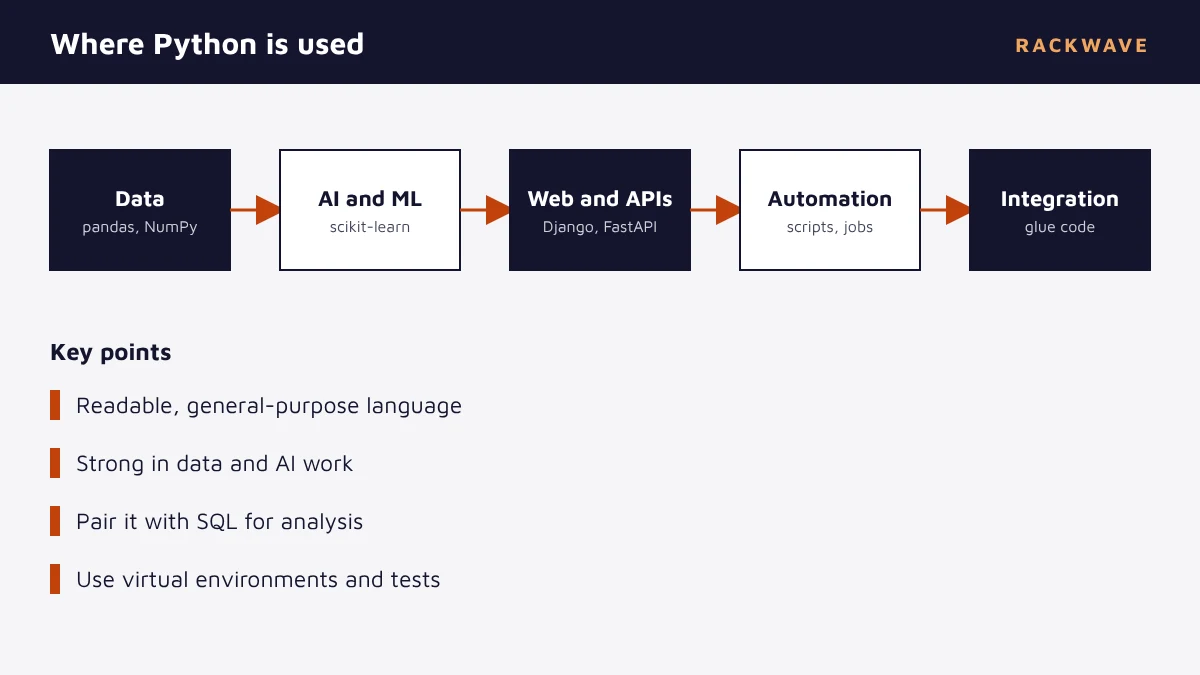
| Area | What Python does | Common libraries |
|---|---|---|
| Data analysis | Clean, explore and summarise data | pandas, NumPy |
| Visualisation | Charts and reports. See data visualization | Matplotlib, Plotly |
| Machine learning and AI | Train and apply models. See machine learning | scikit-learn, PyTorch, TensorFlow |
| Web and APIs | Build sites and services. See APIs | Django, Flask, FastAPI |
| Automation and scripting | Replace repetitive manual tasks | Standard library, requests |
| Data engineering | Build pipelines. See data engineering | PySpark, Airflow |
| Testing and DevOps | Test code and automate operations | pytest, Ansible modules |
A first look at Python code
Three short examples show the flavour. The first defines a function, the second reads a CSV file and summarises it with pandas, and the third calls a web API.
def total_with_tax(amount, rate=0.18):
    """Return the amount including tax."""
    return round(amount * (1 + rate), 2)

print(total_with_tax(1000))   # 1180.0
import pandas as pd
orders = pd.read_csv("orders.csv", parse_dates=["order_date"])
summary = (
orders[orders["status"] != "cancelled"]
.groupby("region")["amount"]
.agg(["count", "sum"])
.sort_values("sum", ascending=False)
)
print(summary.head())import requests
resp = requests.get(
"https://api.example.com/customers",
headers={"Authorization": "Bearer YOUR_TOKEN"},
params={"updated_since": "2026-01-01"},
timeout=30,
)
resp.raise_for_status()
for customer in resp.json()["items"]:
print(customer["id"], customer["email"])The tax rate and API address are placeholders. Notice the timeout and the status check on the request, which are small habits that make scripts dependable when they run unattended.
Python rewards clear thinking. The language gets out of the way so the logic of the problem is what you read.
Python compared with other languages
| Language | Strength | Typical use | Compared with Python |
|---|---|---|---|
| Python | Readability, libraries, data and AI | Analysis, automation, back ends, ML | Baseline |
| JavaScript | Runs in every browser | Front-end and server-side web | Needed for browsers; Python is more common for data |
| Java | Performance, strong typing, enterprise tooling | Large business systems | More verbose; faster at scale |
| C# | Microsoft ecosystem, strong tooling | Windows, .NET and Azure applications | Similar breadth; tied closely to .NET |
| R | Statistics and research | Statistical analysis | Python is more general-purpose |
| SQL | Querying databases. See what is SQL | Data retrieval and shaping | Complements Python rather than replacing it |
Most data teams use Python and SQL together: SQL to pull and shape data inside the database, and Python for analysis, modelling and automation around it.
Python in data, AI and automation
Python is the working language of modern data science and artificial intelligence. Analysts use it to clean and explore data, data scientists to train models, and engineers to put them behind an API. It also powers a great deal of everyday automation: renaming files, moving data between systems, generating reports and calling the APIs of CRM and marketing platforms. For larger flows, a dedicated workflow automation or integration platform may be a better home, with Python used for the custom steps.
Project hygiene: environments and packages
Beginners often hit trouble because every project needs different package versions. Solve it with a virtual environment per project and a file that lists dependencies.
python -m venv .venv
source .venv/bin/activate      # Windows: .venv\Scripts\activate
pip install pandas requests
pip freeze > requirements.txt- Use one virtual environment per project.
- Pin dependency versions so builds are repeatable.
- Follow PEP 8, the community style guide, and use a formatter to keep code consistent.
- Write tests with pytest for anything that matters.
- Keep secrets in environment variables, not in code. See cyber security for the wider picture.
Running Python in production
A script on a laptop is not a system. For production, package the code, test it and deploy it through a pipeline. Many teams run Python in containers, which is explained in what is Docker, and ship it through a CI/CD pipeline as part of DevOps practice. Machine learning code adds more concerns, covered in what is MLOps. Our DevOps service and API development service help teams do this properly.
A realistic automation example
Consider a finance team that receives a spreadsheet of supplier invoices every Monday and copies figures into a reporting sheet by hand. A short Python script can read each file, check that totals add up, flag invoices with missing purchase order numbers and write a clean summary, all in seconds. The same script can email exceptions to the right person. The value is not just the hours saved. It is that the rules are written down, applied the same way every time and visible to anyone who reads the code. When the rules change, you change one function and the improvement reaches every future run.
Start with a task like this one: small, frequent, rule-based and annoying. Success on a modest problem builds the confidence and the shared habits you need for larger ones.
How to start learning Python
- Install Python and an editor. Use the current stable release and a code editor with Python support.
- Learn the basics. Variables, data types, conditions, loops, functions and collections.
- Read and write files. Process a CSV or text file, since this is the first real task most people need.
- Pick a goal. Automate a chore, analyse a dataset or call an API. A concrete goal keeps you learning.
- Learn one library well. For data work, start with pandas.
- Use version control and tests. Habits that save time as projects grow.
- Read other people's code. Open-source projects are the best textbooks.
If you are building analytics capability across a team, our data analytics service and AI and machine learning service can supply both the platform and the practices.
Common mistakes beginners make
- Installing everything globally and ending up with version conflicts.
- Copying code without understanding it.
- Ignoring error messages, which usually say exactly what is wrong.
- Writing one very long script instead of small functions.
- Using loops over large tables when a vectorised pandas operation is faster.
- Hard-coding passwords and keys.
Key takeaways
- Python is a readable, general-purpose language with a huge library ecosystem.
- It dominates data analysis and machine learning and is also strong in web, automation and integration.
- Pair Python with SQL: SQL shapes data in the database, Python analyses and automates around it.
- Use virtual environments, pinned dependencies and tests from the start.
- Learn with a concrete goal and one library at a time.
Quick glossary
| Term | Meaning |
|---|---|
| pandas | A library for working with tables of data |
| Virtual environment | An isolated set of packages for one project |
| PEP 8 | The Python community style guide |
| pip | Python's package installer |
| Interpreter | The program that runs Python code |
Read next: Lead Nurturing: Strategy, Tactics and Examples · Data Quality: Dimensions, Causes and How to Improve It · What Is a Data Pipeline? Components, Types and Examples
Frequently asked questions
What is Python used for?
Python is used for data analysis, machine learning and AI, web development and APIs, task automation, scripting, testing and connecting systems together, across industries from finance to healthcare.
Is Python easy to learn?
Python is widely regarded as one of the easiest languages to start with because its syntax is readable and forgiving. Becoming good at design, testing and performance still takes practice, as with any language.
Is Python free?
Yes. Python is open source and free to use, including for commercial work, and so are most of its popular libraries, though each library has its own licence to check.
What is the difference between Python and SQL?
SQL is a language for querying and managing data in databases. Python is a general-purpose programming language. Data teams use SQL to retrieve and shape data and Python for analysis, modelling and automation.
Is Python good for data science and AI?
Yes. Libraries such as pandas, NumPy, scikit-learn, PyTorch and TensorFlow make Python the most common language for data science and machine learning.
Is Python slow?
Pure Python runs slower than compiled languages, but most heavy work in data and AI is done by optimised libraries written in faster languages, so Python is fast enough for the large majority of business uses.
What is pip in Python?
Pip is the standard tool for installing Python packages from the Python Package Index. It is usually used inside a virtual environment, with a requirements file that lists the exact versions a project needs.
Can Python be used for web development?
Yes. Frameworks such as Django, Flask and FastAPI are used to build websites, back ends and APIs, and Python is common on the server side even when the front end is written in JavaScript.