
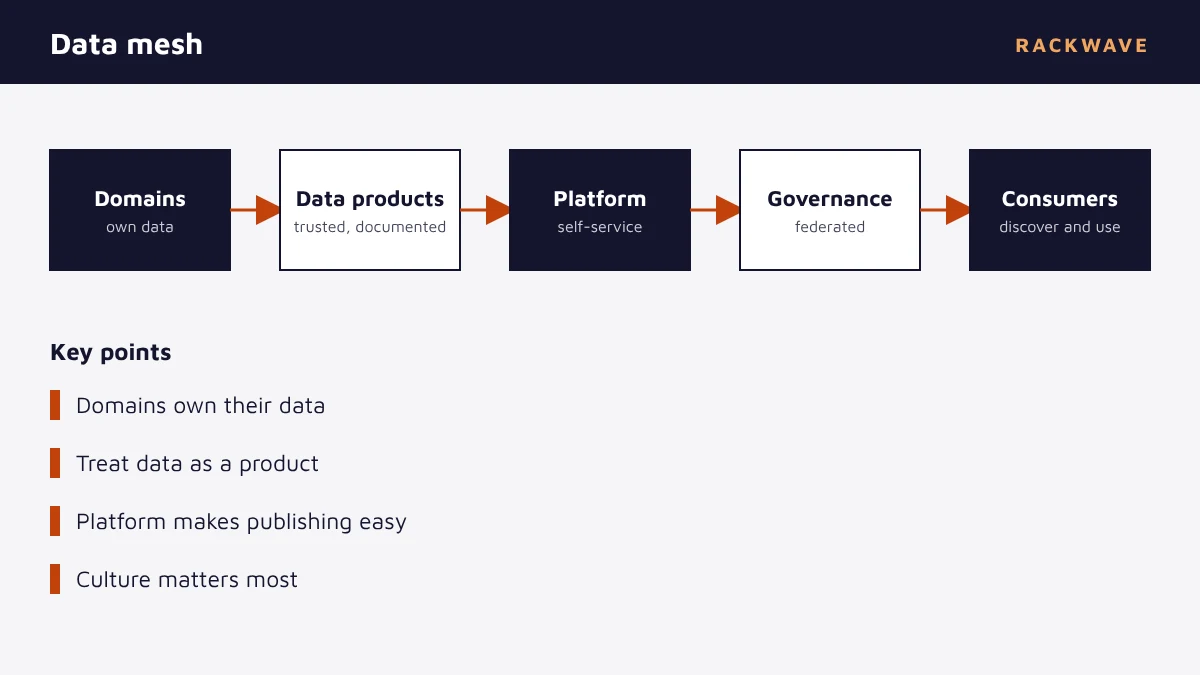
What is data mesh? It is an approach to analytics architecture and organisation in which data is owned and delivered as a product by the business domains that know it best, instead of being collected into one central team and platform. Each domain, such as sales, logistics or finance, publishes trusted, documented data products, and a shared self-service platform plus federated governance keep everything consistent. This guide explains data mesh, its four principles, how it differs from a central warehouse or lake, when it fits, the challenges and how to start without a reorganisation.
Short answer: Data mesh decentralises data ownership. Domain teams treat their data as a product with owners, quality targets and clear interfaces, supported by a self-service platform and shared rules. It suits large organisations where a central data team has become a bottleneck.
What is data mesh?
Data mesh was introduced by Zhamak Dehghani in 2019 and is summarised in the data mesh article on Wikipedia. It responds to a common problem: a central data team receives requests from every department, becomes a queue and lacks the business context to fix data properly. Mesh moves responsibility to the people closest to the data, much as microservices moved applications from one large codebase to many owned services.
The four principles of data mesh
| Principle | Meaning | What it looks like |
|---|---|---|
| Domain ownership | Business domains own and serve their analytical data | The logistics team owns shipment data end to end |
| Data as a product | Data has an owner, documentation, quality targets and consumers | A discoverable, versioned customer orders product |
| Self-serve data platform | A platform team provides tools so domains can publish data easily | Templates, pipelines, storage and a catalog |
| Federated computational governance | Shared standards enforced by automation across domains | Common definitions, access policy and quality checks |
What is a data product?
- Discoverable: listed in a catalog with a clear description. See what is a data catalog.
- Addressable: has a stable, documented way to access it.
- Trustworthy: has quality tests, an owner and published service levels.
- Self-describing: schema, meaning and lineage are available.
- Interoperable: uses shared identifiers so products can be combined.
- Secure: access follows central policy.
Data mesh compared with other architectures
| Aspect | Central warehouse | Data lake | Data mesh |
|---|---|---|---|
| Ownership | Central data team | Central or shared | Business domains |
| Architecture | One integrated model. See what is a data warehouse | Raw storage for everything. See what is a data lake | Network of data products |
| Bottleneck | Central team capacity | Data swamp risk | Needs mature domain teams |
| Best for | Small and mid-size organisations | Exploratory data science | Large, complex organisations |
| Technology | Warehouse platform | Object storage and engines | Any platform that supports the principles |
Mesh is not a technology and cannot be bought as a product. A mesh can be built on a lakehouse, warehouse or a mix, and the central platform often remains. What changes is who is accountable for the quality and meaning of the data.
When data mesh is a good fit
| Good fit | Poor fit |
|---|---|
| Many domains with distinct data and expertise | Small company with one data team |
| Central team is a long queue | Little appetite for domain ownership |
| Strong engineering culture in domains | Domains with no data or engineering skills |
| Need to scale analytics across business units | Simple reporting needs that a warehouse meets |
How to start with data mesh
- Start with the problem. Identify where the central model fails, such as long delivery times or low trust.
- Choose a pilot domain. Pick a motivated domain with valuable data and some engineering capacity.
- Define the first data products. Agree the consumers, the interface and the quality targets.
- Build a thin platform. Provide storage, pipelines, a catalog and templates that make publishing easy. See what is ETL.
- Set minimal federated governance. Agree identifiers, metadata standards and access rules. See what is data governance.
- Measure and expand. Track product usage, quality and time to deliver, then add domains gradually.
Challenges of data mesh
- Cultural change: domains must accept accountability for data they used to ignore.
- Skills: domain teams need data engineering capability or support.
- Duplication: poor coordination creates competing products and definitions.
- Platform investment: a self-service platform takes effort to build well.
- Governance balance: too little leads to chaos, too much recreates the bottleneck.
- Cost visibility: spending is spread across teams. See what is FinOps.
Our data governance service sets the federated rules, our data analytics service builds data products and platforms, and our data warehousing service provides the foundations they run on.
A worked example: from queue to products
A global retailer has a central data team of twenty people supporting forty business teams. A new report takes an average of nine weeks, and arguments about definitions are common. The company pilots a mesh in its supply chain domain. A product owner and two engineers in the domain publish a shipments data product with documented fields, a daily freshness target of 06:00 and tests that compare counts with the warehouse management system.
Finance and customer service use the product directly through the catalog, without a ticket to the central team. The central team shifts to running the platform and the governance standards. Delivery time for shipment related reports falls from nine weeks to ten days. The retailer extends the approach to three more domains over the next year. The hard part was not the tools. It was agreeing who is accountable when a data product breaks, and writing that into job descriptions and service levels.
Measuring a data mesh
- Number of data products with owners, documentation and quality tests.
- Time from request to usable data for a new analytical need.
- Reuse: how many consumers use each product.
- Quality scores and freshness against published targets.
- Satisfaction of data consumers, measured through short surveys.
Data mesh and the platform team
The platform team is the quiet hero of a mesh. Its job is to make the right thing the easy thing: a template that creates a new data product with storage, tests, documentation and access rules already in place, so a domain team can publish in days instead of months. It also provides shared services such as identity, lineage, cost reporting and monitoring, so each domain does not reinvent them. A good platform team treats domains as customers, measures their productivity and removes friction, while governance keeps the products compatible.
Data contracts and interoperability
As soon as several teams depend on each other, informal promises stop working. A data contract is a written, machine readable agreement between a data product owner and its consumers. It describes the schema, the meaning of fields, the freshness and quality guarantees and how changes will be announced. When a producer wants to rename a column, the contract shows who is affected and a deprecation period gives consumers time to adapt. Contracts are also tested automatically in the pipeline, so a breaking change is caught before it reaches a report.
Key takeaways
- Data mesh gives business domains ownership of data as a product.
- Its four principles are domain ownership, data as a product, a self-serve platform and federated governance.
- It addresses central team bottlenecks in large organisations and is not needed everywhere.
- Success depends on culture, skills and a strong platform team.
- Start with a pilot domain and a few valuable data products.
Quick glossary
| Term | Meaning |
|---|---|
| Data product | Data delivered with an owner, documentation and quality targets |
| Domain | A business area such as sales or logistics |
| Self-serve platform | Shared tools that let domains publish data easily |
| Federated governance | Shared rules enforced across domains |
| Data contract | An agreed description of the data a product provides |
Read next: BigQuery vs Snowflake: Which Cloud Data Platform? · BigQuery Streaming Inserts: Real-Time Ingestion Guide · BigQuery Access Control: IAM, Policy Tags and Row Security
Frequently asked questions
What is data mesh in simple terms?
Data mesh is a way of organising data so that each business area owns and publishes its data as a trusted product, using shared tools and rules, rather than relying on one central team.
What are the four principles of data mesh?
Domain ownership, data as a product, a self-serve data platform and federated computational governance.
Is data mesh a technology?
No. It is an organisational and architectural approach. You can implement it on many technologies, including warehouses, lakes and lakehouses.
What is the difference between data mesh and data lake?
A data lake is a storage architecture, often central. Data mesh describes ownership and delivery across domains and can use lakes as part of its platform.
What is a data product?
A data product is a dataset or service delivered like a product, with an owner, documentation, quality guarantees and a clear interface for consumers.
Who should use data mesh?
Large organisations with many business domains, a strong engineering culture and a central data team that has become a bottleneck.
What are the risks of data mesh?
Cultural resistance, uneven skills, duplicated or inconsistent products and the cost of building a good platform. Governance and a pilot approach reduce them.
Can I combine data mesh with a data warehouse?
Yes. A warehouse or lakehouse often forms part of the self-serve platform, while ownership and product thinking come from the mesh approach.