
What is a data lake? A data lake is a central repository that stores large volumes of raw data in its original format, structured, semi-structured and unstructured, until it is needed for analytics, reporting or machine learning. Unlike a data warehouse, which stores cleaned and modelled data, a data lake keeps everything as it arrived and applies structure only when the data is read. This guide explains how a data lake works, its architecture, benefits, risks, how it compares with a warehouse and a lakehouse, and how to build one that does not turn into a swamp.
Short answer: A data lake is cheap, scalable storage for raw data of any type, designed so analysts and data scientists can explore it later. It trades upfront structure for flexibility, which makes governance essential.
What is a data lake?
A data lake holds data in its native form: database exports, log files, JSON from APIs, images, documents, sensor readings and clickstreams. The idea, attributed to James Dixon, is a natural lake fed by many streams, from which different people draw water for different uses, rather than a bottled, filtered product.
Most data lakes today sit on cloud object storage, which is inexpensive and scales almost without limit. Compute engines read from that storage on demand, so storage and processing can grow independently.
How a data lake works
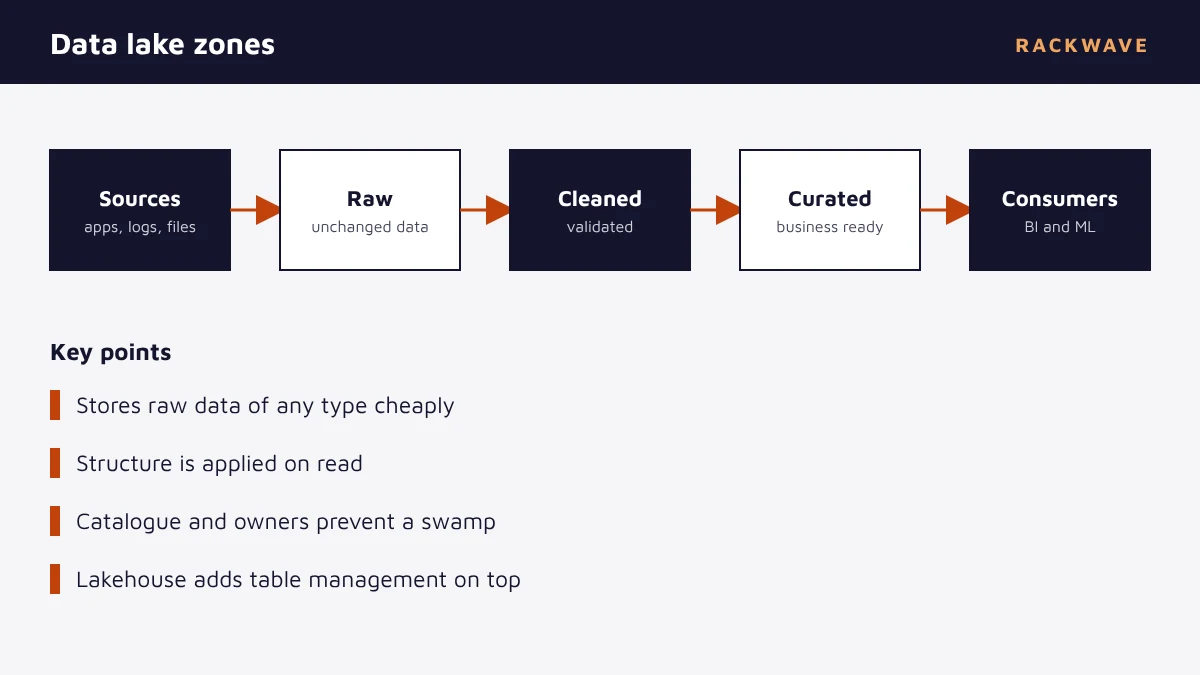
- Ingest. Data arrives from databases, applications, files, streams and devices, in batches or in real time.
- Store raw. Everything lands unchanged in a raw zone, which preserves the original and allows reprocessing later.
- Process. Pipelines clean, standardise and enrich data into curated zones when a use case needs it.
- Catalogue. A metadata catalogue records what each dataset is, where it came from and who owns it.
- Consume. Analysts, BI tools, data scientists and applications query the data with the engine that suits them.
Schema on read vs schema on write
This is the key technical difference. A warehouse uses schema on write: you define the table structure first and data must conform when loaded. A data lake uses schema on read: data is stored as is, and the structure is applied when a query or job reads it. Schema on read gives speed of ingestion and flexibility. It also means that bad data can enter silently unless you add quality checks in the pipeline.
Data lake architecture: zones
| Zone | Content | Typical users |
|---|---|---|
| Raw (bronze) | Unchanged source data, kept for audit and reprocessing | Data engineers |
| Cleaned (silver) | Validated, deduplicated, standardised data | Engineers, analysts |
| Curated (gold) | Business-ready, modelled datasets and aggregates | Analysts, BI, executives |
| Sandbox | Workspace for experiments and model training | Data scientists |
The bronze, silver and gold naming is common but not mandatory. What matters is that every dataset has a clear stage, an owner and quality rules for moving between stages.
Data lake vs data warehouse
| Factor | Data lake | Data warehouse |
|---|---|---|
| Data types | Structured, semi-structured and unstructured | Mostly structured |
| Schema | On read | On write |
| Cost of storage | Low, object storage | Higher, optimised storage |
| Users | Data scientists, engineers, analysts | Analysts, business users |
| Best for | Exploration, machine learning, large raw history | Reliable reporting and dashboards |
| Main risk | Becoming a disorganised "swamp" | Rigid and slow to change |
See our guide to what is a data warehouse for the other side of the comparison. The two are complementary, and most mature organisations use both.
What is a data lakehouse?
A lakehouse combines the two approaches. It keeps data in low-cost lake storage but adds a table layer that supports transactions, schema enforcement and fast SQL, so one copy of the data serves both exploration and reporting. Open table formats such as Delta Lake, Apache Iceberg and Apache Hudi provide that layer. For many new platforms, the lakehouse is the default design because it avoids maintaining separate lake and warehouse copies.
A lake without governance is not a platform. It is a very cheap place to lose data.
Benefits of a data lake
- Keeps raw history: you can reprocess data when a new question or better logic appears.
- Supports machine learning: models need large, varied datasets, including text, images and logs.
- Scales independently: storage and compute grow separately and you pay for what you use.
- Removes silos: data from many systems sits in one governed place.
- Handles streaming: real-time events can be ingested alongside batch loads.
Risks and challenges
- Data swamp. Without a catalogue, owners and quality rules, nobody knows what the data means or whether to trust it.
- Security and privacy. Raw data may include personal information. Apply access control, masking and retention policies from day one.
- Performance. Querying raw files directly can be slow. Use columnar formats such as Parquet and partition data sensibly.
- Skills. Engineering and data science skills are needed, not only SQL.
- Cost drift. Cheap storage encourages hoarding. Set retention rules.
Governance note: Treat metadata, lineage and ownership as part of the lake, not an optional extra. Our guide to what is data governance explains the policies that keep a lake trustworthy.
Data lake use cases
- Customer analytics that combine web, app, CRM and support data.
- Machine learning for forecasting, recommendation and fraud detection.
- Log and event analysis for security and operations.
- Internet of things data, where volumes are high and structure varies.
- Long-term archive of operational data for audit and compliance.
Data lake technologies
| Layer | Purpose | Typical options |
|---|---|---|
| Storage | Hold raw and curated files | Cloud object storage such as Amazon S3, Azure Data Lake Storage, Google Cloud Storage |
| Table format | Add transactions and schema control | Delta Lake, Apache Iceberg, Apache Hudi |
| Processing | Transform and analyse data | Apache Spark, SQL engines, streaming frameworks |
| Orchestration | Schedule and monitor pipelines | Airflow and similar workflow tools |
| Catalogue and governance | Describe, secure and track data | Metadata catalogues and policy engines |
You do not need every layer on day one. A small lake can begin with object storage, one processing engine and a simple catalogue, then add layers as use cases demand them.
Security best practices for a data lake
- Classify data by sensitivity at ingestion and tag personal information.
- Apply least-privilege access by role, and review it regularly.
- Encrypt data at rest and in transit, and manage keys centrally.
- Mask or tokenise personal fields in curated and sandbox zones.
- Log every access and alert on unusual activity.
- Define retention and deletion rules so data is not kept longer than needed.
How to build a data lake
- Start with use cases. Pick two or three business questions that need the data. Do not build a lake "just in case".
- Choose the platform. Select cloud storage and processing engines that match your skills and existing cloud estate.
- Design zones and naming. Define raw, cleaned and curated layers and consistent folder and table conventions.
- Set up ingestion. Use ETL or ELT pipelines with quality checks at each step.
- Add a catalogue and access control. Record owners, descriptions and sensitivity, and restrict access by role.
- Publish curated datasets. Give business users reliable, documented tables instead of raw files.
- Monitor cost and quality. Track storage growth, failed jobs and data quality scores.
If your goal is a reporting layer for business users, our data warehousing service and data analytics service cover the modelling and BI side. For migrating existing sources into a lake, see what is data migration. For moving the platform itself to the cloud, our cloud migration service applies.
Key takeaways
- A data lake stores raw data of any type cheaply and applies structure on read.
- Zones such as raw, cleaned and curated give the data a clear lifecycle.
- Warehouses suit reliable reporting; lakes suit exploration and machine learning.
- A lakehouse combines lake storage with warehouse-style tables.
- Catalogue, ownership and quality rules prevent a data swamp.
Quick glossary
| Term | Meaning |
|---|---|
| Schema on read | Applying structure when data is queried |
| Object storage | Scalable storage for files, such as cloud buckets |
| Parquet | A columnar file format efficient for analytics |
| Data catalogue | An index of datasets with owners and descriptions |
| Lineage | The path data has taken from source to report |
Read next: Lead Nurturing: Strategy, Tactics and Examples · Data Quality: Dimensions, Causes and How to Improve It · What Is a Data Pipeline? Components, Types and Examples
Frequently asked questions
What is a data lake in simple terms?
A data lake is a large storage area that keeps raw data of any kind in its original form so it can be analysed later. Structure is applied when the data is read, not when it is stored.
What is the difference between a data lake and a data warehouse?
A warehouse stores cleaned, modelled, mostly structured data for reliable reporting. A lake stores raw data in any format for exploration and machine learning. Many organisations use both together.
What is an example of a data lake?
A typical example is cloud object storage holding raw application logs, CRM exports and clickstream files, with processing engines and a catalogue on top so analysts and data scientists can query them.
What is a data swamp?
A data swamp is a data lake that has become unusable because data is undocumented, duplicated, of unknown quality or ownerless. Governance, cataloguing and quality checks prevent it.
What is a data lakehouse?
A lakehouse keeps data in low-cost lake storage but adds a table layer with transactions, schema enforcement and fast SQL, so one copy of the data supports both analytics and reporting.
What are the benefits of a data lake?
It stores any data type, scales cheaply, keeps raw history for reprocessing, supports machine learning and brings data from many systems into one place.
Is a data lake secure?
It can be, if access control, encryption, masking and retention policies are applied. Raw data often contains personal information, so security design is essential from the start.
Do I need a data lake?
You may if you have large or varied data, need machine learning or want to keep raw history. If your needs are mostly reporting on structured data, a data warehouse alone may be enough.