
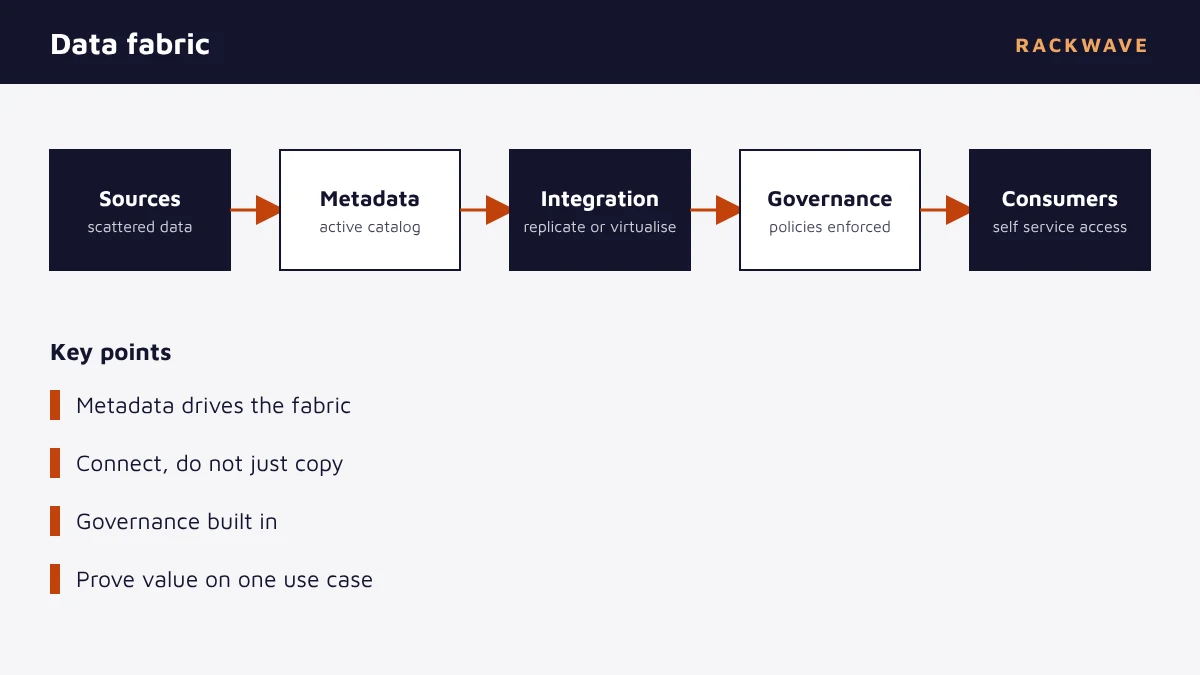
What is data fabric? It is a data management architecture that uses metadata, automation and integration to give consistent, governed access to data wherever it lives, across on premises systems, multiple clouds and applications. Rather than copying everything into one central store, a data fabric connects sources through a unified layer that discovers data, understands its meaning, applies policies and delivers it to the people and systems that need it. The concept, popularised by analysts, addresses the reality that enterprise data is scattered, and that moving all of it is slow and costly. This guide explains what a data fabric is, its components, how it differs from a data mesh, warehouse and virtualisation, how to build one and the realistic limits.
Short answer: A data fabric is a metadata driven architecture that connects distributed data sources, automates integration and governance and provides unified access. It reduces the need to move data and makes it easier to find, trust and use.
What is data fabric?
The data fabric article on Wikipedia describes an integrated layer of data and connecting processes. It is an architectural approach that complements, rather than replaces, a data warehouse or lakehouse. Its foundation is active metadata, as managed in a data catalog, together with data integration and data governance.
Components of a data fabric
| Component | Role | Examples |
|---|---|---|
| Active metadata and knowledge graph | Describe, link and recommend data assets | Catalogs, semantic layers |
| Data integration | Move or access data as needed | ETL, ELT, replication, change data capture |
| Data virtualisation | Query data in place without copying. See what is data virtualization | Federated query engines |
| Governance and security | Policies, access control, masking, lineage | Policy engines, lineage tools |
| Data quality | Profile, monitor and fix data | Quality rules and observability |
| Orchestration and automation | Schedule and automate pipelines | Workflow engines |
| Self service access | Let users find and use data | Catalog search, APIs, marketplaces |
Data fabric compared with related approaches
| Approach | Core idea | Difference from fabric |
|---|---|---|
| Data warehouse | Central curated store for analytics | A fabric spans many stores, including warehouses |
| Data lake or lakehouse | Central storage for raw and curated data | Fabric connects lakes with other sources |
| Data mesh. See what is data mesh | Decentralised ownership of data products | Mesh is organisational, fabric is technological, and they can combine |
| Data virtualisation | Query across sources without moving data | One capability inside a fabric |
| Traditional integration | Point to point pipelines | Fabric adds metadata driven automation and governance |
Data fabric and data mesh are often presented as rivals, but they address different levels. A mesh defines who owns data and how products are shared, while a fabric supplies technology that makes distributed data discoverable and governed.
Benefits of a data fabric
- Faster access to data, since users can find and use it through a common layer.
- Less copying and duplication, which lowers cost and risk.
- Consistent governance and security across environments.
- Automation that reduces manual integration work over time.
- A single view of data assets and lineage for compliance.
- Flexibility to add new sources and clouds without redesign.
How to build a data fabric
- Define business use cases. Start with needs such as a customer 360 view, regulatory reporting or faster analytics, not the architecture.
- Inventory and connect sources. Catalogue systems, owners and sensitivity, and connect them through metadata harvesting.
- Establish the metadata foundation. Build a catalog with a glossary, classifications and lineage, and make it active by linking it to policies and pipelines.
- Select integration styles. Use replication for heavy analytics, virtualisation for light and fresh access, and streaming for real time needs.
- Embed governance. Define policies once and enforce them through access control, masking and monitoring across sources.
- Automate and recommend. Use automation and machine learning to suggest joins, flag quality issues and generate pipelines.
- Deliver self service and iterate. Expose data through catalog, APIs and tools, and expand domain by domain.
Realistic limits and risks
| Limit | Explanation | Response |
|---|---|---|
| Not a product you buy | Vendors offer parts, but the fabric is an architecture | Assemble from components with a clear design |
| Performance of virtualised queries | Federated queries can be slow or load source systems | Cache or replicate heavily used data |
| Metadata quality | The fabric is only as smart as its metadata | Invest in stewardship and automation |
| Organisational ownership | Technology cannot fix unclear responsibility | Combine with governance and data mesh ideas |
| Hype and overpromising | Claims of full automation are often exaggerated | Prove value on a use case first |
Common data fabric mistakes
- Buying a platform labelled data fabric before defining use cases.
- Ignoring metadata quality and ownership.
- Virtualising everything, then suffering slow queries and source load.
- Treating governance as an afterthought.
- Not training users to find and use data through the new layer.
- Trying to cover the whole enterprise at once.
Our data governance service builds the metadata and policy foundation of a data fabric, our data warehousing service provides the analytical stores it connects and our system integration service links the sources.
A worked example: a manufacturer with scattered data
A manufacturer has data in plant systems, an ERP, a cloud warehouse, a lake and several SaaS applications. Analysts spend most of their time finding and reconciling data, and each new report needs a custom pipeline. The company starts with one use case, a supply chain view across plants and suppliers. It builds a catalog that harvests metadata from the main systems, defines a glossary of shared terms such as order and part and applies classification to sensitive supplier data.
Frequently used data is replicated into the lakehouse, while light and fresh queries use virtualisation to read from the ERP in place. Access policies are defined once and enforced across engines, and lineage shows how supply chain metrics are built. Time to deliver a new report falls from weeks to days, duplicate extracts are retired and users trust the shared definitions. The fabric then expands to quality and maintenance data.
Role of automation and AI
Modern fabrics use machine learning to automate repetitive work. Tools can classify columns, suggest business terms, detect anomalies in data quality, propose joins between datasets and even generate pipeline code. These features save time, but results need review by stewards, particularly for sensitive data. Treat automation as an assistant that raises the productivity of a data team and keeps metadata fresh, while accountability remains with named people. Measure the effect through reduced time to find data, fewer duplicate datasets and faster onboarding of new sources.
Governance and ownership in a fabric
A fabric makes data easier to reach, which raises the importance of governance. Define who owns each domain, who approves access and how policies are written and tested. Policies should be expressed in business terms, for example that personal data may be used for analytics only in masked form, and translated automatically into rules in each engine. Review access logs, certify key datasets and keep a clear process for retiring sources. See what is master data management for how shared reference data can be kept consistent across the fabric.
Key takeaways
- A data fabric is a metadata driven architecture that unifies access to distributed data.
- It combines catalog, integration, virtualisation, governance and automation.
- It reduces data movement but does not remove the need for good data management.
- It complements data mesh, warehouses and lakehouses rather than replacing them.
- Start with a use case, build the metadata foundation and expand gradually.
Quick glossary
| Term | Meaning |
|---|---|
| Data fabric | An architecture connecting distributed data through metadata and automation |
| Active metadata | Metadata used to drive automation and policy |
| Knowledge graph | A network of data assets and their relationships |
| Data virtualisation | Querying data in place without copying it |
| Semantic layer | A business friendly view of data definitions |
Read next: BigQuery vs Snowflake: Which Cloud Data Platform? · BigQuery Streaming Inserts: Real-Time Ingestion Guide · BigQuery Access Control: IAM, Policy Tags and Row Security
Frequently asked questions
What is data fabric in simple terms?
It is an architecture that connects data across many systems through a smart layer of metadata and automation, so people can find and use it without moving everything first.
What is the difference between data fabric and data mesh?
A data fabric is a technology architecture driven by metadata. A data mesh is an organisational approach with domain owned data products. They can be used together.
Is data fabric a product?
No. It is an architectural approach. Vendors sell components, and organisations assemble a fabric from catalog, integration, governance and automation tools.
Does a data fabric replace a data warehouse?
No. A warehouse or lakehouse is often one of the sources and engines within a fabric, which connects it with other data.
What is active metadata?
It is metadata that is continuously collected and used to drive automation, such as recommending data, enforcing policies and flagging quality issues.
What are the benefits of a data fabric?
Faster access, less duplication, consistent governance, automation of integration work and a clearer view of data assets and lineage.
What are the challenges?
Metadata quality, query performance for virtualised data, unclear ownership, tool complexity and unrealistic expectations of full automation.
How do I start building a data fabric?
Pick a high value use case, build a catalog and glossary for the relevant sources, apply governance policies and add integration styles as needed, then expand.