
What is a recommendation engine? A recommendation engine is a system that uses data and algorithms to suggest items a person is likely to want, such as products, content, articles, contacts or next best actions. It learns from behaviour like purchases, views, ratings and searches, and from attributes of users and items, to rank options for each individual. Recommendation engines drive a large share of revenue and engagement in retail, media, banking, travel and B2B platforms. This guide explains how they work, the main algorithm families such as collaborative and content based filtering, the data and architecture needed, how to measure success, the risks, and how to implement a recommender in an enterprise setting.
Short answer: A recommendation engine predicts what each user is most likely to value and ranks suggestions accordingly, using collaborative filtering, content based methods or hybrid machine learning models trained on behaviour data.
What is a recommendation engine?
The recommender system article on Wikipedia describes systems that predict a rating or preference a user would give an item. They rely on machine learning, often combined with embeddings and feature engineering, and are a form of predictive analytics. Marketing platforms such as Klaviyo apply the same ideas to messaging.
How recommendation engines work
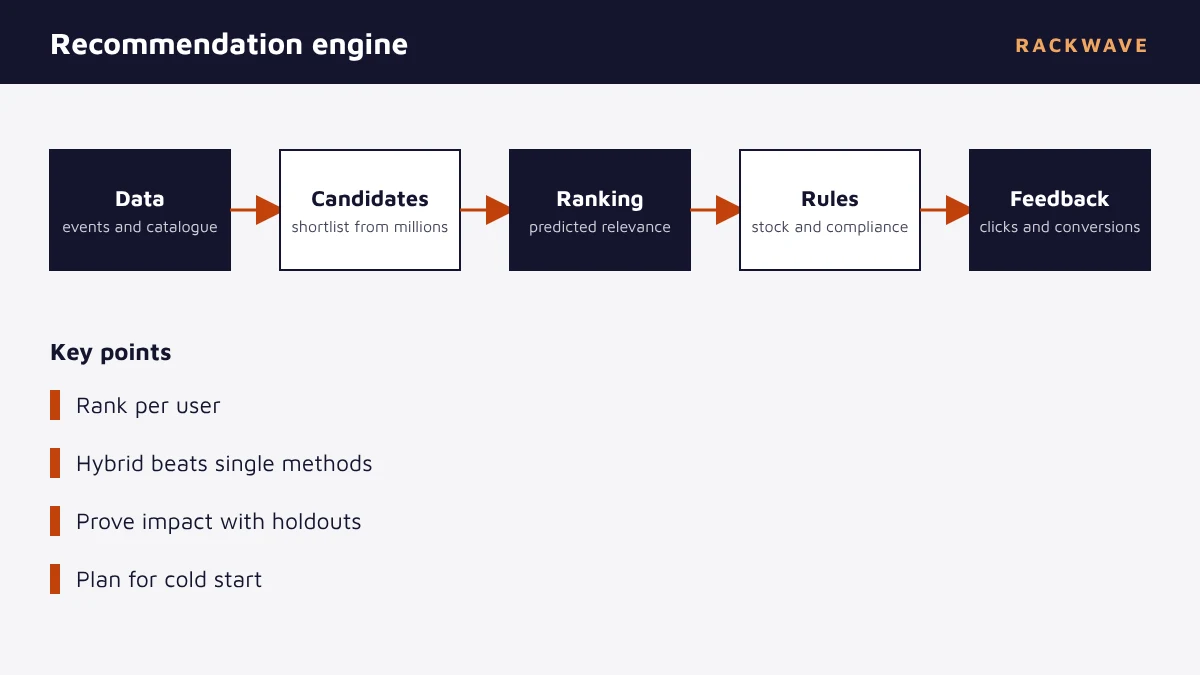
- Collect data: views, clicks, purchases, ratings, searches and attributes of users and items.
- Generate candidates: quickly select a few hundred relevant items from millions.
- Rank: a model scores candidates by predicted relevance for this user and context.
- Apply rules: filter stock, eligibility, compliance and diversity, and apply business priorities.
- Serve: return results in milliseconds in the app, email or site.
- Learn: capture clicks and conversions to retrain and improve.
Main recommendation approaches
| Approach | Idea | Strength | Weakness |
|---|---|---|---|
| Collaborative filtering | Users with similar behaviour like similar items | Finds surprising matches | Cold start for new users and items |
| Content based filtering | Recommend items similar to those the user liked | Works for new items | Can be repetitive |
| Hybrid | Combines behaviour and content signals | Best accuracy in practice | More complex |
| Matrix factorisation and embeddings | Learn compact vectors for users and items | Scales well | Needs tuning |
| Deep learning and sequence models | Model order and context of actions | Captures intent | Data and compute heavy |
| Rules and popularity | Best sellers, new arrivals, editorial picks | Simple, safe baseline | Not personal |
Common use cases
| Industry | Recommendation | Value |
|---|---|---|
| Retail and e-commerce | Related products, bundles, next purchase | Higher basket size and conversion |
| Media and learning | Next video, article or course | Longer engagement |
| Banking and insurance | Next best product or action | Relevant cross sell, lower attrition |
| B2B and SaaS | Features, content, accounts to target | Adoption and expansion. See sales playbook |
| CRM and marketing | Next best offer and send time | Better campaign results |
| Travel | Destinations, hotels, add ons | Higher revenue per booking |
Data and architecture requirements
- Event tracking with consistent user and item identifiers across channels.
- A catalogue with rich, clean attributes, supported by data quality controls.
- A feature layer that serves the same features in training and real time.
- Low latency serving, often under 100 milliseconds.
- Experimentation tooling for A/B tests and holdouts.
- Privacy controls for consent and data retention. See what is GDPR
Measuring success
| Level | Metrics | Notes |
|---|---|---|
| Offline model | Precision at k, recall, NDCG, coverage, diversity | Useful for comparing models quickly |
| Online experiment | Click through rate, conversion, revenue per visitor, retention | Decisive evidence |
| Business | Incremental revenue, margin, engagement | Measure against a holdout group |
| Health | Latency, freshness, error rates | Operational reliability |
Risks and pitfalls
- Cold start for new users and items.
- Filter bubbles that narrow what people see.
- Popularity bias that starves new or niche items.
- Optimising clicks instead of long term value.
- Unfair outcomes for some groups of users or suppliers.
- Privacy concerns when personalisation feels intrusive.
How to implement a recommendation engine
- Choose one placement and goal. For example related products on the product page, measured by conversion.
- Start with strong baselines. Popularity and simple similarity often capture much of the value.
- Build the data foundation. Track events, unify identifiers and clean the catalogue.
- Train and test a model. Compare hybrid and embedding based models offline.
- Run controlled experiments. Use holdouts to prove incremental impact.
- Add rules and explanations. Respect stock, margin, compliance and show why items are recommended.
- Scale and monitor. Expand placements, track drift and retrain regularly.
Our AI and machine learning service designs and runs recommendation systems, and our data analytics service builds the measurement behind them.
A worked example: next best product for a distributor
A B2B distributor sells forty thousand products through a web portal and sales reps. Customers reorder familiar items but rarely discover related lines. The team tracks portal events and order history, cleans product attributes and builds a hybrid model that combines purchase patterns with product categories and customer segment.
Related items appear on product pages and in rep tools as suggested add ons. In a controlled test, average order value rises 7 percent and the share of customers buying from a new category grows. Rules exclude out of stock and restricted items, and a simple explanation, such as customers like you also ordered, builds trust with buyers and reps.
Cold start and cross channel personalisation
New users and new items have no history, so engines need fallbacks. Use popularity within a segment, content attributes, onboarding questions and contextual signals such as device or location until behaviour accumulates. For new items, content based similarity and a small exploration budget help them gain exposure. Across channels, link identities carefully and respect consent, so a customer sees consistent suggestions on the site, in email and in sales conversations without crossing privacy boundaries.
Governance, fairness and explanation
Recommendations shape what people buy and see, so they need oversight. Document the objectives and constraints the engine optimises, review outcomes for fairness across user groups and suppliers, give users controls over personalisation and provide short explanations for suggestions. Keep a record of model versions and experiments so that results can be reproduced, and involve legal and compliance early when recommendations touch regulated products such as credit or insurance.
Real time versus batch recommendations
Some recommendations can be computed overnight and stored, such as weekly email picks or homepage rows for known customers. Others must react to what a person is doing right now, such as items related to the page they are viewing or the basket they are building. Batch systems are cheaper and simpler. Real time systems add session context and are worth the cost where intent changes quickly. Many enterprises combine them: precomputed candidates refreshed daily, then a lightweight real time ranker that adjusts the order using the current session.
Whichever mode you choose, design for graceful failure. If the model service is slow or unavailable, fall back to cached or popularity based results so the page never shows an empty space, and log every fallback so that reliability problems are visible and fixed quickly.
Key takeaways
- A recommendation engine ranks items for each user using behaviour and attribute data.
- Collaborative, content based and hybrid methods are the main approaches, often built on embeddings.
- Success is proven with online experiments and holdouts, not offline metrics alone.
- Plan for cold start, diversity, fairness and privacy.
- Start with one placement, strong baselines and a solid data foundation.
Quick glossary
| Term | Meaning |
|---|---|
| Collaborative filtering | Recommending based on similar users behaviour |
| Cold start | Lack of data for new users or items |
| NDCG | A ranking quality metric |
| Candidate generation | Selecting a shortlist from a large catalogue |
| Holdout group | Users not shown the feature, used to measure impact |
Read next: What Is Fine-Tuning? Methods, Data and Costs · What Is Feature Engineering? Techniques and Workflow · What Is Explainable AI? Methods, SHAP and LIME
Frequently asked questions
What is a recommendation engine in simple terms?
It is software that suggests products, content or actions you are likely to want, based on your behaviour and on what similar people liked.
What are the main types of recommendation algorithms?
Collaborative filtering, content based filtering, hybrid models, matrix factorisation or embedding models and deep learning sequence models.
What is the cold start problem?
It is the difficulty of recommending to new users or items that have no history. Popularity, content attributes and onboarding questions help.
How do I measure a recommendation engine?
Use offline metrics such as precision and NDCG for development, then online A/B tests and holdouts to measure conversion, revenue and retention.
What data does a recommender need?
Behaviour events, user and item attributes, consistent identifiers and a clean catalogue, plus consent and privacy controls.
Can small businesses use recommendation engines?
Yes. Start with simple rules such as best sellers and related items, or use built in features of commerce and marketing platforms.
What is a filter bubble?
It is when personalisation shows people only more of what they already like, narrowing discovery. Diversity rules and exploration reduce it.
How are recommendations used in B2B?
To suggest products, content, features and next best actions to buyers and sales teams, based on purchase history and account data.