
Upselling is the practice of encouraging a customer to buy a higher-priced, upgraded or premium version of the product or service they are already considering or using, such as a larger plan, an extended warranty or a premium tier, in a way that gives them more value. Done well, it raises average order value and revenue per customer while improving outcomes for the buyer. Done badly, it feels like pressure and damages trust. This guide explains what upselling is, how it differs from cross-selling, upselling examples and techniques, how to build an upsell programme with CRM and usage data, the best timing, the metrics to track and the mistakes that turn helpful suggestions into annoying pushes.
Short answer: Upsell by showing customers a better-fit option at the moment they need it, based on their usage and goals, and explaining the added value clearly. Use CRM and product data to find upgrade signals, limit the number of offers and measure upgrade rate, revenue per customer and satisfaction together.
What is upselling?
Upselling means moving customers up the value ladder: from a basic plan to a premium plan, from a standard model to a better model, or from a single licence to a team licence. The sales practice is outlined in the upselling article. It differs from cross-selling, which offers a different complementary product. In subscription businesses, upselling is closely related to expansion revenue, a key part of net revenue retention.
Upselling vs cross-selling
| Aspect | Upselling | Cross-selling |
|---|---|---|
| Offer | A higher tier or upgraded version | A complementary product |
| Example | Premium plan with more users and features | Add-on module or accessory |
| Trigger | Reaching a limit, needing more capability | A related need or purchase |
| Key metric | Upgrade rate, average order value | Attach rate, products per customer |
Upselling examples
| Sector | Example upsell |
|---|---|
| SaaS | Move from a basic to a team plan when a customer hits the user limit. See SaaS expertise |
| E-commerce | Suggest a larger size or higher-quality model at the product page. See e-commerce expertise |
| Banking | Offer a premium account when spending and balance patterns fit. See banking and lending work |
| Travel | Upgrade seating, room or package at booking or check-in. See travel experience |
| Telecoms and utilities | Offer a higher-speed or larger data plan to heavy users |
| Services | Extend scope from a project to a retained support agreement |
A good upsell solves a problem the customer already has. A bad one invents a need to lift the order value.
Upselling techniques that work
- Show the value gap: compare tiers clearly and show what the customer gains.
- Time it to need: offer an upgrade when usage hits a limit, not randomly.
- Use social proof: show how similar customers benefit from the higher tier.
- Limit choices: present one or two options to avoid paralysis.
- Offer a trial: let customers experience the higher tier before committing.
- Make it easy: one-click upgrades with clear pricing and no re-entry of data.
- Be honest: if the current plan is enough, say so. Trust pays off later.
How to build an upselling programme
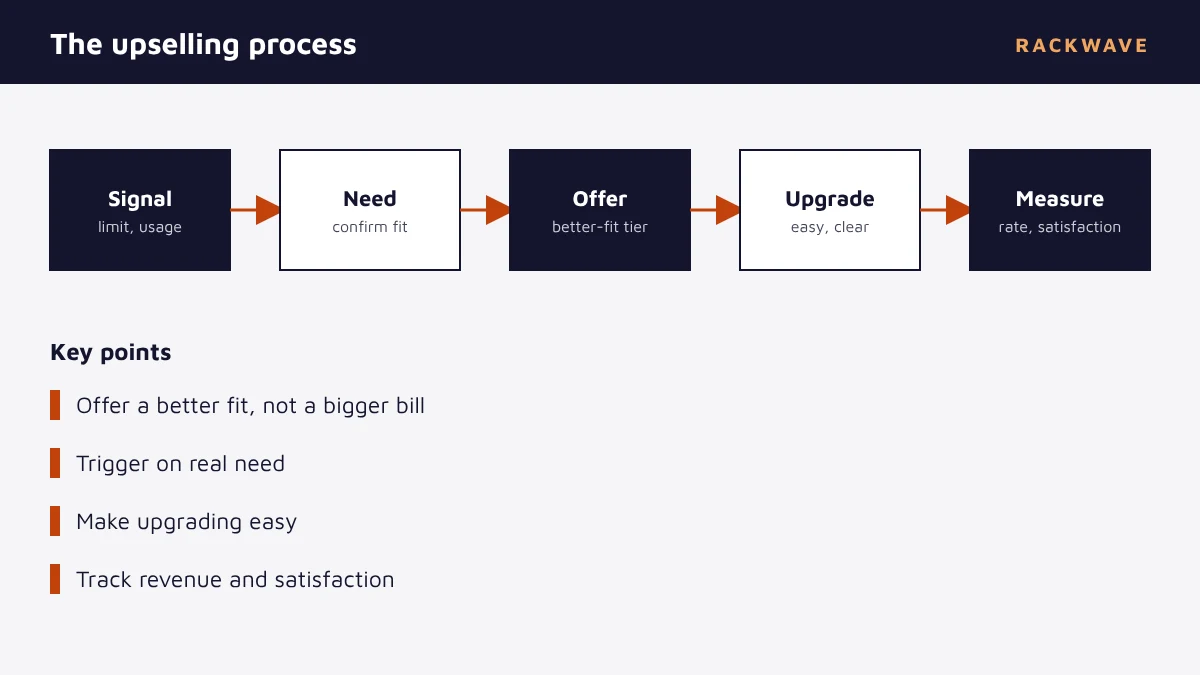
- Define the ladder. Design tiers so each step has a clear, relevant benefit.
- Find the upgrade signals. Analyse customers who upgraded and look for common triggers: usage, team size, feature requests. See predictive analytics.
- Segment. Group by usage, value and propensity. See customer segmentation.
- Equip the teams. Give sales and customer success prompts and talk tracks in the CRM. See sales enablement.
- Automate triggers. Use lifecycle journeys for in-app prompts and emails at the right moment. See lifecycle marketing.
- Make upgrades frictionless. Allow self-service where possible and prorate fairly.
- Protect the experience. Suppress offers during open support cases or low satisfaction.
- Measure and refine. Track results and retire offers that do not work.
Using CRM and data for upselling
Upselling works best where the signals are visible. In the CRM, an account owner can see usage against plan limits, support history, contract dates and past conversations. Rules can raise an alert when a customer reaches 80 percent of a limit, when new teams join or when an executive sponsor asks about advanced features. Our CRM and lifecycle service builds these signals and workflows, and our data analytics service builds the propensity models. See also customer analytics for how to find these patterns.
The best time to upsell
| Moment | Why it works |
|---|---|
| When a customer hits a limit | The need is real and immediate |
| After a clear success | Value is fresh and trust is high |
| At renewal | A natural point to review needs and fit |
| When the team grows | New users require more capacity |
| At the point of purchase | Compare options before committing |
Upselling metrics
| Metric | What it shows |
|---|---|
| Upgrade or upsell rate | Share of customers who move up |
| Expansion revenue | Revenue added from existing customers |
| Average order value or revenue per account | Value per customer |
| Net revenue retention | Growth within the base. See customer retention |
| Downgrade and churn after upsell | Whether upsells fit |
| Customer satisfaction after upsell | Whether customers feel well served. See customer satisfaction |
Common upselling mistakes
- Pushing upgrades the customer does not need.
- Offering too many tiers or confusing comparisons.
- Upselling during a support problem.
- Ignoring usage data and relying on generic scripts.
- Making the upgrade process slow or manual.
- Rewarding sales on revenue alone, ignoring downgrades and churn that follow poor upsells.
A short example
A project software company sells three plans. Customer success notices that customers who add their eighth user often upgrade within two months. The company builds a trigger in its CRM: when an account reaches seven users, the account owner receives an alert and the admin receives an in-app message explaining what the team plan adds, including a short comparison and a thirty-day trial. Accounts that receive the sequence upgrade at a higher rate than those that do not, and satisfaction is unchanged. The company did not push harder. It simply showed the right option at the moment it became useful.
Upselling in B2B account management
In B2B, an upsell is often a conversation about outcomes rather than a button click. Account managers review how the customer is performing against their goals, identify where a higher tier, additional capacity or an extended service would help and build a business case. Involve the economic buyer, quantify the benefit and propose a clear plan. Record the opportunity in the CRM, link it to the account plan and track it through the pipeline like any new deal. See sales pipeline for how to manage expansion opportunities alongside new business.
Pricing and packaging for healthy upsells
Upselling is easier when the tiers make sense. Each step up should add benefits that a specific type of customer values, and the price jump should feel proportional to the gain. Avoid hiding essential features in a higher tier just to force an upgrade, since customers resent it. Instead, base tiers on usage, scale or advanced capability, such as more users, higher limits, automation, security controls or priority support. Review the packaging regularly using upgrade and downgrade data, and talk to customers who stayed on a lower tier to learn why.
Key takeaways
- Upselling encourages a higher-tier or upgraded purchase that gives the customer more value.
- It differs from cross-selling, which offers a complementary product.
- Detect real upgrade signals from usage, limits and conversations in the CRM.
- Time offers to need, keep options few and make upgrading easy.
- Measure upgrade rate, revenue per account and satisfaction together.
Quick glossary
| Term | Meaning |
|---|---|
| Upsell | Offering a higher-priced or upgraded version |
| Expansion revenue | Additional revenue from existing customers |
| Upgrade signal | A behaviour suggesting readiness for a higher tier |
| Propensity model | A model predicting likelihood of upgrading |
| Net revenue retention | Revenue kept plus expansion from existing customers |
Read next: Voice of Customer: Sources, Programme and Examples · Omnichannel Marketing: Strategy, Examples and Technology · RFM Analysis: Scoring, Segments and Marketing Use
Frequently asked questions
What is upselling?
Upselling is encouraging a customer to buy a higher-priced or upgraded version of what they are considering or using, in a way that gives them more value.
What is the difference between upselling and cross-selling?
Upselling offers a higher tier or better version of the same product. Cross-selling offers a different, complementary product.
What are examples of upselling?
Moving a customer from a basic to a premium software plan, offering a larger size or better model, upgrading a flight seat or proposing a higher-speed internet plan.
When is the best time to upsell?
When customers hit a limit, after a clear success, at renewal, when a team grows or at the point of purchase, when options are being compared.
How do you upsell without being pushy?
Base offers on real needs, show clear value, limit options, be honest when the current plan is enough and avoid selling during support problems.
How do you identify upsell opportunities?
Analyse usage against limits, team growth, feature requests and conversation history in the CRM, and study what customers who upgraded had in common.
How do you measure upselling?
Track upgrade rate, expansion revenue, average revenue per account, net revenue retention, downgrades, churn after upsell and customer satisfaction.
Can a CRM help with upselling?
Yes. A CRM provides account history, usage signals, alerts, talk tracks and pipeline tracking for expansion opportunities.