
A loyalty program is a structured scheme that rewards customers for repeat purchases or engagement with points, tiers, discounts, early access or other benefits, with the aim of increasing retention, spend and advocacy. The best programmes recognise real value and make customers feel appreciated, while the worst simply give away margin. This guide explains what a loyalty program is, the main types, how to design one step by step, how to run it on your CRM and data, the economics and metrics to watch, examples across sectors and the mistakes that create expensive programmes with no change in behaviour.
Short answer: A loyalty program works when rewards are valuable, easy to understand and tied to behaviour you want. Define the goal first, choose a structure that fits your customers, build it on a unified customer record, and measure incremental revenue, retention and margin, not just membership numbers.
What is a loyalty program?
Loyalty schemes range from a simple punch card to sophisticated multi-tier platforms with partners and personalised offers. The commercial logic is described in the loyalty program article. The question for any business is whether the program changes behaviour or merely subsidises purchases that would have happened anyway. It supports the broader aims of customer loyalty and customer retention.
Types of loyalty programs
| Type | How it works | Best for | Watch out for |
|---|---|---|---|
| Points-based | Earn points per purchase, redeem for rewards | Retail, travel, frequent purchase | Points liability and low perceived value |
| Tiered | Status levels unlock greater benefits | Brands with a range of customer values | Tiers that are too hard or too easy to reach |
| Cashback or discount | Money back or reduced prices for members | Price-sensitive categories | Margin erosion |
| Paid membership | Fee for ongoing benefits | High-frequency purchasing, services | Needs clear value to justify the fee |
| Value-based or mission-led | Rewards linked to shared values or causes | Brands with strong identity | Authenticity is essential |
| Gamified | Challenges, badges and streaks | Digital products and apps | Novelty can fade |
| Coalition or partner | Points earned and used across brands | Complementary brands | Complex data sharing and governance |
A loyalty program should reward the behaviour that makes a customer valuable, not simply the act of being a customer.
How to design a loyalty program
- Set the goal. Choose what to change: purchase frequency, basket size, retention, data capture or advocacy.
- Study your customers. Use CRM data to see who your best customers are and what they value. See RFM analysis.
- Choose the structure. Select points, tiers, cashback or membership, based on how customers buy.
- Design meaningful rewards. Include experiential and non-monetary rewards, such as early access, service upgrades and recognition.
- Keep the rules simple. Customers should understand earning and redeeming within a minute.
- Build the data foundation. Link members to a single customer record across channels. See customer data platform.
- Plan communication. Welcome, progress, reward and reactivation messages through email, SMS, push and in-app. See lifecycle marketing.
- Pilot and measure. Test with a segment, compare with a control group and adjust before a full launch.
The economics of a loyalty program
| Consideration | Question to ask |
|---|---|
| Cost of rewards | What is the real cost per point or benefit, including liability? |
| Incremental revenue | Which purchases happen only because of the program? |
| Cannibalisation | How many rewards go to customers who would have bought anyway? |
| Operating cost | What do technology, support and marketing cost? |
| Data value | What insight does the program give you about customers? |
| Lifetime value | Do members stay longer and spend more? See customer lifetime value |
Compare members with a similar group of non-members, or use a holdout, to estimate the true uplift. Members are usually your best customers already, so raw comparisons exaggerate the program effect.
Running a loyalty program on your CRM
Loyalty depends on knowing who the member is across every channel. A CRM or customer data platform holds the member profile, balance, tier and history, and powers segmentation and triggers. Typical journeys include a welcome series, a nudge when a customer is close to the next tier, a points expiry reminder and a win-back message for lapsing members. Our CRM and lifecycle service designs the data model and journeys, and our CDP consulting, Braze, Klaviyo and CleverTap teams implement them. See customer engagement for related tactics.
Loyalty program metrics
| Metric | What it shows |
|---|---|
| Enrolment and active member rate | Reach and ongoing engagement |
| Purchase frequency and basket size by members | Behaviour change |
| Incremental revenue and margin | True financial effect |
| Redemption rate and liability | Reward value and cost |
| Retention of members vs non-members | Loyalty effect |
| NPS and satisfaction of members | Relationship quality. See net promoter score |
Examples across sectors
| Sector | Typical approach |
|---|---|
| E-commerce and retail | Points, tiers, birthday rewards and early access. See e-commerce expertise |
| Travel | Status tiers, upgrades and partner earning. See travel experience |
| Banking | Relationship tiers and bundled benefits. See banking and lending work |
| Healthcare and wellness | Rewards for healthy habits and appointments. See healthcare expertise |
| SaaS | Customer advisory boards, early feature access and certification |
Common loyalty program mistakes
- Copying a competitor structure without understanding your customers.
- Rewards that are too small, too complicated or too slow to earn.
- No data foundation, so members are not recognised across channels.
- Measuring enrolment instead of incremental revenue.
- Ignoring points liability and expiry rules.
- Treating the programme as a marketing campaign instead of a long-term customer strategy.
A short example
A specialist food retailer launches a points programme, enrols many customers, but sees little change in order frequency. Analysis shows that most points go to customers who already buy every month. The team redesigns it with two tiers, adds early access to limited products for the top tier and sets triggers for customers who have not ordered in 60 days, offering a modest bonus on their next purchase. It also measures against a holdout group. The next quarter shows modest but real uplift in frequency among lapsing customers, while top-tier members spend more per order. By tying rewards to the behaviours it wanted, the company improved the economics and kept its best customers feeling valued.
Designing rewards that feel valuable
Customers judge a reward by how easy it is to earn, how soon they can use it and how much they want it. A scheme that needs a year of purchases for a small discount feels distant, so include early wins: a welcome reward on sign-up, a bonus on the second purchase and visible progress toward the next level. Mix transactional rewards, such as points, with experiential ones, such as early access, free upgrades, personal service or invitations to events, which cost less and feel more special. Let members choose where possible, and make redemption frictionless at every channel. A reward that is too hard to use is worse than none, because it reminds the customer of what they did not get.
- Give an early reward within the first purchase or two.
- Show progress to the next tier in every message and on the account page.
- Offer non-monetary benefits that cost little but signal status.
- Let points be used across online and in-store channels.
- Set clear, fair expiry rules and warn members before points lapse.
Privacy, consent and governance
A loyalty program collects personal data, so governance matters. Be clear about what you collect and why, obtain consent for marketing separately from enrolment, let members view and delete their data and keep it secure. If you share data with partners in a coalition, document the rules and limit access. Good governance is not just compliance; customers who trust how their data is handled are more willing to share the preferences that make personalisation possible. Our data governance service helps structure these controls.
Key takeaways
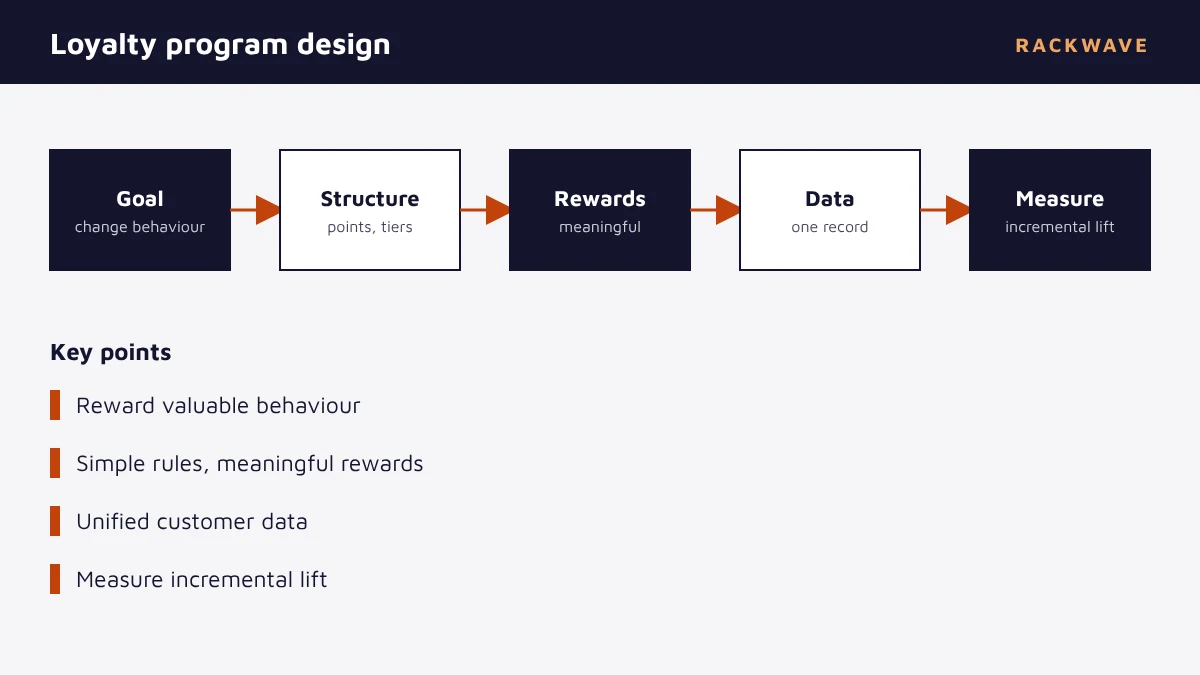
- A loyalty program rewards behaviour that creates value, using points, tiers, membership or other benefits.
- Set a clear goal and study customers before choosing a structure.
- Keep rules simple and rewards meaningful, including non-monetary benefits.
- Build it on a unified customer record and run journeys through your CRM.
- Measure incremental revenue, margin and retention against a control group.
Quick glossary
| Term | Meaning |
|---|---|
| Points liability | The cost of outstanding unredeemed points |
| Tier | A status level with specific benefits |
| Redemption | Using points or rewards |
| Holdout group | Customers excluded to measure true uplift |
| Cannibalisation | Rewarding purchases that would have happened anyway |
Read next: Voice of Customer: Sources, Programme and Examples · Omnichannel Marketing: Strategy, Examples and Technology · RFM Analysis: Scoring, Segments and Marketing Use
Frequently asked questions
What is a loyalty program?
A loyalty program is a structured scheme that rewards customers for repeat purchases or engagement, using points, tiers, discounts or other benefits, to increase retention, spend and advocacy.
What are the types of loyalty programs?
Common types are points-based, tiered, cashback, paid membership, value-based, gamified and coalition programmes involving partners.
How do you design a loyalty program?
Set the goal, study your customers, choose a structure, design meaningful rewards, keep rules simple, build the data foundation, plan communication, and pilot against a control group.
Do loyalty programs increase sales?
They can, when rewards change behaviour. Measure incremental revenue against a control group, because members are often already your best customers.
How much does a loyalty program cost?
Costs include rewards, technology, operations and marketing, and vary widely. Model reward cost, liability and incremental revenue before launch.
How does a CRM support a loyalty program?
A CRM or CDP holds member profiles, balances and history across channels, enabling segmentation, tier tracking, triggers and measurement.
What metrics should I track for a loyalty program?
Track active members, purchase frequency, basket size, incremental revenue and margin, redemption, retention versus non-members and satisfaction.
Why do loyalty programs fail?
Common causes are weak rewards, complex rules, no data foundation, measuring enrolment instead of impact and rewarding purchases that would have occurred anyway.